Author

admin

Browsing
  • A trio of SEC stars sit atop our 2026 NFL Draft QB prospect rankings after two weeks of college football play.
  • Leading the way is LaNorris Sellers of South Carolina, followed by LSU’s Garrett Nussmeier and Texas’ Arch Manning.
  • Oklahoma’s John Mateer is the big riser this week.

Week 2 of the season had fewer ranked matchups than the first week. Oklahoma and Michigan loomed as the lone game between two ranked opponents and did not disappoint.

It was another week of film for the top players in the 2026 NFL Draft class, quarterbacks included. A much deeper class than 2025 could see a handful of passers drafted in the first round.

Week 2 didn’t see much change as SEC quarterbacks held the top three spots in the rankings with solid to OK performances. The biggest riser came from that ranked matchup as John Mateer’s game against Michigan bumps him ahead of two other passers.

We’ll be following the top players at the position throughout the season and updating our rankings in the wake of weekly results.

2026 NFL Draft QB prospect rankings

1. LaNorris Sellers, South Carolina (last week: 1)

  • Week 2 vs. South Carolina State: 11-19 (57.9%) passing, 128 yards, one touchdown; six carries, 28 yards, one fumble

South Carolina needed a special teams touchdown to kick-start the team and get past visiting South Carolina State in the Gamecocks’ home opener.

Sellers showed out well in Week 1 against Virginia Tech but wasn’t quite on the same mark in Week 2. He threw deep more with an average depth of target (ADOT) of 11.0 yards compared to 7.9 in Week 1, per Pro Football Focus. Yet he only had 128 passing yards and faced fewer pressures than against the Hokies.

He could’ve scored a touchdown as runner on a key third-down conversion in the opening drive of the second half. Instead, he ran into the lone defender – occupied by a Gamecocks wide receiver who was blocking – left between him and the end zone. That shows a potential worrying trend that he showed in Week 1, when he ran into contact that kept him from scoring instead of moving around it to score.

Still, in a down week for most of the top quarterbacks in the class, Sellers retains his No. 1 spot. The Gamecocks stay home in Week 3 for a game against 2-0 Vanderbilt.

2. Garrett Nussmeier, LSU (last week: 2)

  • Week 2 vs. Louisiana Tech: 26-41 (63.4%) passing, 237 yards, one touchdown, one interception

Nussmeier followed his outstanding showing against Clemson with a solid game against Louisiana Tech. The game plan was vastly different than what the Tigers did in Week 1; Nussmeier’s ADOT was 9.1 yards, more than double what it was against Clemson (4.4).

He started off a bit scattershot with unsettled feet. An overthrow with a clean pocket that would’ve been a chunk gain to Barion Brown in the first quarter stands out. He found his rhythm more in the second half as the Tigers eventually pulled away for a 23-7 win.

Nussmeier had relatively clear pockets but stood tall against pressure to deliver, including when the Tigers were backed up in their own territory. This wasn’t Nussmeier’s best game statistically as the Louisiana Tech secondary played physically against the Tigers’ wideouts. He still made enough throws to keep his standing at No. 2.

LSU has Florida up next in its first SEC matchup of the season.

3. Arch Manning, Texas (last week: 3)

  • Week 2 vs. San Jose State: 19-30 (63.3%) passing, 295 yards, four touchdowns, one interception; three carries, 30 yards, one touchdown, one fumble

Manning’s scoring spree in Week 2 improves his outlook in general but, given the level of competition, doesn’t bump him up the rankings.

He played with a lot more confidence against San Jose State but still had some of the issues we saw in Week 1 against Ohio State. His footwork impacted his accuracy even with more open throws on offer against the visiting Spartans.

Manning and the Longhorns face UTEP at home this week. It should be another opportunity for him to build on his improvements from the San Jose State game.

4. Drew Allar, Penn State (last week: 4)

  • Week 2 vs. FIU: 19-33 (57.6%) passing, 200 yards, two touchdowns

Allar had a strong start to the year against Nevada but, like Nussmeier and Sellers, some issues cropped up in Week 2 – along with the flashes that scouts like to see.

His footwork was inconsistent at times and that caused the ball to miss the mark, hence his nearly 30-point drop in completion percentage. Penn State pushed the ball on Saturday and Allar had a 9.1-yard ADOT but missed the mark more than you’d like.

Still, his second touchdown was one of the reasons why scouts and fans alike should be excited about his potential. Allar faked a handoff and powered a ball 55 yards in the air to Devonte Ross in the end zone for the score.

When he’s right, it’s quite right. Allar and Penn State have a tune-up against Villanova before their bye week and a showdown at home against Oregon.

5. Fernando Mendoza, Indiana (last week: 5)

  • Week 2 vs. Kennesaw State: 18-25 (72%) passing, 245 yards, four touchdowns; three carries, 20 yards

Mendoza wasted no time showing off both his passing and running skills against Kennesaw State. He led consecutive touchdown drives in the first quarter and capped off the second with a nicely-placed slot fade to Elijah Sarratt.

That duo connected multiple times on Saturday – including three touchdowns. The last score came on a wide open shot up the middle to extend the lead.

Mendoza’s settling in at Indiana after transferring from Cal. His footwork looked improved overall in Week 2 and that showed in his high completion percentage. The Hoosiers have one more game against an unranked opponent – Indiana State – in Week 3 before taking on their first ranked team of the season in No. 9 Illinois. That game will be crucial for his evaluation.

6. John Mateer, Oklahoma (last week: 8)

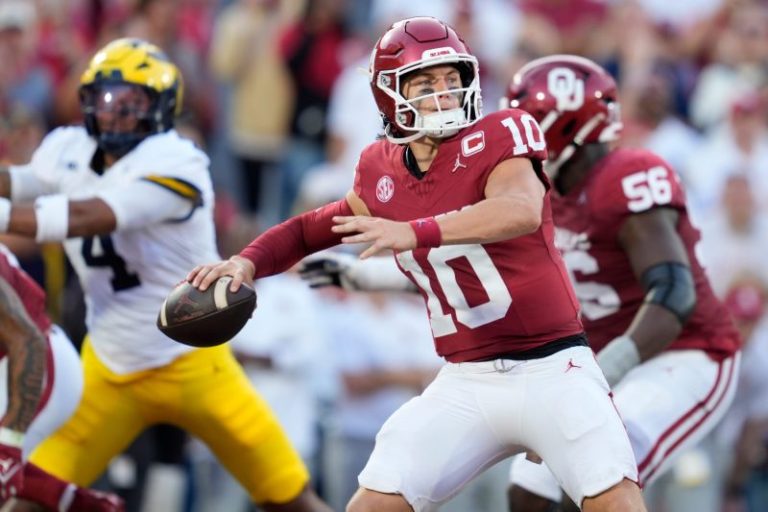
  • Week 2 vs. Michigan: 21-34 (61.8%) passing, 270 yards, one touchdown, one interception; 19 carries, 75 yards, two touchdowns

Mateer jumps up the rankings after putting on a great showing against a good Michigan defense in Week 2 following his historic performance against Illinois State in Week 1.

Mateer showcased his pocket mobility and varied arm slots against the Wolverines. He was more aggressive than the other passers on this list and it could’ve come back to bite him. It didn’t this time, leaving him a great performance both as a passer and a runner in Week 2.

A crucial third-down conversion stands out as his best play in the Sooners’ 24-13 win over the Wolverines.

Oklahoma heads on the road for the first time in Week 3 for a game against Temple.

7. Cade Klubnik, Clemson (last week: 6)

  • Week 2 vs. Troy: 18-24 (75%) passing, 196 yards, two touchdowns, one interception; four rushes, 7 yards

The Tigers were nearly upset at home by Troy and had to roar back from a 16-3 halftime deficit to win 27-16. Klubnik and the offense as a whole started slow in the first quarter.

His footwork was troubling early on and a tipped pass became a 4-yard pick-six to put the Tigers down 16-0. That’s a tough start against an unranked opponent.

To his credit, Klubnik came back in the second half. One of his best throws of the night came against pressure up the middle with a 34-yard dime to Bryant Wesco Jr. for a touchdown.

He’s yet to put together a complete game but there’s still plenty of time for that. Clemson heads on the road to face Georgia Tech in its ACC opener this week.

8. Taylen Green, Arkansas (last week: NR)

  • Week 2 vs. Arkansas State: 17-26 (65.4%) passing, 239 yards, four touchdowns, two interceptions; nine carries, 151 yards, one touchdown

Green makes his debut on this ranking behind another multi-touchdown performance in Week 2. At 6-foot-6 and 235 pounds, he’s similar in size to Sellers with outstanding athleticism, as well.

He leads the FBS in passing touchdowns after his four on Saturday. He showed off his athleticism on one play by scrambling for a first down (and hurdling a defender) before firing a shot to Jalen Brown from 8 yards out for a touchdown.

Green’s dual threat abilities and production have him on the radar early in the season. This week’s game against Ole Miss on the road will be massive for his draft outlook.

Next two up: Sam Leavitt, Arizona; Nico Iamaleava, UCLA

This post appeared first on USA TODAY

(TheNewswire)

Vancouver, British Columbia / September 11, 2025 ‑ TheNewswire – Harvest Gold Corporation (TSXV: HVG,OTC:HVGDF) (‘ Harvest Gold ‘ or the ‘ Company ‘) announces that, subject to the approval of the TSX Venture Exchange (the ‘ Exchange ‘), it has arranged a non-brokered private placement of up to 6,666,667 units of the Company (‘ Units ‘) at a price of $0.075 per Unit for aggregate gross proceeds of up to $500,000 (the ‘ Private Placement ‘).

Harvest Gold President and CEO, Rick Mark, states: ‘One of our investors in the recently completed Private Placement has asked if we would accept a larger investment with the same terms. The board of directors of the Company has approved the request as it will allow us to do prospecting, mapping and geo chemistry on areas in the southern part of Mosseau and on LaBelle with the goal of providing new drill targets this year. It also provides us flexibility should we wish to add meters to the current drill program at Mosseau.’

Each Unit will consist of one common share in the capital of the Company (each, a ‘ Share ‘) and one transferable common share purchase warrant (each, a ‘ Warrant ‘). Each Warrant will entitle the holder thereof to acquire one additional Share (each, a ‘ Warrant Share ‘) at a price of $0.12 per Warrant Share for a period of two years following the closing date of the Private Placement.

The Company anticipates using the proceeds from the Private Placement for exploration expenses on its properties in the Urban Barry area of Quebec, Canada, and general working capital.

All securities issued will be subject to a four-month hold period pursuant to securities laws in Canada and, where applicable.  Finders’ fees may be payable to qualified parties.

About Harvest Gold Corporation

Harvest Gold has three active gold projects focused in the Urban Barry area, totalling 329 claims covering 17,539.25 ha , located approximately 45-70 km east of the Gold Fields Windfall Deposit.

Harvest Gold acknowledges that the Mosseau Gold Project straddles the Eeyou Istchee-James Bay and Abitibi territories.  Harvest Gold is committed to developing positive and mutually beneficial relationships based on respect and transparency with local Indigenous communities.

ON BEHALF OF THE BOARD OF DIRECTORS

Rick Mark
President and CEO
Harvest Gold Corporation

For more information please contact:

Rick Mark or Jan Urata
@ 604.737.2303 or
info@harvestgoldcorp.com

Neither TSX Venture Exchange nor its Regulation Services Provider (as that term is defined in the policies of the TSX Venture Exchange) accepts responsibility for the adequacy or accuracy of this release.

Forward Looking Information

This news release includes certain statements that may be deemed ‘forward looking statements’. All statements in this news release, other than statements of historical facts, that address events or developments that Harvest Gold expects to occur, are forward looking statements. Forward looking statements are statements that are not historical facts and are generally, but not always, identified by the words ‘expects’, ‘plans’, ‘anticipates’, ‘believes’, ‘intends’, ‘estimates’, ‘projects’, ‘potential’ and similar expressions, or that events or conditions ‘will’, ‘would’, ‘may’, ‘could’ or ‘should’ occur.

Although the Company believes the expectations expressed in such forward-looking statements are based on reasonable assumptions, such statements are not guarantees of future performance and actual results may differ materially from those in the forward-looking statements. Factors that could cause the actual results to differ materially from those in forward looking statements include market prices, exploitation and exploration successes, and continued availability of capital and financing, and general economic, market or business conditions. Investors are cautioned that any such statements are not guarantees of future performance and actual results or developments may differ materially from those projected in the forward-looking statements. Forward looking statements are based on the beliefs, estimates and opinions of the Company’s management on the date the statements are made. Except as required by securities laws, the Company undertakes no obligation to update these forward-looking statements in the event that management’s beliefs, estimates or opinions, or other factors, should change.

The securities referred to in this news release have not been, and will not be, registered under the United States Securities Act of 1933, as amended (the ‘U.S. Securities Act’), or any applicable securities laws of any state of the United States, and may not be offered or sold within the United States or to, or for the account or benefit of, U.S. persons (as such term is defined in Regulation S under the U.S. Securities Act) or persons in the United States unless registered under the U.S. Securities Act and any other applicable securities laws of the United States or an exemption from such registration requirements is available.

This press release does not constitute an offer to sell or a solicitation of an offer to buy any of these securities within any jurisdiction, including the United States.  Any public offering of securities in the United States must be made by means of a prospectus containing detailed information about the company and management, as well as financial statements.

NOT FOR DISTRIBUTION OR DISSEMINATION TO THE UNITED STATES

Copyright (c) 2025 TheNewswire – All rights reserved.

News Provided by TheNewsWire via QuoteMedia

This post appeared first on investingnews.com

/ NOT INTENDED FOR DISTRIBUTION TO UNITED STATES NEWS WIRE SERVICES OR FOR DISSEMINATION IN THE UNITED STATES /

Heritage Mining Ltd. (CSE: HML) (FRA: Y66 ) (‘ Heritage ‘ or the ‘ Company ‘) is pleased to announce an exploration update on Zone 3 Extension Mega-Quartz Vein System at its Flagship Drayton-Black Lake Project (‘DBL’). Which has confirmed broad gold zone within a newly discovered ~74m wide quartz vein system (true width unknown) associated with a magnetic anomaly that extends for ~4km along strike length and is up to 200m in width (Figure 2) at its flagship Drayton Black Lake Project September 9, 2025 press release.

DBL Exploration Program Highlights:

  • Aggressive Soil/Till Orientation Survey (Figure 1) over Zone 3 Extension Area
  • Follow-up Soil/Till Survey – success based on Orientation Survey (Figure 1) expected Q4 2025
  • Outcrop/Vein stripping permit received above HML25-013 (Figure 2)
  • Initiate a structural Study of the Mega-Quartz Vein System (Figure 2)
  • Diamond Drilling Q4, 2025/Q1 2026 (Figure 3)

‘We are eager to further explore the newly discovered Zone 3 Extension Mega-Quartz Vein Structure systematically. Our team has developed a comprehensive approach to further exploring this area as well as broader exploration programs before winter. I would like to thank the exploration team for their strong efforts in the discovery of a such wide vein system.’ Commented Peter Schloo , President, CEO and Director of Heritage Mining Ltd.

Discussion of Exploration Program

Soil/Till Program

The purpose of the soil and till program is to Rapidly evaluation the newly identified Zone 3 Extension – Mega Quartz Vein Structure as well as a broader evaluation of Alcona , Zone 10, Zone 3, and New Millennium with a terrain-aware B-horizon program. Bias sampling toward stable, well-drained eluvial–illuvial positions where podzolic Bf/Bh horizons preserve pathfinder chemistry. Soil/till program will be solidified following an orientation survey of key areas. The outcome of this program is to identify Pathfinders for each target defined and identify near surface mineralization footprint across target areas.

Stripping and Structural Evaluation

The Company has received a stripping permit for the area above HML25-013 along the newly identified Zone 3 Extension – Mega Quartz Vein Structure. Stripping this area with follow on sampling and structural evaluations are planned for the Company’s 2025 Exploration program at DBL. The result of this program is to further evaluate the structural discovery at surface to better prioritize further targeting methods.

Scout Diamond Drilling

Additional scout diamond drilling is planned for the 2025 exploration program at the newly identified Zone 3 Extension – Mega Quartz Vein Structure. Following the completion of Soil/Till Program and Stripping and Structural Evaluation the Company intends to commence scout drilling with additional data. The Company may initiate the scout drilling program earlier depending on additional internal evaluation.

Conclusion

The discovery of a broad gold zone in the the newly identified Zone 3 Extension – Mega Quartz Vein Structure warrants additional systemic exploration to further develop our discovery model.

Qualified Person

Stephen Hughes P. Geo , Strategic Advisor for the Company, serves as a qualified person as defined by National Instrument 43-101 – Standards of Disclosure for Mineral Projects and has reviewed the scientific and technical information in this news release, approving the disclosure herein.

Technical Program

Heritage Mining adheres to a strict QA/QC protocol for handling, sampling, sample transportation and analyses.  Chain-of-custody protocols are designed to ensure security of samples until their delivery at the laboratory.

Sampling, Sub-sampling, and Laboratory Analysis for Heritage Mining Drayton Black Lake Project All drilling at the Drayton Black Lake project recovers NQ core. Drill core is systematically split in half using a diamond saw. A qualified geologist examines the drill core, marking intervals for sampling and indicating the cutting line. Sample lengths are typically 1.0 metre, adjusted to a minimum length of 0.5 metre as necessary to respect lithological and/or mineralogical contacts and to isolate narrow veins or structures that may contain higher-grade mineralization.

Technicians saw the core along the cutting lines determined by the geologist. One half of the core is retained as a witness sample, while the other half is submitted for analysis. Individual sample bags are securely sealed and placed into sealed bags, which are then clearly marked with their contents.

Heritage Mining submits samples for gold determination by PhotonAssay to ALS Canada Ltd. (‘ ALS ‘). ALS operates under a commercial contract with Heritage Mining.

Drill core samples are shipped to ALS for sample preparation at their facilities in Thunderbay Ontario. ALS is an ISO/IEC 17025:2017 accredited laboratory for the PhotonAssay method in addition to a variety of diverse metal determination methods.

Analytical Procedures

The ALS procedure for PhotonAssay involves lab applying preparation codes LOG-21 (sample logging via barcode), CRU-31 (fine crushing so that 70% passes through a 2mm screen) and SPL-32a (rotary splitting of a representative ~500g subsample)  followed by analytical code Au-PA01 which is a non-destructive gold analysis method using high-energy X-rays with a gold detection range from 0.03 ppm to 350ppm.

After gold assays are returned, Heritage then may choose to perform multi-element assays on selected samples based on the gold results. In these cases, sample preparation codes FND-05 (locate and use remaining crushed material from Au-PA01) and PUL-32m (pulverization so that >85% passes 75 µm screen) are then applied followed by analytical code ME-MS61 (multi-element ICP-MS analysis for base metals, pathfinder elements, lithophile elements and rare earth elements).

________________________________________
Quality Assurance/Quality Control (QA/QC)

The drill program design, QA/QC, and interpretation of results are performed by qualified persons employing a rigorous QA/QC program consistent with industry best practices. Standards and blanks account for a minimum of 10% of the samples, in addition to the laboratories’ internal quality assurance programs.

Quality Control data are meticulously evaluated upon receipt from the laboratories for any failures. Appropriate corrective action is taken if assay results for standards and blanks fall outside allowed tolerances. All results disclosed by Heritage Mining have successfully passed the Company’s stringent quality control protocols.

The Company does not recognize any factors of drilling, sampling, or recovery that could materially affect the accuracy or reliability of the assay data disclosed. The assay data disclosed in this press release have been verified by the Company’s Qualified Person against the original assay certificates.

Heritage Mining notes that it has not completed any economic evaluations of its Drayton-Black Lake Project, and the project does not currently have any resources or reserves.

ABOUT HERITAGE MINING LTD.

The Company is a Canadian mineral exploration company advancing its two high grade gold-silver-copper projects in Northwestern Ontario . The Drayton Black Lake and the Contact Bay projects are located near Sioux Lookout in the underexplored Eagle-Wabigoon-Manitou Greenstone Belt. Both projects benefit from a wealth of historic data, excellent site access and logistical support from the local community.

FORWARD-LOOKING STATEMENTS

This news release contains certain statements that constitute forward looking information within the meaning of applicable securities laws. These statements relate to future events of the Company. Any statements that express or involve discussions with respect to predictions, expectations, beliefs, plans, projections, objectives, assumptions or future events or performance (often, but not always, using words or phrases such as ‘seek’, ‘anticipate’, ‘plan’, ‘continue’, ‘estimate’, ‘expect’, ‘forecast’, ‘may’, ‘will’, ‘project’, ‘predict’, ‘potential’, ‘targeting’, ‘intend’, ‘could’, ‘might’, ‘should’, ‘believe’, ‘outlook’ and similar expressions are not statements of historical fact and may be forward looking information. All statements, other than statements of historical fact, included herein are forward-looking statements.

Forward looking information involves known and unknown risks, uncertainties and other factors which may cause the actual results, performance, or achievements of the Company to be materially different from any future results, performance or achievements expressed or implied by the forward-looking information. Such risks include, among others, the inherent risk of the mining industry; adverse economic and market developments; the risk that the Company will not be successful in completing additional acquisitions; risks relating to the estimation of mineral resources; the possibility that the Company’s estimated burn rate may be higher than anticipated; risks of unexpected cost increases; risks of labour shortages; risks relating to exploration and development activities; risks relating to future prices of mineral resources; risks related to work site accidents, risks related to geological uncertainties and variations; risks related to government and community support of the Company’s projects; risks related to global pandemics and other risks related to the mining industry. The Company believes that the expectations reflected in such forward-looking information are reasonable, but no assurance can be given that these expectations will prove to be correct and such forward‐looking information should not be unduly relied upon. These statements speak only as of the date of this news release. The Company does not intend, and does not assume any obligation, to update any forward‐looking information except as required by law.

This document does not constitute an offer to sell, or a solicitation of an offer to buy, securities of the Company in Canada , the United States , or any other jurisdiction. Any such offer to sell or solicitation of an offer to buy the securities described herein will be made only pursuant to subscription documentation between the Company and prospective purchasers. Any such offering will be made in reliance upon exemptions from the prospectus and registration requirements under applicable securities laws, pursuant to a subscription agreement to be entered into by the Company and prospective investors.

SOURCE Heritage Mining Ltd.

View original content to download multimedia: http://www.newswire.ca/en/releases/archive/September2025/11/c1327.html

News Provided by Canada Newswire via QuoteMedia

This post appeared first on investingnews.com

Mart Wolbert, analyst at Contrarian Codex, is seeing a uranium mindset shift as more investors take stock of the growing supply/demand imbalance in the market.

He explains how he’s approaching uranium stocks and shares his price outlook.

Securities Disclosure: I, Charlotte McLeod, hold no direct investment interest in any company mentioned in this article.

This post appeared first on investingnews.com

Clem Chambers, CEO of aNewFN.com, shares his outlook for gold and silver.

He also shares his thoughts on the broader US economy.

‘We’re in an elevated inflationary situation, QE is coming, interest rates are coming down, the dollar’s going to fall hard and precious metals are going to go up,’ Chambers emphasized.

Securities Disclosure: I, Charlotte McLeod, hold no direct investment interest in any company mentioned in this article.

This post appeared first on investingnews.com

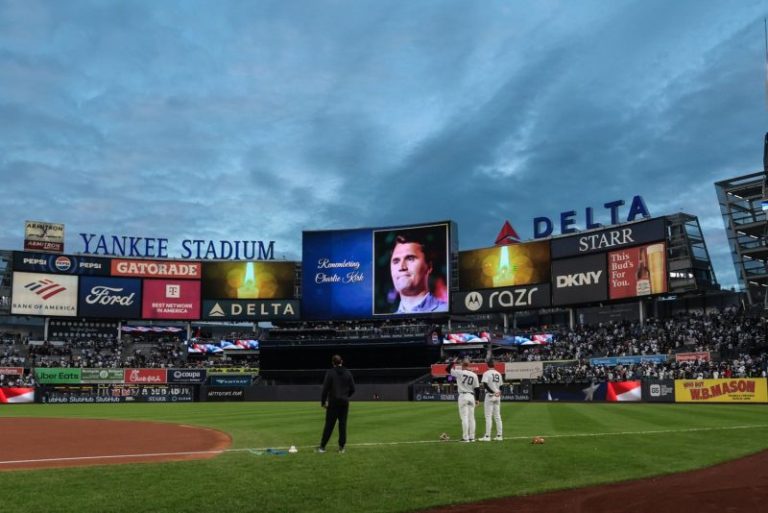
The New York Yankees held a moment of silence in remembrance of Charlie Kirk before Wednesday’s game against the Detroit Tigers.

Kirk was shot and killed during a speaking event at Utah Valley University in Orem, Utah, earlier in the day.

He was a right-wing talk show host who founded Turning Point USA, a conservative youth-focused organization, in 2012.

He also spoke at the Republican National Convention in Milwaukee in 2024. 

Kirk was a known ally of President Donald Trump, who confirmed Kirk’s death after the shooting on the college campus.

Trump is scheduled to make an appearance at Yankee Stadium, where the team is expected to hold a pregame ceremony to recognize the victims and heroes of 9/11.

This post appeared first on USA TODAY

  • The Big Ten currently distributes revenue almost equally, with most members receiving about $63.2 million in 2024.
  • Other conferences, like the ACC and Mountain West, have already adopted tiered revenue distribution based on viewership or brand value.
  • Ohio State may face resistance from other Big Ten schools who would be unwilling to accept a smaller share of the revenue.

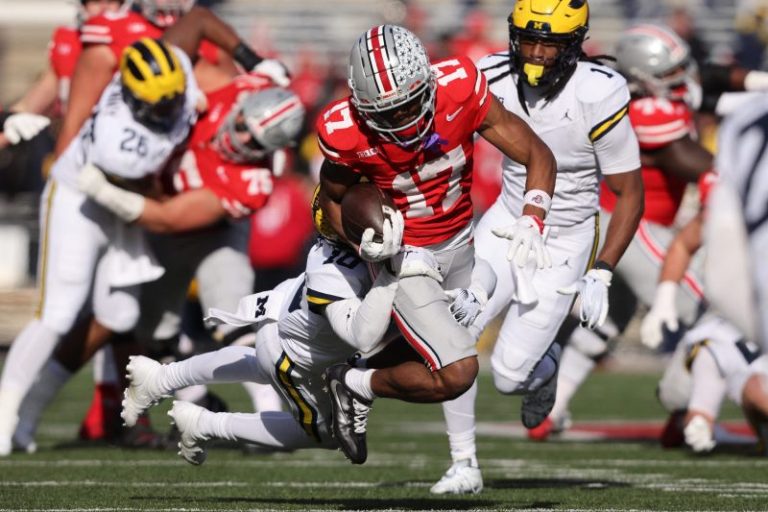
Ohio State is open to the possibility of changes to the Big Ten’s current revenue-sharing arrangement and how the university approaches athletics department funding, school president Ted Carter told USA TODAY Sports.

“I will say that there’s only a couple of schools that really represent the biggest brands in the Big Ten, and you can see that by the TV viewership,” said Carter.

Ohio State is not the first school to push for different levels of revenue sharing, nor would the Big Ten be the first to disburse tiered amounts of annual payouts.

PATH TO PLAYOFF: Sign up for our college football newsletter

The Mountain West distributes more money to Boise State because of a carveout related to television revenue that pays the Broncos an additional $1.8 million per season. (Boise is poised to join the Pac-12 in 2026.) The ACC recently adopted a system that will distribute 60% of TV revenue based on a weighted five-year average of viewership.

But there are a few major differences between the steps taken by those conferences and the potential fallout should Ohio State push the Big Ten to adopt a dramatically different and likely very controversial new model.

What is the Big Ten’s current revenue model?

The Big Ten had just over $928 million in total revenue and distributed about $63.2 million to each of the league’s dozen longest-standing members during the 2024 fiscal year, according to federal tax records.

That total is more than what schools received in the SEC. Records released in February showed that league distributed about $52.5 million in 2024 to every school except first-year members Oklahoma and Texas.

Looking ahead, the Big Ten’s per-school payout for 2025 is likely to be around $75 million for every member except for Oregon and Washington, whose shares are being phased in over seven years.

And these per-member payouts are expected to continue to grow. Wisconsin’s athletics department made a presentation to a university committee during the spring that projected just under $82.6 million in revenue during the 2026 fiscal year, according to the Wisconsin State Journal.

Would Big Ten members accept a new model?

No, they would not — or not happily, at least. Here’s where major differences stand out when looking at steps taken by the Mountain West and ACC.

The Big Ten is not hurting financially; the opposite is true, actually. There is no rancorous debate over buyout numbers or the league’s grant of rights deal, as was the case in the ACC. While the Buckeyes may claim otherwise, there is not one single team responsible for the Big Ten’s reputation and national draw, as Boise State successfully argued with the Mountain West.

Getting the Big Ten to make a seismic change in revenue distribution would require a cut in the annual revenue of the Buckeyes’ fellow members. Even if revenue is soaring, that would be very difficult for the rest of the conference to accept.

Would Michigan and Penn State be OK with taking money out of their pockets to send to Columbus? Would this arrangement be acceptable to schools such as Purdue, Rutgers, Maryland and others near the bottom of the Big Ten power structure?

This would clearly be an extremely difficult sell.

Does Ohio State really have bargaining power?

Ohio State is one of college sports’ elite brands, capable of moving the needle on any number of key topics in a manner unmatched by all but a few members of the NCAA.

But there is a very real question about the Buckeyes’ bargaining power in terms of truly pushing for an altered revenue model. The reason for that is simple: OSU has nowhere to go.

Florida State and Clemson were able to push the ACC into changes by essentially dangling the threat of leaving the conference. That was a real concern for the ACC, not only because of the potential loss of two flagship members but because schools such as Miami and North Carolina would almost certainly follow the Seminoles and Tigers out the door. The same fear does not exist in the Big Ten.

And FSU, Clemson and others could’ve knocked on the doors of the Big Ten or SEC offices. Ohio State is obviously not going to leave for the SEC. So should the Buckeyes push for more revenue and the Big Ten balks, where would they go? The NFC South?

The landscape-shifting fallout of an Ohio State move

Let’s say OSU is unable to sway the Big Ten. The school’s only real move would be to push for the creation of one or two super leagues, which would create the biggest shakeup to college football since the Division I split in 1978.

Again, the Buckeyes are one of only a few schools capable of officially putting this topic on the table.

They should find many Power Four schools willing to at least have the conversation. The top programs in the SEC could be persuaded by the possibility to add millions of dollars in annual revenue — as we’ve seen in recent years, just about every single move taken by schools and conferences has been driven by finances.

Likewise with high-profile Big Ten teams, who would push back at changing the league’s revenue structure but could be more willing to follow OSU into a super conference occupying the current Big Ten footprint.

This is the possible fallout that frightens the majority of NCAA members: After trying and failing to obtain more revenue than the rest of the Big Ten, Ohio State takes a drastic step that could create permanent change to college football.

This post appeared first on USA TODAY

  • NBA commissioner Adam Silver said he expects to have All-Star Game tweaks approved by the start of the 2025-26 regular season.
  • Silver confirmed that the NBA was looking at a structure he referred to as a ‘Ryder Cup-type format.’
  • The 2026 NBA All-Star Game will be played Sunday, Feb. 15 at the Intuit Dome in Los Angeles.

NEW YORK — Expect changes to the NBA All-Star Game to be formalized very soon.

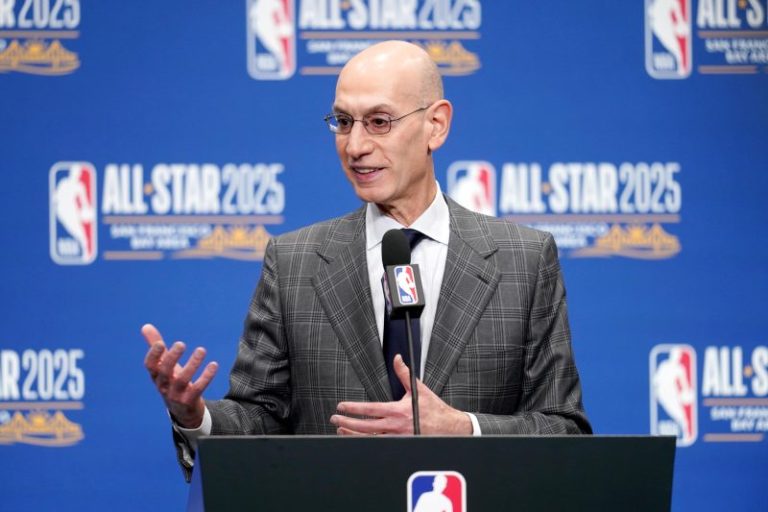
After news emerged last week that the league had honed in on a round-robin tournament structure featuring domestic players against international ones, NBA commissioner Adam Silver said Wednesday, Sept. 10 that he expects to have the tweaks approved by the start of the 2025-26 regular season on Oct. 21.

“The goal is to have the new format in place by the opening of the regular season,” Silver said upon the conclusion of the Board of Governors session at the St. Regis Hotel in Midtown Manhattan. “I think there’s something to that, that once the season starts everyone should understand the rules of the road and what we’re looking at for All-Star this year. That would be our goal.”

Silver confirmed that the NBA was looking at a structure with a pair of teams featuring domestic players and one consisting of international stars, something he referred to as a “Ryder Cup-type format of U.S. against international,” alluding to the golf tournament. Each team will have eight players, and 12-minute quarter games will be played. He said the structure had been discussed with the Competition Committee, and that it was raised with the Board of Governors at the meetings this week.

This is a departure from the format at the 2025 All-Star Game in San Francisco, which saw a mini-tournament with four teams competing in three games. Silver has been outspoken about the format being “a miss.”

Silver also added that the NBA is working alongside the National Basketball Players Association and executive director Andre Iguodala to finalize the revised format.

“I think they have the same interest we do in having a more exciting and engaging All-Star,” Silver said. “None of us have shied away from acknowledging our disappointment of what we’ve seen on the floor the last few years. It’s an odd situation because it’s not just us and the Players Association, but even the players individually are acknowledging, ‘Yeah, this is not the best foot forward for the league.’ ”

Although the NBA is fully leaning into the U.S. versus World format, one of the four teams at last season’s event was comprised mostly of international superstars. That team, Chuck’s Global Stars, had players like Shai Gilgeous-Alexander, Nikola Jokić and Victor Wembanyama, though it also had domestic players like Donovan Mitchell and Trae Young.

The NBA is also looking to capitalize on the potential momentum of international competition, with the All-Star break coming right in the middle of the Winter Olympics, which will be held in Milan Cortina.

“I will say I’m hopeful,” Silver said. “I know I’ve stood up before all of you before and said, we fixed it, we got it, it’s going to work this year. So I don’t want to overpromise. But I feel pretty good about it.”

The 2026 All-Star Game will be played Sunday, Feb. 15 at the Intuit Dome in Los Angeles, the home arena of the Los Angeles Clippers.

This post appeared first on USA TODAY

President Donald Trump is scheduled to attend the New York Yankees’ home game against the Detroit Tigers on Thursday, Sept. 11.

The Yankees are expected to hold a pregame ceremony to recognize the victims and heroes of 9/11.

The president has made appearances at several sporting events this year, including the US Open men’s tennis final on Sept. 7 and several UFC events.

His arrival caused an increased presence of Secret Service, who are usually at the scene of the event with dogs on hand before the president’s arrival.

The Yankees encourage anyone with a ticket for the game to arrive early because of the enhanced security measures around Yankee Stadium.

The stadium gates are scheduled to open at 4 p.m. ET, three hours before the scheduled first pitch.

The biggest stories, every morning. Stay up-to-date on all the key sports developments by subscribing to USA TODAY Sports’ newsletter.

This post appeared first on USA TODAY