Author

admin

Browsing

TSX-V: WLR

Walker Lane Resources Ltd. (TSXV: WLR,OTC:CMCXF) (Frankfurt: 6YL) ‘Walker Lane’) announces that it has engaged Stockhouse Publishing Limited, Marcus Brummell, and Baystreet.ca to conduct marketing and publishing services. The purpose of these marketing activities is to increase market awareness and visibility of Company activities, detail recent acquisitions, and generate a better understanding of the exploration potential of its gold and silver prospects in Nevada and Canada. 

The Company has entered into contracts dated August 15, 2025 and have been fully paid in cash. Both of these firms are arm’s length service providers and are in accordance with the policies of the TSX Venture Exchange (‘TSX-V’) and applicable securities laws.

Stockhouse Publishing Limited

Stockhouse Publishing Limited (‘Stockhouse’) will complete marketing and advertising services designed to connect Walker Lane with North America’s largest small cap investor community. Stockhouse’s investor community includes investors from Canada, United States, Australia, New Zealand, China, Germany and the United Kingdom. The campaign is expected to commenced in October, 2025 and will continue for up to a 12-month period at an aggregate cost of $75,000 CAD.

Marcus Brummell

The Company engaged Marcus Brummell of Langley B.C. (‘consultant’) in a contract dated August 15, 2025 to conduct a marketing awareness campaign of Company activities. Mr. Brummell has considerable experience in creating and publishing marketing materials for the mining sector and implements projects aimed to increase market awareness levels. The consultant was fully paid in cash for a total of $10,000 CDN for a minimum of 38 days of services but is also continuing to promote activities of the Company beyond the initial contractual obligation as a goodwill gesture to continue efforts to improve market visibility of the Company activities as some planned activities had been delayed for reasons beyond the control of the Company.

Baystreet.ca

Baystreet.ca (‘Baystreet’) is one of the leading financial content providers in Canada and has been actively assisting a broad range of clientele including junior mining companies for the past 27 years. Baystreet have established contacts with over 100 tier one financial publications with tens of thousands of downstream partners in Canada and the United States. The company established a contract to Baystreet to provide marketing services for a three-month period with the campaign commencing in October 2025 and continuing through to the end of December, 2025, at an aggregate total cost of $66,000 CAD plus applicable taxes. However, after the initial month, the parties reached a mutual agreement to discontinue the marketing program and a refund of $44,000 plus GST for two months of services not completed will be provided to the Company by Baystreet.ca

These consultants have no direct or indirect interest in the Company and do not intend to acquire an interest in the Company during the period of their contracts. The Consultants will be communicating directly with existing prospective investors. Any information distributions will be reviewed and approved by the Company prior to release. The services of these consultants are being provided in accordance with the policies and the approval of the TSX Venture Exchange (‘TSX-V’) and also align with the policies the BC Securities Commission.

If anyone would like further details on the marketing plans of the Company you are asked to contact Kevin Brewer at the contact information below.

About Walker Lane Resources Ltd.

Walker Lane Resources Ltd. is a growth-stage exploration company focused on the exploration of high-grade gold, silver and polymetallic deposits in the Walker Lane Gold Trend District in Nevada and the Rancheria Silver District in Yukon/B.C. and other property assets in Yukon. The Company intends to initiate an aggressive exploration program to advance the Tule Canyon (Walker Lane, Nevada) and Amy (Rancheria Silver, B.C.) projects through an aggressive drilling program to resource definition stage in the near future.

On behalf of the Board:
‘Kevin Brewer’
Kevin Brewer, President, CEO and Director
Walker Lane Resources Ltd.

Cautionary and Forward Looking Statements

This press release and related figures, contain certain forward-looking information and forward-looking statements as defined in applicable securities laws (collectively referred to as forward-looking statements). These statements relate to future events or our future performance. All statements other than statements of historical fact are forward-looking statements. The use of any of the words ‘anticipate’, ‘plans’, ‘continue’, ‘estimate’, ‘expect’, ‘may’, ‘will’, ‘project’, ‘predict’, ‘potential’, ‘should’, ‘believe’ ‘targeted’, ‘can’, ‘anticipates’, ‘intends’, ‘likely’, ‘should’, ‘could’ or grammatical variations thereof and similar expressions is intended to identify forward-looking statements. These statements involve known and unknown risks, uncertainties and other factors that may cause actual results or events to differ materially from those anticipated in such forward-looking statements. These statements speak only as of the date of this presentation. These forward-looking statements include, but are not limited to, statements concerning: our strategy and priorities including certain statements included in this presentation are forward-looking statements within the meaning of Canadian securities laws, including statements regarding the Tule Canyon, Cambridge, Silver Mountain, and Shamrock Properties in Nevada (USA), and its properties including Silverknife and Amy properties in British Columbia, the Silver Hart, Blue Heaven and Logjam properties in Yukon and the Bridal Veil property in Newfoundland and Labrador all of which now comprise the mineral property assets of WLR. WLR has assumed other assets of CMC Metals Ltd. including common share holdings of North Bay Resources Inc. (OTC-US: NBRI) and all conditions and agreements pertaining to the sale of the Bishop mill gold processing facility and remain subject to the condition of the option of the Silverknife property with Coeur Mining Inc. (TSX:CDE). These forward-looking statements reflect the Company’s current beliefs and are based on information currently available to the Company and assumptions the Company believes are reasonable. The Company has made various assumptions, including, among others, that: the historical information related to the Company’s properties is reliable; the Company’s operations are not disrupted or delayed by unusual geological or technical problems; the Company has the ability to explore the Company’s properties; the Company will be able to raise any necessary additional capital on reasonable terms to execute its business plan; the Company’s current corporate activities will proceed as expected; general business and economic conditions will not change in a material adverse manner; and budgeted costs and expenditures are and will continue to be accurate.

Actual results and developments may differ materially from results and developments discussed in the forward-looking statements as they are subject to a number of significant risks and uncertainties, including: public health threats; fluctuations in metals prices, price of consumed commodities and currency markets; future profitability of mining operations; access to personnel; results of exploration and development activities, accuracy of technical information; risks related to ownership of properties; risks related to mining operations; risks related to mineral resource figures being estimates based on interpretations and assumptions which may result in less mineral production under actual conditions than is currently anticipated; the interpretation of drilling results and other geological data; receipt, maintenance and security of permits and mineral property titles; environmental and other regulatory risks; changes in operating expenses; changes in general market and industry conditions; changes in legal or regulatory requirements; other risk factors set out in this presentation; and other risk factors set out in the Company’s public disclosure documents. Although the Company has attempted to identify significant risks and uncertainties that could cause actual results to differ materially, there may be other risks that cause results not to be as anticipated, estimated or intended. Certain of these risks and uncertainties are beyond the Company’s control. Consequently, all of the forward-looking statements are qualified by these cautionary statements, and there can be no assurances that the actual results or developments will be realized or, even if substantially realized, that they will have the expected consequences or benefits to, or effect on, the Company.

The information contained in this presentation is derived from management of the Company and otherwise from publicly available information and does not purport to contain all of the information that an investor may desire to have in evaluating the Company. The information has not been independently verified, may prove to be imprecise, and is subject to material updating, revision and further amendment. While management is not aware of any misstatements regarding any industry data presented herein, no representation or warranty, express or implied, is made or given by or on behalf of the Company as to the accuracy, completeness or fairness of the information or opinions contained in this presentation and no responsibility or liability is accepted by any person for such information or opinions. The forward-looking statements and information in this presentation speak only as of the date of this presentation and the Company assumes no obligation to update or revise such information to reflect new events or circumstances, except as may be required by applicable law. Although the Company believes that the expectations reflected in the forward-looking statements and information are reasonable, there can be no assurance that such expectations will prove to be correct. Because of the risks, uncertainties and assumptions contained herein, prospective investors should not read forward-looking information as guarantees of future performance or results and should not place undue reliance on forward-looking information. Nothing in this presentation is, or should be relied upon as, a promise or representation as to the future. To the extent any forward-looking statement in this presentation constitutes ‘future-oriented financial information’ or ‘financial outlooks’ within the meaning of applicable Canadian securities laws, such information is being provided to demonstrate the anticipated market penetration and the reader is cautioned that this information may not be appropriate for any other purpose and the reader should not place undue reliance on such future-oriented financial information and financial outlooks. Future-oriented financial information and financial outlooks, as with forward-looking statements generally, are, without limitation, based on the assumptions and subject to the risks set out above. The Company’s actual financial position and results of operations may differ materially from management’s current expectations and, as a result, the Company’s revenue and expenses. The Company’s financial projections were not prepared with a view toward compliance with published guidelines of International Financial Reporting Standards and have not been examined, reviewed or compiled by the Company’s accountants or auditors. The Company’s financial projections represent management’s estimates as of the dates indicated thereon.

SOURCE Walker Lane Resources Ltd

View original content to download multimedia: http://www.newswire.ca/en/releases/archive/December2025/10/c6157.html

News Provided by Canada Newswire via QuoteMedia
This post appeared first on investingnews.com

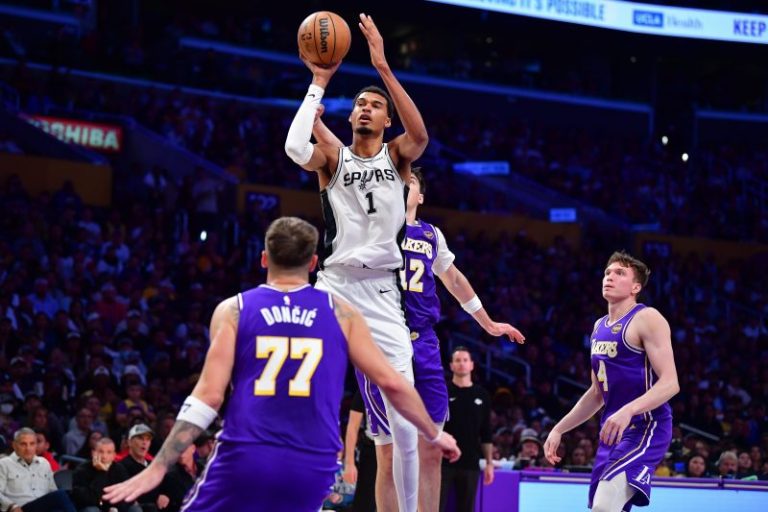
There was a different energy when Victor Wembanyama entered the practice gym with a trio of injured San Antonio Spurs players earlier this week, coach Mitch Johnson told reporters before the team’s most recent win over the New Orleans Pelicans, and he made one promise regarding his 7-foot-5 center.

‘He’s going to be on that plane to LA, for sure. He better be,’ Johnson said.

Wembanyama is nearing a return to the court for the first time in almost a month as the Spurs (16-7) get set to face the Los Angeles Lakers (17-6) in an NBA Cup West quarterfinal game on Wednesday, Dec. 10. The third-year French star is making progress, joining his Spurs teammates on their current road trip and participating in multiple workouts in recent days.

San Antonio recently welcomed 2025 NBA Rookie of the Year Stephon Castle and big man Luke Kornet back to the lineup from injury. Will Wembanyama join them and play in the opening knockout round of the league’s in-season tournament?

Here’s the latest update on Wembanyama’s injury situation, as well as his game status when the Spurs play the Lakers in the 2025 NBA Cup quarterfinals on Wednesday:

Is Victor Wembanyama playing today?

No, Wembanyama will miss Wednesday’s contest. He was listed as out on the Spurs’ latest injury report on Tuesday, Dec. 9 ahead of their NBA Cup game against the Los Angeles Lakers. He has missed the team’s previous 11 games.

Victor Wembanyama injury update

Wembanyama joined the team in New Orleans after not traveling to start this current road trip and was a full participant in a practice on Sunday, according to the San Antonio Express-News. He then did a workout after the team’s morning shootaround on Monday and warmed up before the Spurs’ game against the Pelicans. Johnson noted, however, that the team would not place added importance on Wednesday’s game being part of the NBA Cup in terms of determining Wembanyama’s potental return.

Wembanyama appeared in just 46 games last season after being diagnosed with deep vein thrombosis in his right shoulder.

Victor Wembanyama stats

Wembanyama was off to a strong start in his third NBA season, leading the league in blocks again (3.6 per game) and ranking second in rebounds (12.9). The 2024 NBA Rookie of the Year is averaging a career-best 26.2 points while shooting better than 50% from the floor through 12 games of the 2025-26 season.

This post appeared first on USA TODAY

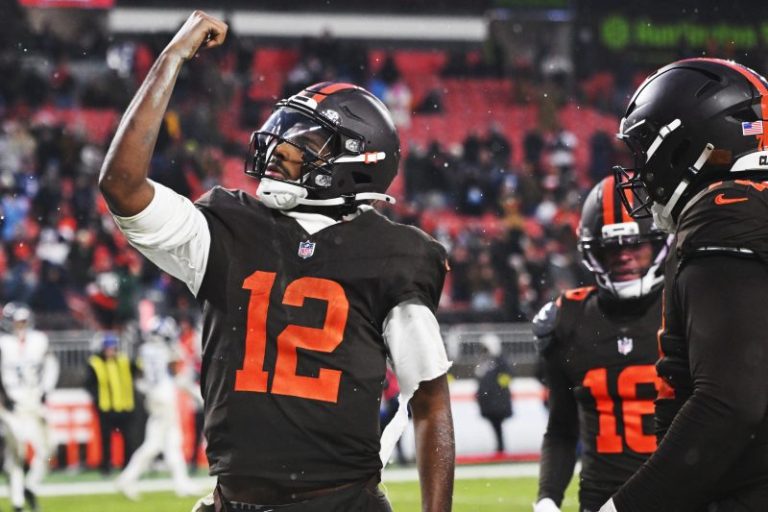
  • A viral image led to speculation that Browns quarterback Shedeur Sanders was wearing a thong during a game.
  • Shedeur Sanders clarified the image actually showed tape for a previous back injury.
  • Shilo Sanders, who is out of football, is now pursuing music, acting, and brand deals.

Shedeur and Shilo Sanders have gotten to the bottom of one of the biggest mysteries this week in the NFL.

Was Shedeur, the Cleveland Browns starting quarterback, wearing a thong under his uniform during a 31-29 loss against the Tennessee Titans on Dec. 7?

It kind of looked like it, according to a screen shot after one play. Shilo, his older brother, conducted a not-so-serious investigation about it and then posted the findings on YouTube.

“Let’s cut to the business, bro,” Shilo said to Shedeur by phone. “Did you wear a thong or not?”

“Come on bro,” Shedeur replied.

“What’s going on with you, bro?” Shilo persisted.

“You forget I have a back injury, right?” Shedeur said. “So I get my back taped. So it is crazy that I did look like that… That is funny, though.”

Shedeur suffered a fractured back during the 2023 season at Colorado.  Shilo and Shedeur are sons and former players of Colorado head coach Deion Sanders.  

What is Shilo Sanders doing now?

Shilo is out of football after being waived by the Tampa Bay Buccaneers before the season. In the video, he said he is moving from Tampa to Miami, where he said he is looking for a chef to cook for him and has been working on a rap album. He also said he was considering acting classes and has been doing YouTube videos and brand deals.

Shilo filed for bankruptcy in 2023 in a case that remains pending.  In general, he is entitled to earnings he made after the filing.

“In the future, I definitely want to build that up – the music and the acting, the modeling, all that,” he said.

Shilo modeled with his brother in Paris in January 2024.

Follow reporter Brent Schrotenboer @Schrotenboer. Email: bschrotenb@usatoday.com

This post appeared first on USA TODAY

  • Why do athletic directors need to be on CFP committee? Answer: They don’t.
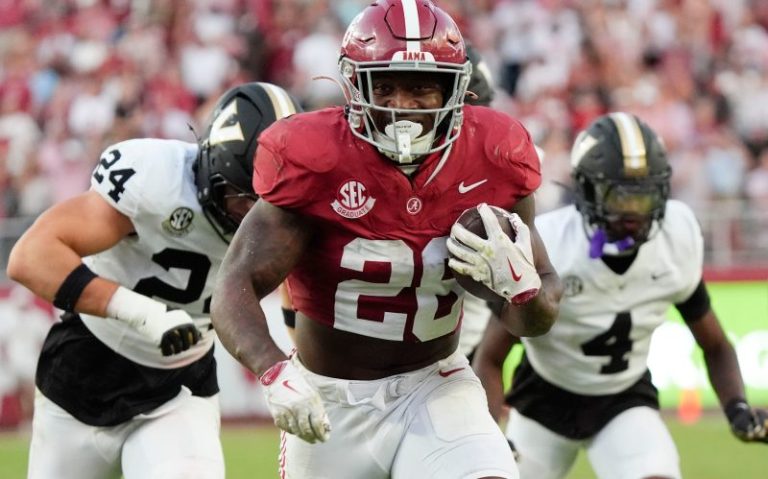
  • Alabama, Miami were fine playoff picks, but process became a farce.
  • Pick the 12 best teams for CFP bracket. Period.

Did the College Football Playoff committee get the bracket right? Well, that depends on your perspective and your rooting interests. The bubble got awfully crowded, so not everyone was going to come away happy.

Overall, Alabama and Miami seem like fair choices, but the course the committee charted to reach that destination became an exercise of the absurd.

On this edition of ‘SEC Football Unfiltered,’ a podcast from the USA TODAY Network, hosts Blake Toppmeyer and John Adams offer their biggest grievances with this bracket — and with this committee — and propose a different way to approach the playoff.

Here are four thoughts about how to improve the system:

Is this season proof that playoff expansion is necessary? No. There’s an argument for 16 teams. It’s a worthy idea, but there’s also a case for staying at 12, with format alterations.

∎ Whether 12 or 16 teams, how should the bids be allocated? Get rid of automatic bids. Conferences have become so big that conference championships are no guarantee of pitting the league’s two best teams against one another. Also, with apology to the little guy, no conference should be guaranteed a bid. That includes the Group of Five. Pick the best teams, period. No automatic bids. All at-large selection.

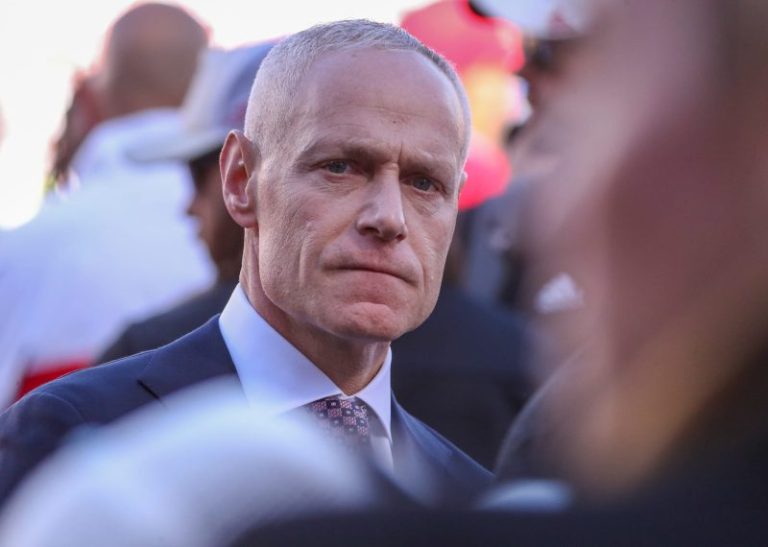
So, that means keeping the committee? Yes, but with changes to the construction of the committee. No sitting or former athletic director should be allowed on the committee. There’s nothing about being an AD that makes you an expert at ranking football teams. Also, athletic directors give off the appearance of bias, if not outright inserting bias. ADs have big jobs. CFP committee chairman Hunter Yurachek had to hire a football coach at Arkansas while being the front man of the selection process. That’s an inappropriate ask, and it’s unfair to fans to have someone juggle a coaching search and a selection process.

∎ So, who would be on the committee? Boot the ADs, and come up with a mix of former coaches and media members. Perhaps, include an analytics nerd, as well. If this sounds crazy, remember that for many, many years, the national championship was awarded based on AP (media) and coaches’ polls. So, removing ADs in favor of coaches and media to devise the CFP rankings aligns with the sport’s history.

Also in this episode

∎ The hosts discuss potential playoff upsets, and they predict the national champion, offering divergent choices.

Where to listen to SEC Football Unfiltered

  • Apple
  • Spotify
  • iHeart
  • Google

Blake Toppmeyer is the USA TODAY Network’s national college football columnist. John Adams is the senior sports columnist for the Knoxville News Sentinel. Subscribe to the SEC Football Unfiltered podcast, and check out the SEC Unfiltered newsletter, delivered straight to your inbox.

This post appeared first on USA TODAY

Notre Dame’s exclusion from the College Football Playoff marked the end of the season for coach Marcus Freeman’s team, but the beginning of a war of words.

On Monday, fewer than 24 hours after the Fighting Irish didn’t see their name revealed on the 12-team playoff bracket, Notre Dame athletic director Pete Bevacqua went on “The Dan Patrick Show” to lash out at the ACC, saying the league that houses most of the school’s non-football sports had “done permanent damage to the relationship” between the two parties after the conference publicly lobbied for Miami to make the playoff field over the Fighting Irish.

Bevacqua’s comments received widespread criticism — including from one of his fellow power brokers in the world of college athletics.

During a sit-down interview at Sports Business Journal’s Intercollegiate Athletics Forum in Las Vegas, Big 12 commissioner Brett Yormark slammed Bevacqua’s criticism of the ACC, describing the administrator’s words as “egregious.”

“I don’t like how Notre Dame’s reacted to it,” Yormark said. “I think Pete’s behavior has been egregious. It’s been egregious going after (ACC commissioner) Jim Phillips when they saved Notre Dame during COVID.”

While Notre Dame is an independent in football, 24 of the university’s athletic programs are members of the ACC. Additionally, the school has had a football scheduling agreement with the ACC since 2014, one in which the Fighting Irish have to play an average of five ACC programs a year over the life of the deal. In 2020, in the middle of the COVID-19 pandemic, the ACC allowed Notre Dame to play 10 ACC teams on its 11-game schedule that season and be eligible for the league’s championship game. On the back of that ACC-heavy schedule, the Fighting Irish made the ACC championship game, where it lost to Clemson, and was selected for the then-four-team College Football Playoff.

As the debate waged last week over which combination of Notre Dame, Miami and Alabama should earn the final two at-large spots in the playoff, the ACC campaigned for Miami, the only one of the trio that is a football member of the conference. 

On Nov. 10, the league’s official account on X (formerly Twitter) posted a graphic comparing the respective resumes of the Hurricanes and Fighting Irish while highlighting Miami’s head-to-head victory against Notre Dame and its higher number of wins against top-25 opponents. The ACC Network also aired the Hurricanes’ 27-24 Week 1 victory over the Fighting Irish more than a dozen times last week in the days leading up to the final playoff bracket reveal. Miami ultimately earned the final at-large spot after being behind Notre Dame for each of the previous weekly ranking unveilings.

Those actions irked Bevacqua, who has voiced his displeasure with the conference of which his school’s football program isn’t a member.

‘I understand they have to stand up for their teams in football,’ Bevacqua said on Tuesday, Dec. 9. ‘We just think there’s other ways to do it, and it has created damage. I’m not going to shy away from that, and that’s just not me speaking. People a lot more important at this university than me feel the same way.”

ACC commissioner Jim Phillips had responded to Bevacqua’s comments on Monday in a statement in which he said that “when it comes to football, we have a responsibility to support and advocate for all 17 of our football-playing member institutions, and I stand behind our conference efforts to do just that leading up to the College Football Playoff Committee selections on Sunday.”

Though Notre Dame’s coaches and players may have understandably felt blindsided by the playoff selection committee’s final ranking, Yormark believes the clues for Miami leapfrogging the Fighting Irish were apparent all along. And, to him, that makes Bevacqua’s behavior even more unacceptable.

“(Playoff selection committee chairman) Hunter (Yurachek) was very transparent about it, the chair, that as Notre Dame and Miami got closer together, head-to-head would be a factor,” Yormark said. “BYU lost. They became closer and head-to-head made a difference in that decision. I think he’s totally out of bounds in his approach and if he was in the room, I’d tell him the same thing.”

This post appeared first on USA TODAY

An international human rights group filed a complaint with the ethics committee of world soccer’s governing body to look into FIFA President Gianni Infantino, accusing him of a possible breach of political neutrality.

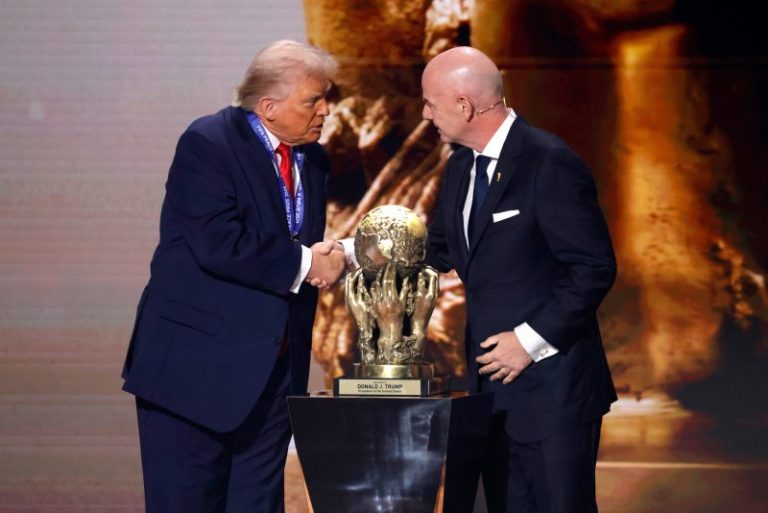
FairSquare, based in London, which says its company promotes ‘systemic change and stops human rights abuses,’ filed an eight-page complaint with FIFA’s Ethics Committee over the organization’s decision to give its inaugural Peace Prize to President Donald Trump, a decision that was met with swift condemnation.

“The award of a prize of this nature to a sitting political leader is in and of itself a clear breach of FIFA’s duty of neutrality,” FairSquare said in its complaint.

“If Mr. Infantino acted unilaterally and without any statutory authority, this should be considered an egregious abuse of power.’

FIFA’s ethics bylaws require neutrality in all political matters, and violations can carry a two-year ban from the sport.

Infantino and Trump were together at the Kennedy Center in Washington, DC, for the World Cup draw. The 2026 tournament, which is being held in North America, starts June 11.

FairSquare also said Infantino’s attendance at Trump’s inauguration in January ‘indicates support for President Trump’s political agenda.’

‘This complaint is about a lot more than Infantino’s support for President Donald Trump’s political agenda,’ said Nicholas McGeehan, FairSquare’s program director.

‘More broadly this is about how FIFA’s absurd governance structure has allowed Gianni Infantino to openly flout the organisation’s rules and act in ways that are both dangerous and directly contrary to the interests of the world’s most popular sport.’

This post appeared first on USA TODAY

Here’s a quick recap of the crypto landscape for Monday (December 8) as of 9:00 p.m. UTC.

Get the latest insights on Bitcoin, Ether and altcoins, along with a round-up of key cryptocurrency market news.

Bitcoin and Ether price update

Bitcoin (BTC) was priced at US$90,672.01, down by 0.9 percent over 24 hours.

Bitcoin price performance, December 8, 2025.

Chart via TradingView.

Cryptocurrencies traded choppily, but were ultimately directionless over the weekend.

Bitcoin briefly slipped toward the high US$87,000s on Sunday (December 7) ahead of this week’s US Federal Reserve meeting, with both short and long positions liquidated.

Markets are pricing in a 25 basis point interest rate cut from the Fed on Wednesday (December 10), but labor weakness and sticky inflation will make Chair Jerome Powell’s tone pivotal.

Linh Tran, senior market analyst at XS.com, believes Bitcoin “will likely continue oscillating within the US$84,000 to US$100,000 range until the Fed delivers a clear message,” adding that a 0.25 percentage point cut and dovish signals “would be favorable for risk assets, particularly Bitcoin,” while a hawkish stance risks downward pressure.

On Monday, Bitcoin briefly traded at around US$92,000, but failed to retest US$92,000 to US$93,500 resistance, dropping below US$90,000 as the US market opened.

Crypto analyst Daan Crypto Trades said bulls must defend the 0.382 Fibonacci retracement zone, which serves as a key area of support and resistance during market cycles. Failure to do so could result in a fall to April lows. Fellow analyst van de Poppe is eyeing US$86,000 as key support before potential lows retest.

Liquidity stayed thin, and derivatives positioning showed waning momentum rather than clear trend conviction, setting up a cautious, data‑dependent start to the new week.

Last week, US spot Bitcoin exchange-traded funds (ETFs) experienced net outflows of US$87.77 million, while spot Ether ETFs recorded US$65.59 million in outflows.

Cycle data mirroring 2022’s market suggests Bitcoin’s long-term bottom is in or imminent, according to investment manager Timothy Peterson. Derivatives data analyzed by CryptoQuant indicates trader apathy, signaled by low OI and leverage, paving the way for a potential rally.

Ether (ETH) is currently priced at US$3,129.54, down 0.4 percent over 24 hours.

Altcoin price update

  • XRP (XRP) was priced at US$2.09, a decrease of 0.2 percent over 24 hours.
  • Solana (SOL) was trading at US$134.23, down by 1.3 percent over 24 hours.

Crypto derivatives and market indicators

Bitcoin futures open interest rose 0.53 percent to US$58.18 billion in the last four hours of trading, alongside US$4.88 million in liquidations that hit mostly long positions, while Ether open interest climbed 0.49 percent to US$37.84 billion, with US$8.76 million liquidated.

Bitcoin’s relative strength index sits neutral at 51.67 with a mildly negative funding rate of -0.001 percent, signaling balanced momentum and slight short bias, whereas Ether’s positive 0.006 percent funding rate points to lingering long interest despite the downside pressure.

These metrics reflect cautious positioning amid recent Bitcoin consolidation, with rising open interest indicating fresh capital entering despite liquidation flushes that targeted longs more aggressively. The neutral-to-bearish Bitcoin funding and RSI suggest limited upside conviction short-term, potentially capping rallies until macro catalysts provide direction, while Ether’s funding tilt hints at relative resilience in alt positioning.

Today’s crypto news to know

StableChain launches mainnet

StableChain has launched its mainnet, introducing USDT as the gas fee token alongside a new dedicated governance token for network participants.

Tether’s USDT regulatory win

Tether’s USDT stablecoin received key regulatory status in Abu Dhabi, enhancing its legitimacy for institutional use.

BlackRock files for staked Ether ETF

BlackRock filed to list a staked Ether ETF, signaling growing institutional appetite for Ether-based yield products.

SEC closes Ondo probe

The US Securities and Exchange Commission (SEC) ended its investigation into tokenized equity platform Ondo Finance, clearing a major regulatory hurdle.

Strategy boosts BTC holdings

Strategy’s (NASDAQ:MSTR) Bitcoin treasury has surpassed 660,000 BTC after a US$962 million purchase, underscoring aggressive accumulation by major players.

Securities Disclosure: I, Meagen Seatter, hold no direct investment interest in any company mentioned in this article.

This post appeared first on investingnews.com

Clem Chambers, CEO of aNewFN.com, shares his outlook for silver in 2026.

In his view, the white metal could rise as high as US$150 to US$160 per ounce.

Chambers also discusses his other areas of focus right now, including gold, as well as the defense industry and tech stocks like Intel (NASDAQ:INTC).

Securities Disclosure: I, Charlotte McLeod, hold no direct investment interest in any company mentioned in this article.

This post appeared first on investingnews.com

(TheNewswire)

Vancouver, British Columbia, December 8, 2025 TheNewswire – Prismo Metals Inc. (‘ Prismo ‘ or the ‘ Company ‘) (CSE: PRIZ,OTC:PMOMF) (OTCQB: PMOMF) is pleased to announce that it has continued out of the jurisdiction of Canada under the Canada Business Corporations Act into the provincial jurisdiction of British Columbia under the Business Corporations Act (British Columbia) (the ‘ BCBCA ‘). Shareholders approved the continuance at the Company’s annual general and special meeting of shareholders held on October 2, 2025.

In connection with the continuance, the Company has replaced its articles and bylaws with new notice of articles and articles, respectively, under the BCBCA. The CUSIP / ISIN numbers for the Company’s common shares and the stock symbol for the Company’s common shares remain unchanged.

About Prismo Metals Inc.

Prismo (CSE: PRIZ,OTC:PMOMF) is mining exploration company focused on advancing its Silver King, Ripsey and Hot Breccia projects in Arizona and its Palos Verdes silver project in Mexico.

Please follow @ PrismoMetals on , , , Instagram , and

Prismo Metals Inc.

1100 – 1111 Melville St., Vancouver, British Columbia V6E 3V6

Phone: (416) 361-0737

Contact:

Alain Lambert, Chief Executive Officer alain.lambert@prismometals.com

Gordon Aldcorn, President gordon.aldcorn@prismometals.com

Neither the Canadian Securities Exchange nor its Market Regulator (as that term is defined in the policies of the Canadian Securities Exchange) accepts responsibility for the adequacy or accuracy of this release.

Copyright (c) 2025 TheNewswire – All rights reserved.

News Provided by TheNewsWire via QuoteMedia

This post appeared first on investingnews.com

After 2025’s volatile end, 2026 is poised to be a watershed moment for the cryptocurrency sector, marking a transition from a speculative asset class to essential global financial infrastructure.

Further regulatory clarity, artificial intelligence (AI) integration, real-world asset (RWA) tokenization and sustained institutional inflows could propel DeFi and crypto markets in 2026. According to experts, this is no longer a conversation about crypto versus TradFi; it’s about a hybrid financial system where digital assets are simply better tools.

Crypto market maturity and resilience

According to Elkaleh, Bitcoin’s resilience during its recent pullback, which brought a 37 percent drawdown from its October all-time high, was telling. While such severity was surprising, he observed that long-term holders and institutions continued to accumulate rather than unwind exposure, which he sees as an indicator of health.

“Q4 was defined by a major leverage reset, with BTC’s sharp pullback forcing a broader reassessment of risk,” he said.

At the time of this writing, analysts were split on where Bitcoin could go next. A further crash risk lingers if the US Federal Reserve delays interest rate cuts; however, a post-purge rally to US$135,000 to US$150,000 is in sight mid-year if institutions return, exchange-traded fund (ETF) flows flip positive and futures premiums stabilize above 5 percent.

As Bitcoin dropped, Elkaleh observed other segments of the market tied to practical use cases and diversification strategies — such as privacy assets, decentralized AI and stablecoin ecosystems — weather the storm.

“The market (has shown) growing maturity: capital and developer attention shifted toward utility-driven sectors such as tokenization, stablecoins and real-world integrations.”

Tokenization: The on-chain first institutional default

Mersch sees tokenization accelerating in 2026, eventually becoming the default for new institutional financial products.

He sees the foundation of this shift being built, with tokenized treasuries and money-market funds serving as a core yield sleeve for institutional investors who demand liquidity, standardized reporting and programmable settlement.

“If current growth holds, tokenized assets could be a multi-trillion dollar market by 2030, with government bonds and cash-like instruments as the anchor,” he said. “Over the next five years, the key shift is likely that new institutional products are designed as on-chain first, and only secondarily wrapped in legacy wrappers.”

He anticipates that stablecoins will be solidified as the liquidity backbone for a growing tokenized market, acting as the new cash layer. The most likely end state, according to Mersch, will be a hybrid digital cash stack, where bank-issued stablecoins, private stablecoins and central bank digital currenciesco-exist and interoperate.

Mersch predicts that tokenized real estate and private credit will now start to see expansion.

For real estate, tokenization converts a traditionally illiquid market into tradable, divisible assets, lowering the barrier to entry for global investors and providing recurring revenue streams.

Rupena, whose company, Milo, pioneered the crypto-backed mortgage, asserts that lenders will be expected to recognize digital assets as a core part of a client’s real balance sheet, just like cash or securities.

Elkaleh also expects to see strong expansion in RWA tokenization in 2026, alongside stablecoin-based payouts and small-business payment rails. “The most accelerated growth will occur in emerging markets, where mobile-first users turn to crypto as a practical financial alternative,” he wrote in an email.

“The rise of RWA markets, L2 scalability and more accessible DeFi will allow onchain credit and savings to scale meaningfully. Combined with steady institutional inflows, these economies will become the strongest demand engines of 2026, driving both user growth and real economic activity onchain.”

DeFi: An institutional derivatives and credit layer

The final pillar of the 2026 crypto outlook is the maturation of DeFi. Mersch asserted that DeFi is poised to emerge as a compliance-ready core platform for credit and risk management in 2026.

Real-world structural resilience supports Mersch’s forecast.

Rupena noted that market ups and downs are expected in the digital asset ecosystem, and that conservative LTVs, real-time monitoring and clear margining frameworks are designed to cope with volatility.

“Lower forced liquidation activity, even during big market moves, is a very healthy signal,” he explained, adding that customers are purposely keeping collateral cushions so they can stay calm during market swings.

This focus on prudence and durability validates the market’s readiness for institutional-grade credit and risk products.

“If successful, this creates a liquid, 24/7 derivatives layer that sits on top of both tokenized and traditional markets,” Mersch said. “By 2026 and beyond, the most interesting innovation may not be crypto versus TradFi, but portfolio and product designs that blend tokenized assets, stablecoin liquidity and DeFi-based synthetic exposure into a single stack.”

This institutional leap is fundamentally enabled by regulatory clarity.

“You can already see this through partnerships like Coinbase (NASDAQ:COIN) with Circle Internet Group (NYSE:CRCL) and Morpho (TSE:3653), where yield is embedded at the platform level without requiring users to interact directly with on-chain protocols. Regulation will accelerate that model,’ he added.

Elkaleh noted that clearer rules will allow users to adopt on-chain tools for cross-border payments, tokenized savings and AI-driven bill pay with the same confidence they have in regulated fintech apps. He expects the most transformational impact will come from next-generation L2 scalability paired with AI-agent execution.

“These shifts will bring down transaction costs, compress settlement times, and enable autonomous payments, subscriptions and cross-chain operations,” the expert explained.

“We also expect prediction-market aggregation to emerge as a breakout consumer interface and RWA perpetuals to bring macro assets, including commodities, credit and inflation onchain through synthetic markets. These developments collectively move crypto into a more comprehensive, high-velocity financial system.”

Upcoming crypto market catalysts

The pivot to a hybrid financial system will be driven by several concurrent catalysts.

The US Market Structure Bill is targeted for a Senate floor vote in early 2026, aiming to create the first federal framework for digital assets. North of the border, Canada’s Stablecoin Act, which provides C$10 million for Bank of Canada oversight starting in 2026, signals official endorsement of the digital cash layer.

Globally, the Basel Committee on Banking Supervision is set to implement new capital standards for banks’ crypto exposures, crucial for encouraging institutional momentum, by January 1, 2026.

The technological engine supporting this adoption is fueled by scalability and intelligence.

On the blockchain side, Ethereum’s aggressive roadmap, including the Glamsterdam upgrade targeted for 2026, continues to refine Layer-2 (L2) systems. This focus on L2 efficiency, combined with the integration of AI agent execution, is key for supporting the millions of transactions needed for a comprehensive, high-velocity financial system.

Investor takeaway

In 2026, the crypto market is set to deliver meaningful gains and stable, sustained growth as this new, highly efficient, and globally interoperable financial system moves from the laboratory into production scale.

Securities Disclosure: I, Meagen Seatter, hold no direct investment interest in any company mentioned in this article.

This post appeared first on investingnews.com