Author

admin

Browsing

(TheNewswire)

Vancouver, Canada, December 12, 2025 TheNewswire – Spartan Metals Corp. (‘ Spartan ‘ or the ‘ Company ‘) (TSX-V: W | OTCQB: SPRMF | FSE: J03) announces, effectively immediately, it has terminated the previously announced (November 17, 2025) investor relations agreement with ValPal Management Consultancy.

About Spartan Metals Corp.

Spartan Metals is focused on developing critical minerals projects in well-established and stable mining jurisdictions in the Western United States, with an emphasis on building a portfolio of diverse strategic defense minerals such as Tungsten, Rubidium, Antimony, Bismuth, and Arsenic.

Spartan’s flagship project is the Eagle Project in eastern Nevada that consists of the highest-grade historic tungsten resource in the USA (the past-producing Tungstonia Mine) along with significant under-defined resources consisting of: high-grade rubidium; antimony; bismuth; indium; as well as precious and base metals. More information about Spartan Metals can be found at www.SpartanMetals.com

On behalf of the Board of Spartan

‘Brett Marsh’

President, CEO & Director

Further Information:

Brett Marsh, M.Sc., MBA, CPG

President, CEO & Director

1-888-535-0325

info@spartanmetals.com

Neither the TSX Venture Exchange nor its Regulation Service Provider (as that term is defined in the policies of the TSX Venture Exchange) accepts responsibility for the adequacy or accuracy of this press release.

Copyright (c) 2025 TheNewswire – All rights reserved.

News Provided by TheNewsWire via QuoteMedia

This post appeared first on investingnews.com

We also break down next week’s catalysts to watch to help you prepare for the week ahead.

In this article:

    This week’s tech sector performance

    Markets opened the week subdued with investors eyeing the US Federal Reserve’s rate decision, leading to modest gains in the tech-heavy Nasdaq Composite (INDEXNASDAQ:.IXIC) and the S&P 500 (INDEXSP:.INX).

    Reports of US President Donald Trump’s approval for NVIDIA (NASDAQ:NVDA) H200 chip sales to China boosted chip stocks and sustained AI enthusiasm. Tuesday’s (December 9) JOLTS report delivered data suggesting a cooling labour market amid tariff uncertainty but offering limited new clarity ahead of the Federal Reserve’s two-day meeting.

    Markets rallied sharply on Wednesday (December 10) after the meeting resulted in a 25 basis point rate cut to 3.5 to 3.75 percent; however, Nasdaq gains were tempered, hinting at continued caution around AI capex sustainability ahead of earnings from Oracle and Broadcom.

    Rate-sensitive areas like financials and industrials led the rally, pushing the Dow Jones Industrial Average (INDEXDJX:.DJI) ahead of the Nasdaq, which closed slightly down. This highlighted a shift from tech dominance to a more diversified market. The S&P ended up 0.21 percent at a record 6,901.

    Markets interpreted Fed Chair Jerome Powell’s measured tone during his post-meeting press conference — hawkish on cuts but dovish on recession — as reinforcing a gradual easing despite tariff caution.

    Gains moderated toward the end of the week as Oracle (NYSE:ORCL) and Broadcom (NASDAQ:AVGO) reported earnings that garnered a mixed reaction from investors and analysts.

    Tech stocks have whipsawed in recent weeks, rallying on Fed rate cut bets and trade negotiation optimism before sharp pullbacks triggered by AI bubble fears and overvaluation concerns.

    3 tech stocks moving markets this week

    1. NVIDIA (NASDAQ:NVDA)

    Nvidia’s shares initially surged on Tuesday (December 9) on reports that President Trump would permit H200 exports to pre-approved Chinese clients, subject to a 25 percent US federal surcharge.

    However, these early gains diminished as further reports emerged that Beijing is reviewing its domestic chip prioritization strategy.

    Meanwhile, companies like ByteDance and Alibaba (NYSE:BABA) are reportedly seeking large orders, pending approval. On Friday, Reuters reported that Nvidia is considering increasing H200 chip output due to robust Chinese demand. Its share price was US$175.02 at Friday’s close, a modest decrease of 4.35.

    2. Oracle (NYSE:ORCL)

    Oracle shares dropped over 7 percent after hours on Wednesday after the company’s Q2 earnings missed revenue forecasts, coming at US$16.1 billion compared to expectations of US$16.2 billion.

    The report showed cloud sales rose 34 percent, while infrastructure revenue increased by 68 percent. Both figures were below analyst expectations of 35 and 71 percent, respectively.

    Oracle shares plunged further after executives disclosed on a conference call that this fiscal year’s capital expenditure would reach around US$50 billion, higher than prior guidance, including around US$12 billion spent this quarter on data centers.

    On a more positive note, some analysts viewed capex as a strategic investment, citing AI’s growth potential and pointing to Oracle’s US$523 billion backlog of deals with companies like Meta Platforms (NASDAQ:META) and Nvidia.

    Oracle shares closed more than 16 percent lower this week at a price of US$189.97 on Friday afternoon.

    3. Broadcom (NASDAQ:AVGO)

    Conversely, Broadcom shares rose post-market on Thursday after reporting its Q4 2025 earnings results, which revealed a 74 percent increase in AI chip revenue, with custom XPUs now comprising 65 percent of its semiconductor business.

    Total revenue reached US$18.02 billion year-over-year, exceeding expectations of US$17.46 billion.

    Looking ahead, the company projects semiconductor revenue to double to US$8.2 billion in the next fiscal year. Q1 2026 guidance calls for US$19.1 billion total revenue.

    During the earnings call, Broadcom CEO Hock Tan named Anthropic as the newly qualified fourth hyperscale, confirming its US$11 billion additional order for custom XPUs and AI racks. Shipments are expected to ramp up in late FY26.

    After an initial rise, stocks fell during the call after the company guided low quarterly growth for its non-AI chips and a tax rate increase to 16.5 percent due to normalized post-acquisition tax benefits expiring.

    Still, JPMorgan (NYSE:JPM) analyst Vivek Arya reset his price target on Broadcom stock from US$460 to US$500 on Friday (December 12).

    Despite the positive sentiment, Broadcom shares saw a decline of 11.79 to US$359.93 from the start of the week due to Friday’s sell-off.

    Broadcom, Nvidia and Oracle’s performance, December 8 to 12, 2025.

    Chart via Google Finance.

    Top tech news of the week

        Tech ETF performance

        Tech exchange-traded funds (ETFs) track baskets of major tech stocks, meaning their performance helps investors gauge the overall performance of the niches they cover.

        This week, the iShares Semiconductor ETF (NASDAQ:SOXX) declined by 3.88 percent, while the Invesco PHLX Semiconductor ETF (NASDAQ:SOXQ) saw a gain of 1.31 percent.

        The VanEck Semiconductor ETF (NASDAQ:SMH) also decreased by 3.71 percent.

        Tech news to watch next week

        Speeches from Fed Governors Stephen Miran and Christopher J. Waller on Monday (December 15) and Wednesday (December 17) next week may further clarify the Fed’s dot plot.

        Bank of Canada Governor Tiff Macklem will also speak in Montreal on Tuesday (December 16), while key jobs, manufacturing and retail sales data in the US throughout the week could shift rate cut bets, pressuring growth stocks.

        Earnings from Micron Technology (NASDAQ:MU) and BlackBerry (TSX:BB) will be released on Wednesday and Thursday (December 18), respectively.

        Securities Disclosure: I, Meagen Seatter, hold no direct investment interest in any company mentioned in this article.

        This post appeared first on investingnews.com

        Sweet 16 action continues in the 2025 NCAA volleyball tournament with a slate of four games on Friday.

        No. 1 seed Texas kicked off the day by sweeping Indiana. No. 1 overall seed Nebraska will end the night against No. 4 Kansas after opening the tournament with back-to-back sweeps. The Huskers (32-0) remain undefeated and have only dropped seven sets all year, with the last coming nearly a month ago on Nov. 14 against UCLA.

        Speaking of sweeps, No. 1 Kentucky and No. 1 Pittsburgh punched their tickets to the Elite Eight on Thursday. The Wildcats ended Cal Poly’s Cinderella story in straight sets, while Pittsburgh brought out the brooms against Minnesota.

        USA TODAY gives you everything you need to know about Friday’s schedule, matchups, scores and highlights:

        SWEET 16 NCAA VOLLEYBALL RECAP: Kentucky, Pittsburgh sweep way to Elite Eight

        Set 1: Nebraska 25, Kansas 12

        Nebraska took a quick lead against Kansas and easily put away the first set.

        The Cornhuskers looked every bit like the No. 1 overall seed. They collectively hit .357 and registered six blocks against the Jayhawks, who were held to a negative hitting percentage (-.024) in the first set. Rebekah Allick led the Huskers with six kills on six attempts, while Andi Jackson added four blocks and three kills.

        Nebraska vs. Kansas volleyball underway

        Final: Texas A&M 3, Louisville 2

        Set 5: Texas A&M 3, Louisville 2

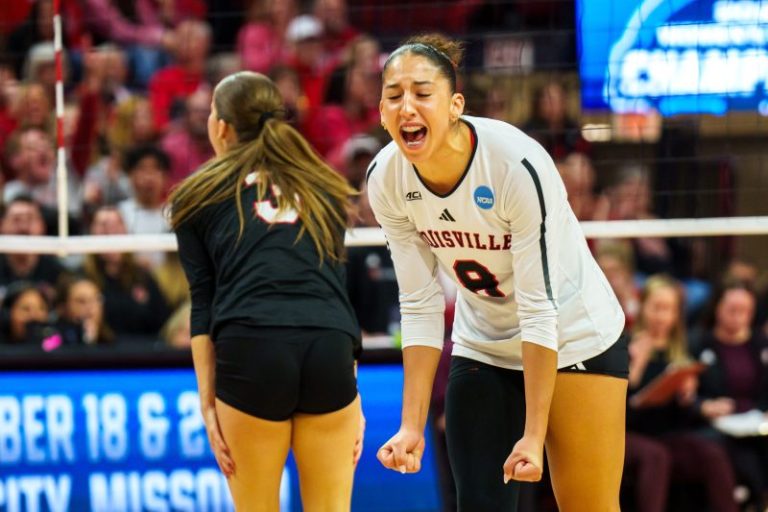
        No. 3 Texas A&M completed a reverse sweep against No. 2 Louisville to advance to the regional final for the first time since 2001 after winning the fifth set, 15-12. The Aggies were able to swing the momentum of the game with their blocking ability, led by Ifenna Cos-okpalla’s 12 total blocks.

        Texas A&M’s Logan Lednicky (20 kills, 10 digs on .245 hitting), Kyndal Stowers (16 kills, 11 digs on .282 hitting) and Emily Hellmuth (12 kills on .226 hitting) each recorded double-digit kills.

        ‘We just weren’t finishing the last end of the set,’ said an emotional Lednicky, who was three blocks away from a triple double. ‘We’re like, we’re not letting them sweep us. We know how to grind, we know how to dig it. We saw it in the TCU match and we did just that last one.’

        Tensions boiled over in the fifth set. Louisville head coach Dan Meske earned a yellow card for swatting the ball because he thought the referee missed a carry call during a long rally Texas A&M won to go up 12-10.

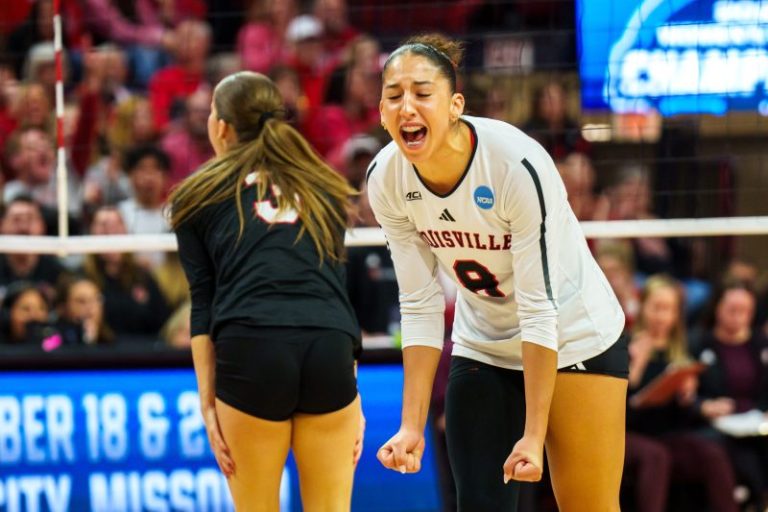
        Louisville’s Chloe Chicoine finished with a game-high 26 kills hitting .300 in the loss.

        Set 4: Louisville 2, Texas A&M 2

        No. 3 Texas A&M took a 17-8 lead after holding No. 2 Louisville to a -.143 hitting percentage to start the fourth set with its defensive prowess. The Aggies stretched their lead to as many as nine points, but Louisville went on a 7-1 run to come within three points of Texas A&M. The Aggies didn’t relinquish the lead this time. Texas A&M finished the fourth set on a 4-0 run to force a decisive fifth set.

        Texas A&M held Louisville to .000 hitting in the fourth set. The Aggies hit .267 and recorded nine blocks. Texas A&M’s Logan Lednicky (18 kills on .333 hitting), Kyndal Stowers (14 kills on .243 hitting) and Emily Hellmuth (10 kills on .200 hitting) each have double-digit kills. Ifenna Cos-okpalla is up to 11 blocks.

        The Aggies are going for the reverse sweep, the team’s first since September 2024.

        Set 3: Louisville 2, Texas A&M 1

        No. 3 Texas A&M head coach Jamie Morrison said his team needed to do a better job at finishing at the end of the set if they wanted to extend their season against No. 2 Louisville after giving up leads in the first two sets. The Aggies did just that in a third set that featured 15 ties and five lead changes.

        The Aggies had a 23-21 lead in the third set before Louisville tied it up at 23-23 following back-to-back kills from Chloe Chicoine. Texas A&M’s Kyndal Stowers responded with a pair of kills herself to give the Aggies the set, 25-23.

        Texas A&M’s Logan Lednicky (14 kills on .333 hitting), Kyndal Stowers (11 kills on .259 hitting) and Emily Hellmuth (10 kills on .261) each have double-digit kills as the team is collectively hitting .292.

        Meanwhile, Chicoine is up to 19 kills on .405 hitting. Cara Crease added seven blocks.

        Set 2: Louisville 2, Texas A&M 0

        New set, same scenario. Much like the first set, Texas A&M was the first team to reach 15 points. The Aggies had a 21-16 lead in the second set, before Louisville staged another comeback. The Cardinals went on a 9-1 run to take the lead and clinch the second set, 25-22, to take a 2-0 lead over Texas A&M.

        Louisville capitalized on 14 total blocks and three aces. Chloe Chicoine (11 kills on .400 hitting) and Payton Petersen (10 kills on .563 hitting) led the Cardinals in kills.

        Logan Lednicky has nine kills, while Emily Hellmuth and Kyndal Stowers each have seven kills for Texas A&M.

        Set 1: Louisville 1, Texas A&M 0

        No. 3 Texas A&M had control of the first set and was the first team to 15 points, but No. 2 Louisville went on a 5-0 run to tie it up at 17-17. Five more ties ensued before Louisville ultimately created some separation to take the first set, 25-23. Louisville hit .457 and had two players with six or more kills — Payton Petersen (seven kills on .778 hitting) and Chloe Chicoine (six kills on .600 hitting).

        Louisville starters

        Wisconsin 3, Stanford 1

        Set 4: Wisconsin 25, Stanford 22

        The Badgers had to fight for it, but they moved on after a 3-1 win over Stanford that was sealed with a team block. Wisconsin finished the day hitting .420. Match standout Mimi Colyer had a blistering 27 kills on .373 hitting and 10 digs. On the other side of the net, Stanford hit very well for most of the match, but slipped to a .242 percentage in Set 4 after maintaining around .400 during the first three sets. The Cardinal had four players who finished with double-digit kills. Elia Rubin led the group with 15 kills and 13 digs.

        Set 3: Wisconsin 25, Stanford 23

        The third set was a back-and-forth battle. There were a whopping 9 ties and 4 lead changes before Wisconsin finally pulled away to go up 2-1. Grace Egan sealed Set 3 for the Badgers with a timely kill after two set points. Mimi Colyer continues her day of domination with 19 kills on .333 hitting. Carter Booth has also been fantastic for Wisconsin with 13 kills on .813 hitting. Julia Blyashov and Jordyn Harvey both have 10 kills for Stanford.

        Set 2: Stanford: 25, Wisconsin 21

        Stanford was poised in Set 2 with better defense and serving. The Cardinal were tied with the Badgers at 13, all, before letting off a 12-8 run to take the set. Elia Rubin had the deciding kill after three set points. Stanford hit .484 in Set 2 with three players who had six or more kills, including Rubin, who had a .417 hitting percentage and seven digs. Wisconsin’s Mimi Colyer leads all players with 16 kills on 25 swings and .480 hitting.

        Wisconsin vs. Stanford is a sister-against-sister showdown

        Look across the court, and fans will see a pair of sisters on opposite sides of the court. Wisconsin’s Alicia Andrew and Stanford’s Lizzy Andrew are facing off against each other today in the Sweet 16.

        Set 1: Wisconsin 25, Stanford 17

        Wisconsin hit a blistering .514 in the first set, sealed by a Carter Booth kill. Mimi Colyer led the Badgers with nine kills on 15 swings and a .467 hitting percentage. Lizzy Andrew led the Cardinal, going a perfect three-for-three on kills.

        Wisconsin vs. Stanford is underway

        No. 3 Wisconsin and No. 2 Stanford are in the first set of the second match of day two of the Sweet 16.

        Texas star Cari Spears had her dad in the stands against Indiana

        Former NFL player and ESPN analyst Marcus Spears was in the stands today to watch his daughter, Texas freshman Cari Spears, play.

        Final: Texas 3, Indiana 0

        Set 3: Texas 25, Indiana 22

        Whitney Lauenstein sent Texas to the regional final with a kill to secure the sweep against Indiana. The Longhorns finished with .374 hitting and 23 total blocks. Torrey Stafford was brilliant with 19 kills on 28 swings (with zero errors) and a .679 hitting percentage. Nya Bunton was also critical to the Longhorns’ success with seven kills on .545 hitting and five blocks. Candela Alonso-Corcelles and Jaidyn Jager had 21 combined kills for the Hoosiers.

        Indiana is pushing Texas in Set 3

        The Hoosiers look much more relaxed in Set 3 as they try to fight off elimination. They are hitting .261 in the frame and have slowed down Texas’s blocks.

        Set 2: Texas 25, Indiana 22

        It took four set points, but Abby Vander Wal again secured the set Texas. The Longhorns have held the Hoosiers to under .200 for the match while maintaining .365 hitting percentage. Torrey Stafford is putting on a clinic from all over the court. Stafford has zero errors on 19 swings, including 15 kills and a .789 hitting percentage. Candela Alonso-Corcelles leads Indiana with seven kills on .125 hitting and six digs.

        Texas’s defense is rolling against Indiana

        The Longhorns have 17 total blocks and have held Indiana to a .088 hitting percentage in the second set and .127 hitting for the match.

        Set 1: Texas 25, Indiana 20

        Texas took the first set after two set points, with Abby Vander Wal landing the deciding point. As a team, Texas hit .323 in the set, compared to .162 for Indiana with nine errors. The Hoosiers had several runs to close the game with the Longhorns, but Texas was too much. Torrey Stafford led all players with six kills on .750 hitting.

        Texas is the first to 15 in Set 1 against Indiana

        The Longhorns reached 15 points behind a huge boost from outside hitter Torrey Stafford, who had five kills and two blocks.

        Indiana vs. Texas is underway

        The Indiana Hoosiers and Texas Longhorns are in the first set of the first match during Day 2 of the Sweet 16.

        NCAA volleyball Sweet 16 continues Friday

        Two No. 1 seeds play on Friday, with Texas playing Indiana in the opener. The top overall seed, Nebraska, puts its unbeaten streak on the line against No. 4 Kansas in the nightcap after opening the tournament with back-to-back sweeps.

        When is NCAA women’s volleyball Sweet 16?

        • Date: Dec. 12
        • Time: Four matches beginning at noon ET Friday. Match-by-match times below.

        How to watch NCAA volleyball tournament

        • Streaming: ESPN+ ∣ Fubo (free trial)

        The 2025 NCAA women’s volleyball tournament will air across the ESPN and ABC family of networks. Games can be streamed ESPN+, ESPN’s subscription streaming service, and Fubo, which offers a free trial to potential subscribers.

        NCAA volleyball Sweet 16 schedule: Times, TV

        All times Eastern

        Thursday, Dec. 11

        • No. 3 Creighton 3, No. 2 Arizona State 1
        • No. 1 Kentucky 3, Cal Poly 0
        • No. 1 Pittsburgh 3, No. 4 Minnesota 0
        • No. 3 Purdue 3, No. 2 SMU 1

        Friday, Dec. 12

        • No. 1 Texas 3, No. 4 Indiana 0
        • No. 3 Wisconsin 3, No. 2 Stanford 1
        • No. 3 Texas A&M 3, No. 2 Louisville 2
        • No. 1 Nebraska vs. No. 4 Kansas, 9:30 p.m. | ESPN2

        Saturday, Dec. 13

        • No. 3 Creighton vs. No. 1 Kentucky, 5 p.m. | ESPN2
        • No. 1 Pittsburgh vs. No. 3 Purdue, 7:30 p.m. | ESPN2

        Sunday, Dec. 14

        • No. 1 Texas vs. No. 3 Wisconsin, TBD
        • No. 1 Nebraska/No. 4 Kansas vs. No. 3 Texas A&M, TBD

        When is the NCAA volleyball Final Four in 2025?

        • Dates: Thursday, Dec. 18 and Sunday, Dec. 21

        The two semifinal matches in the Final Four of the 2025 NCAA volleyball tournament will take place on Thursday, Dec. 18 and will be broadcast on ESPN. The national championship game is Sunday, Dec. 21 on ABC.

        NCAA volleyball second-round results

        Lexington bracket

        • No. 1 Kentucky 3, No. 8 UCLA 1 (30-28, 25-16, 28-30, 25-17)
        • No. 3 Creighton 3, No. 6 Northern Iowa 1 (25-18, 23-25, 25-22, 25-21)
        • No. 2 Arizona State 3, Utah State 1 (25-15, 25-18, 22-25, 25-15)
        • Cal Poly 3, No. 4 USC 2 (25-19, 25-20, 20-25, 14-25, 15-7)

        Austin bracket

        • No. 4 Indiana 3, No. 5 Colorado 0 (25-20, 25-17, 25-23)
        • No. 3 Wisconsin 3, North Carolina 0 (25-14, 25-21, 27-25)
        • No. 1 Texas 1, No. 8 Penn State 0 (25-16, 25-9, 25-19)
        • No. 2 Stanford 3, Arizona 1 (25-16, 25-27, 25-17, 25-20)

        Pittsburgh bracket

        • No. 3 Purdue 3, No. 6 Baylor 1 (25-16, 25-19, 23-25, 25-20)
        • No. 1 Pittsburgh 3, Michigan 0 (25-23, 25-23, 25-18)
        • No. 2 SMU 3, Florida 0 (25-11, 25-21, 26-24)
        • No. 4 Minnesota 3, No. 5 Iowa State 0 (25-22, 25-21, 25-14)

        Lincoln bracket

        • No. 4 Kansas 3, No. 5 Miami 1 (25-17, 25-22, 22-25, 27-25)
        • No. 2 Louisville 3, Marquette 2 (21-25, 25-11, 23-25, 25-19, 15-12)
        • No. 1 Nebraska 3, Kansas State 0 (25-17, 25-21, 25-16)
        • No. 3 Texas A&M 3, No. 6 TCU 1 (23-25, 25-23, 25-22, 29-27)

        NCAA volleyball first-round results

        Lexington bracket

        • No. 1 Kentucky 3, Wofford 0 (25-11, 25-19, 25-12)
        • No. 8 UCLA 3, Georgia Tech 2 (24-26, 25-19, 25-23, 25-18, 15-10)
        • Cal Poly 3, No. 5 BYU 2 (25-19, 17-25, 20-25, 25-20, 15-10)
        • No. 4 USC 3, Princeton 0, (25-19, 25-12, 25-13)
        • No. 3 Creighton 3, Northern Colorado 2 (12-25, 25-23,25-23,17-25, 8-15)
        • No. 6 Northern Iowa 3, Utah 2 (15-25, 21-25, 26-24, 25-20, 15-10)
        • Utah State 3, No. 7 Tennessee 2 (25-19, 25-15, 19-25, 25-18, 15-11)
        • No. 2 Arizona State 3, Coppin State 0 (25-11, 25-14, 25-12)

        Austin bracket

        • No. 1 Texas 3, Florida A&M 0 (25-11, 25- 8, 25-14)
        • No. 8 Penn State 3, South Florida 1 (25-23, 12-25, 25-21, 25-19)
        • No. 5 Colorado 3, American 0 (25-16, 25-19, 25-16)
        • No. 4 Indiana 3, Toledo 0 (25-18, 25-15, 25-17)
        • No. 3 Wisconsin 3, Eastern Illinois 0 (25-11, 25-6, 25-19)
        • North Carolina 3, No. 6 UTEP 1 (24-26, 25-11, 25-18, 25-21)
        • Arizona 3, No. 7 South Dakota State 1 (25-21, 22-25, 25-15, 25-15)
        • No. 2 Stanford 3, Utah Valley 1 (21-25, 25-21, 25-13, 25-14)

        Pittsburgh bracket

        • No. 1 Pitt 3, UMBC 0 (25-10, 25-17, 25-13)
        • Michigan 3, No. 8 Xavier 0 (25-19, 25-15, 25-23)
        • No. 5 Iowa State 3, St. Thomas-Minnesota 2 (21-25, 25-13, 25-16, 21-25, 15-8)
        • No. 4 Minnesota 3, Fairfield 0 (25-12, 25-7, 25-13)
        • No. 3 Purdue 3, Wright State 0 (25-13, 25-21, 25-19)
        • No. 6 Baylor 3, Arkansas State 2 (23-25, 25-20, 30-28, 23-25, 15-10)
        • Florida 3, No. 7 Rice 0 (27-25, 25-23, 25-19)
        • No. 2 SMU 3, Central Arkansas 0 (25-13, 25-13, 25-13)

        Lincoln bracket

        • No. 1 Nebraska 3, Long Island 0 (25-11, 25-15, 25-17)
        • Kansas State 3, San Diego 2 (21-25, 25-17, 26-28, 25-22, 15-12)
        • No. 5 Miami 3, Tulsa 1 (25-22, 13-25, 25-22, 25-20)
        • No. 4 Kansas 3, High Point 0 (25-20, 25-15, 25-18)
        • No. 3 Texas A&M 3, Campbell 0 (25-20, 25-10, 25-13)
        • No. 6 TCU 3, Stephen F. Austin 0 (25-8, 26-24, 25-20)
        • Marquette 3, Western Kentucky 0 (25-22, 25-21, 25-16)
        • No. 2 Louisville 3, Loyola (Illinois) 0 (25-17, 25-9, 25-12)

        NCAA volleyball tournament champions

        Penn State is the reigning NCAA volleyball champion, having defeated Louisville in four sets last year in the national title game. It was the Nittany Lions’ eighth volleyball championship since 1999.

        Here’s a look at the past 10 NCAA volleyball champions:

        • 2024: Penn State
        • 2023: Texas
        • 2022: Texas
        • 2021: Wisconsin
        • 2020: Kentucky
        • 2019: Stanford
        • 2018: Stanford
        • 2017: Nebraska
        • 2016: Stanford
        • 2015: Nebraska

        The USA TODAY app gets you to the heart of the news — fastDownload for award-winning coverage, crosswords, audio storytelling, the eNewspaper and more.

        This post appeared first on USA TODAY

        2025 is drawing to a close, and silver seems determined to end the year with a bang.

        The white metal’s breakout continued this week, with the price crashing through US$60 per ounce and continuing on up, even briefly passing US$64. It ultimately finished at just under US$62.

        Year-to-date silver is now up over 110 percent, far outpacing gold’s gain of about 63 percent.

        Its latest rise kicked off on November 28, the same day the Comex experienced an outage that lasted about 10 hours. Since then, positive drivers have continued to pile up.

        Chief among them this week was the most recent interest rate reduction from the US Federal Reserve. As was widely expected, the central bank made a 25 basis point cut at its meeting, which wrapped up on Wednesday (December 10), taking the target range to 3.5 to 3.75 percent.

        Both silver and gold tend to fare better in lower-rate environments, and while gold remains below its all-time high, it retook the US$4,300 per ounce level this week.

        Key Fed meeting takeaways

        It’s worth noting that although the Fed’s cut went through, three out of 12 officials voted against it, a situation that hasn’t happened since September 2019. Two wanted rates to stay the same, while Governor Stephen Miran was calling for a 50 basis point reduction.

        Miran took his spot on the Fed’s Board of Governors in September after being nominated by President Donald Trump, who has been critical of the Fed — and Chair Jerome Powell in particular — for not lowering rates as quickly as he would like. Powell’s term ends in May 2026, and it’s anticipated that his replacement will follow Trump’s vision. Kevin Hassett of the National Economic Council is said to be a strong contender, with 84 percent of respondents to a CNBC survey saying they think it will be him.

        While the Fed’s rate decision was in focus this week, market watchers are also closely eyeing its post-meeting statement, as well as press conference comments from Powell, to figure out what the central bank’s policy will look like heading into the new year and beyond.

        The latest dot plot shows that Fed officials expect only one rate cut in 2026, plus another in 2027. That’s unchanged from projections made in September, but experts have pointed out that the dot plot also highlights the growing divide between Federal Open Market Committee members.

        Another important facet is the news that the Fed will start buying short-dated bonds as of Friday (December 12), with an initial round involving purchasing US$40 billion worth of treasuries per month. This move comes after the end of quantitative tightening measures on December 1, and is being looked at as a step in the direction of quantitative easing.

        ‘This is basically another way of saying quantitative easing, and we’re going to continue to print money,’ said David Erfle of Junior Miner Junky. ‘The Federal Reserve is in a situation where, ‘Hey, we’ve got to continue to issue new debt to pay off the old debt.’ So now the yield curve is going to steepen as the Fed pivots toward these treasury bills, and private investors are going to have to absorb more duration risk. So basically, this means loose monetary conditions are on the way, and that’s positive for both gold and especially now silver.’

        Will the silver price keep rising?

        With that in mind, what exactly is next for the silver price?

        I’ve been asking guests on our channel where the metal goes from here, and many have said it’s becoming harder and harder to predict as silver enters uncharted territory.

        Peter Krauth of Silver Stock Investor and Silver Advisor said that a ‘relatively conservative’ outlook for 2026 would be US$70. However, he also emphasized that higher levels are possible:

        ‘It’s taken 45 years for (silver) to finally break out through that US$50 level. And so we’re in uncharted waters, uncharted territory, and this being the kind of market that we’re in — fundamentally, as well as macroeconomically, as well as geopolitically — I think odds are silver is going to continue to climb higher.

        ‘And I think it’s going to convert a lot of doubters into into believers that silver is going to go on setting new record highs, and that it’s still relatively early in this market. We’re going to see it perform very, very well for several more years.’

        For his part, Erfle weighed in on upside and downside for silver, outlining how the precious metal could get close to the US$100 level. Here’s what he said:

        ‘If you consider the supply/demand fundamentals, this is a fifth year of a supply deficit in silver, which has constantly been outpacing supply.

        ‘All these forces have converged to take the silver price so much higher, and looking at upside targets, the next target is the US$66, US$68 area, and then US$80 to US$83 if the momentum continues into January. But the long-term measured target of the cup-and-handle breakout is US$96.’

        I’ll be having more conversations about silver next week with experts like Gareth Soloway, John Rubino and John Feneck, so drop a comment on our YouTube channel if you have any questions.

        Securities Disclosure: I, Charlotte McLeod, hold no direct investment interest in any company mentioned in this article.

        This post appeared first on investingnews.com

        Sweet 16 action concluded in the 2025 NCAA volleyball tournament with four games Friday.

        No. 1 seed Texas kicked off the day by sweeping Indiana. No. 1 overall seed Nebraska ended the night with a sweep of Kansas. Wisconsin took down Stanford and Texas A&M shocked Louisville with a comeback win.

        No. 1 Kentucky and No. 1 Pittsburgh punched their tickets to the Elite Eight on Thursday. The Wildcats ended Cal Poly’s Cinderella story in straight sets, while Pittsburgh brought out the brooms against Minnesota.

        Next up, Kentucky takes on No. 3 Creighton at 5 p.m. ET Saturday, followed by Pittsburgh vs. No. 3 Purdue. Sunday, Nebraska and No. 3 Texas A&M fight for a trip to the semifinals, along with Texas and No. 3 Wisconsin.

        USA TODAY gives you everything you need to know about Friday’s matches and highlights:

        SWEET 16 NCAA VOLLEYBALL RECAP: Kentucky, Pittsburgh sweep way to Elite Eight

        FINAL SCORE: Nebraska 3, Kansas 0

        The Huskers have now won 29 straight NCAA tournament matches at home. Andi Jackson (nine kills on .600 hitting) and Rebekah Allick (nine kills on 1.000 hitting) combined for 18 kills with no errors. Nebraska hit .450 collectively, while holding Kansas to .029 hitting.

        Set 3: Nebraska 25, Kansas 12

        Nebraska sweeps Kansas to advance to the Elite Eight on Sunday, where they will face Texas A&M.

        Nebraska was in the driver’s seat once again and was the first team to reach 15 points in the third set, leading 15-8. The Huskers were hitting .762 at that point, compared to Kansas’ .353.

        Set 2: Nebraska 25, Kansas 11

        No. 1 Nebraska went on a 5-0 run to claim the second set, 25-11. The Huskers have been dominant on both sides of the ball, recording 22 kills and 17 total blocks through the first two sets, all while holding Kansas to a negative hitting percentage (-.039).

        The Huskers cruised through the first set, but the second set started out much closer. Kansas cut Nebraska’s lead to 9–7, but the Huskers responded with a 4–0 run to go up 13–7. Rebekah Allick has been the hot hand, with nine kills on nine attempts, hitting a perfect 1.000.

        Set 1: Nebraska 25, Kansas 12

        Nebraska took a quick lead against Kansas and easily put away the first set.

        The Cornhuskers looked every bit like the No. 1 overall seed. They collectively hit .357 and registered six blocks against the Jayhawks, who were held to a negative hitting percentage (-.024) in the first set. Rebekah Allick led the Huskers with six kills on six attempts, while Andi Jackson added four blocks and three kills.

        Nebraska vs. Kansas volleyball underway

        Nebraska volleyball arena expansion

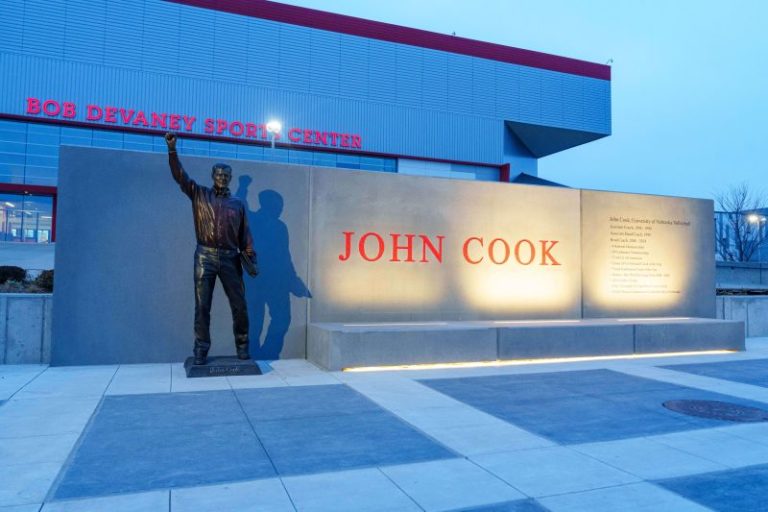
        Nebraska volleyball is so successful, it’s home court at John Cook Arena will be expanded to 10,000 seats ahead of the 2026 season.

        The Nebraska Athletic Fund released renderings and details for the plan earlier this week. The addition of about 2,000 seats also means there will be a ‘comprehensive reseating of season tickets,’ according to the school fundraising site.

        FINAL SCORE: Texas A&M 3, Louisville 2

        Set 5: Texas A&M 3, Louisville 2

        No. 3 Texas A&M completed a reverse sweep against No. 2 Louisville to advance to the regional final for the first time since 2001 after winning the fifth set, 15-12. The Aggies were able to swing the momentum of the game with their blocking ability, led by Ifenna Cos-okpalla’s 12 total blocks.

        Texas A&M’s Logan Lednicky (20 kills, 10 digs on .245 hitting), Kyndal Stowers (16 kills, 11 digs on .282 hitting) and Emily Hellmuth (12 kills on .226 hitting) each recorded double-digit kills.

        ‘We just weren’t finishing the last end of the set,’ said an emotional Lednicky, who was three blocks away from a triple double. ‘We’re like, we’re not letting them sweep us. We know how to grind, we know how to dig it. We saw it in the TCU match and we did just that last one.’

        Tensions boiled over in the fifth set. Louisville head coach Dan Meske earned a yellow card for swatting the ball because he thought the referee missed a carry call during a long rally Texas A&M won to go up 12-10.

        Louisville’s Chloe Chicoine finished with a game-high 26 kills hitting .300 in the loss.

        Set 4: Louisville 2, Texas A&M 2

        No. 3 Texas A&M took a 17-8 lead after holding No. 2 Louisville to a -.143 hitting percentage to start the fourth set with its defensive prowess. The Aggies stretched their lead to as many as nine points, but Louisville went on a 7-1 run to come within three points of Texas A&M. The Aggies didn’t relinquish the lead this time. Texas A&M finished the fourth set on a 4-0 run to force a decisive fifth set.

        Texas A&M held Louisville to .000 hitting in the fourth set. The Aggies hit .267 and recorded nine blocks. Texas A&M’s Logan Lednicky (18 kills on .333 hitting), Kyndal Stowers (14 kills on .243 hitting) and Emily Hellmuth (10 kills on .200 hitting) each have double-digit kills. Ifenna Cos-okpalla is up to 11 blocks.

        The Aggies are going for the reverse sweep, the team’s first since September 2024.

        Set 3: Louisville 2, Texas A&M 1

        No. 3 Texas A&M head coach Jamie Morrison said his team needed to do a better job at finishing at the end of the set if they wanted to extend their season against No. 2 Louisville after giving up leads in the first two sets. The Aggies did just that in a third set that featured 15 ties and five lead changes.

        The Aggies had a 23-21 lead in the third set before Louisville tied it up at 23-23 following back-to-back kills from Chloe Chicoine. Texas A&M’s Kyndal Stowers responded with a pair of kills herself to give the Aggies the set, 25-23.

        Texas A&M’s Logan Lednicky (14 kills on .333 hitting), Kyndal Stowers (11 kills on .259 hitting) and Emily Hellmuth (10 kills on .261) each have double-digit kills as the team is collectively hitting .292.

        Meanwhile, Chicoine is up to 19 kills on .405 hitting. Cara Crease added seven blocks.

        Set 2: Louisville 2, Texas A&M 0

        New set, same scenario. Much like the first set, Texas A&M was the first team to reach 15 points. The Aggies had a 21-16 lead in the second set, before Louisville staged another comeback. The Cardinals went on a 9-1 run to take the lead and clinch the second set, 25-22, to take a 2-0 lead over Texas A&M.

        Louisville capitalized on 14 total blocks and three aces. Chloe Chicoine (11 kills on .400 hitting) and Payton Petersen (10 kills on .563 hitting) led the Cardinals in kills.

        Logan Lednicky has nine kills, while Emily Hellmuth and Kyndal Stowers each have seven kills for Texas A&M.

        Set 1: Louisville 1, Texas A&M 0

        No. 3 Texas A&M had control of the first set and was the first team to 15 points, but No. 2 Louisville went on a 5-0 run to tie it up at 17-17. Five more ties ensued before Louisville ultimately created some separation to take the first set, 25-23. Louisville hit .457 and had two players with six or more kills — Payton Petersen (seven kills on .778 hitting) and Chloe Chicoine (six kills on .600 hitting).

        Louisville starters

        FINAL SCORE: Wisconsin 3, Stanford 1

        Set 4: Wisconsin 25, Stanford 22

        The Badgers had to fight for it, but they moved on after a 3-1 win over Stanford that was sealed with a team block. Wisconsin finished the day hitting .420. Mimi Colyer had a blistering 27 kills on .373 hitting and 10 digs. On the other side of the net, Stanford hit well for most of the match, but slipped to a .242 percentage in the fourth set after maintaining around .400 during the first three sets. The Cardinal had four players who finished with double-digit kills. Elia Rubin led the group with 15 kills and 13 digs.

        Set 3: Wisconsin 25, Stanford 23

        The third set was a back-and-forth battle. There were a whopping nine ties and four lead changes before Wisconsin finally pulled away to go up 2-1. Grace Egan sealed the third set for the Badgers with a timely kill after two set points. Mimi Colyer continues her day of domination with 19 kills on .333 hitting. Carter Booth has also been fantastic for Wisconsin with 13 kills on .813 hitting. Julia Blyashov and Jordyn Harvey both have 10 kills for Stanford.

        Set 2: Stanford: 25, Wisconsin 21

        Stanford was poised with better defense and serving. The Cardinal were tied with the Badgers at 13 before letting off a 12-8 run to take the set. Elia Rubin had the deciding kill after three set points. Stanford hit .484 with three players who had six or more kills, including Rubin, who had a .417 hitting percentage and seven digs. Wisconsin’s Mimi Colyer leads all players with 16 kills on 25 swings and .480 hitting.

        Wisconsin vs. Stanford is a sister-against-sister showdown

        Look across the court, and fans will see a pair of sisters on opposite sides of the court. Wisconsin’s Alicia Andrew and Stanford’s Lizzy Andrew are facing off against each other today in the Sweet 16.

        Set 1: Wisconsin 25, Stanford 17

        Wisconsin hit a blistering .514 in the first set, sealed by a Carter Booth kill. Mimi Colyer led the Badgers with nine kills on 15 swings and a .467 hitting percentage. Lizzy Andrew led the Cardinal, going a perfect three-for-three on kills.

        Wisconsin vs. Stanford is underway

        No. 3 Wisconsin and No. 2 Stanford are in the first set of the second match of day two of the Sweet 16.

        Texas star Cari Spears had her dad in the stands against Indiana

        Former NFL player and ESPN analyst Marcus Spears was in the stands today to watch his daughter, Texas freshman Cari Spears, play.

        FINAL SCORE: Texas 3, Indiana 0

        Set 3: Texas 25, Indiana 22

        Whitney Lauenstein sent Texas to the regional final with a kill to secure the sweep against Indiana. The Longhorns finished with .374 hitting and 23 total blocks. Torrey Stafford was brilliant with 19 kills on 28 swings (with zero errors) and a .679 hitting percentage. Nya Bunton was also critical to the Longhorns’ success with seven kills on .545 hitting and five blocks. Candela Alonso-Corcelles and Jaidyn Jager had 21 combined kills for the Hoosiers.

        Indiana is pushing Texas in Set 3

        The Hoosiers look much more relaxed in the third set as they try to fight off elimination. They are hitting .261 in the frame and have slowed down Texas’s blocks.

        Set 2: Texas 25, Indiana 22

        It took four set points, but Abby Vander Wal again secured the set Texas. The Longhorns have held the Hoosiers to under .200 for the match while maintaining .365 hitting percentage. Torrey Stafford is putting on a clinic from all over the court. Stafford has zero errors on 19 swings, including 15 kills and a .789 hitting percentage. Candela Alonso-Corcelles leads Indiana with seven kills on .125 hitting and six digs.

        Texas’s defense is rolling against Indiana

        The Longhorns have 17 total blocks and have held Indiana to a .088 hitting percentage in the second set and .127 hitting for the match.

        Set 1: Texas 25, Indiana 20

        Texas took the first set after two set points, with Abby Vander Wal landing the deciding point. As a team, Texas hit .323 in the set, compared to .162 for Indiana with nine errors. The Hoosiers had several runs to close the game with the Longhorns, but Texas was too much. Torrey Stafford led all players with six kills on .750 hitting.

        Texas is the first to 15 in Set 1 against Indiana

        The Longhorns reached 15 points behind a huge boost from outside hitter Torrey Stafford, who had five kills and two blocks.

        Indiana vs. Texas is underway

        The Indiana Hoosiers and Texas Longhorns are in the first set of the first match during Day 2 of the Sweet 16.

        NCAA volleyball Sweet 16 continues Friday

        Two No. 1 seeds play on Friday, with Texas playing Indiana in the opener. The top overall seed, Nebraska, puts its unbeaten streak on the line against No. 4 Kansas in the nightcap after opening the tournament with back-to-back sweeps.

        When is NCAA women’s volleyball Sweet 16?

        • Date: Dec. 12
        • Time: Four matches beginning at noon ET Friday. Match-by-match times below.

        How to watch NCAA volleyball tournament

        • Streaming: ESPN+ ∣ Fubo (free trial)

        The 2025 NCAA women’s volleyball tournament will air across the ESPN and ABC family of networks. Games can be streamed ESPN+, ESPN’s subscription streaming service, and Fubo, which offers a free trial to potential subscribers.

        NCAA volleyball Sweet 16 schedule: Times, TV

        All times Eastern

        Thursday, Dec. 11

        • No. 3 Creighton 3, No. 2 Arizona State 1
        • No. 1 Kentucky 3, Cal Poly 0
        • No. 1 Pittsburgh 3, No. 4 Minnesota 0
        • No. 3 Purdue 3, No. 2 SMU 1

        Friday, Dec. 12

        • No. 1 Texas 3, No. 4 Indiana 0
        • No. 3 Wisconsin 3, No. 2 Stanford 1
        • No. 3 Texas A&M 3, No. 2 Louisville 2
        • No. 1 Nebraska vs. No. 4 Kansas, 9:30 p.m. | ESPN2

        Saturday, Dec. 13

        • No. 3 Creighton vs. No. 1 Kentucky, 5 p.m. | ESPN2
        • No. 1 Pittsburgh vs. No. 3 Purdue, 7:30 p.m. | ESPN2

        Sunday, Dec. 14

        • No. 1 Nebraska vs. No. 3 Texas A&M, 3 p.m. | ABC
        • No. 1 Texas vs. No. 3 Wisconsin, 7:30 p.m. | ESPN

        When is the NCAA volleyball Final Four in 2025?

        • Dates: Thursday, Dec. 18 and Sunday, Dec. 21

        The two semifinal matches in the Final Four of the 2025 NCAA volleyball tournament will take place on Thursday, Dec. 18 and will be broadcast on ESPN. The national championship game is Sunday, Dec. 21 on ABC.

        NCAA volleyball second-round results

        Lexington bracket

        • No. 1 Kentucky 3, No. 8 UCLA 1 (30-28, 25-16, 28-30, 25-17)
        • No. 3 Creighton 3, No. 6 Northern Iowa 1 (25-18, 23-25, 25-22, 25-21)
        • No. 2 Arizona State 3, Utah State 1 (25-15, 25-18, 22-25, 25-15)
        • Cal Poly 3, No. 4 USC 2 (25-19, 25-20, 20-25, 14-25, 15-7)

        Austin bracket

        • No. 4 Indiana 3, No. 5 Colorado 0 (25-20, 25-17, 25-23)
        • No. 3 Wisconsin 3, North Carolina 0 (25-14, 25-21, 27-25)
        • No. 1 Texas 1, No. 8 Penn State 0 (25-16, 25-9, 25-19)
        • No. 2 Stanford 3, Arizona 1 (25-16, 25-27, 25-17, 25-20)

        Pittsburgh bracket

        • No. 3 Purdue 3, No. 6 Baylor 1 (25-16, 25-19, 23-25, 25-20)
        • No. 1 Pittsburgh 3, Michigan 0 (25-23, 25-23, 25-18)
        • No. 2 SMU 3, Florida 0 (25-11, 25-21, 26-24)
        • No. 4 Minnesota 3, No. 5 Iowa State 0 (25-22, 25-21, 25-14)

        Lincoln bracket

        • No. 4 Kansas 3, No. 5 Miami 1 (25-17, 25-22, 22-25, 27-25)
        • No. 2 Louisville 3, Marquette 2 (21-25, 25-11, 23-25, 25-19, 15-12)
        • No. 1 Nebraska 3, Kansas State 0 (25-17, 25-21, 25-16)
        • No. 3 Texas A&M 3, No. 6 TCU 1 (23-25, 25-23, 25-22, 29-27)

        NCAA volleyball first-round results

        Lexington bracket

        • No. 1 Kentucky 3, Wofford 0 (25-11, 25-19, 25-12)
        • No. 8 UCLA 3, Georgia Tech 2 (24-26, 25-19, 25-23, 25-18, 15-10)
        • Cal Poly 3, No. 5 BYU 2 (25-19, 17-25, 20-25, 25-20, 15-10)
        • No. 4 USC 3, Princeton 0, (25-19, 25-12, 25-13)
        • No. 3 Creighton 3, Northern Colorado 2 (12-25, 25-23,25-23,17-25, 8-15)
        • No. 6 Northern Iowa 3, Utah 2 (15-25, 21-25, 26-24, 25-20, 15-10)
        • Utah State 3, No. 7 Tennessee 2 (25-19, 25-15, 19-25, 25-18, 15-11)
        • No. 2 Arizona State 3, Coppin State 0 (25-11, 25-14, 25-12)

        Austin bracket

        • No. 1 Texas 3, Florida A&M 0 (25-11, 25- 8, 25-14)
        • No. 8 Penn State 3, South Florida 1 (25-23, 12-25, 25-21, 25-19)
        • No. 5 Colorado 3, American 0 (25-16, 25-19, 25-16)
        • No. 4 Indiana 3, Toledo 0 (25-18, 25-15, 25-17)
        • No. 3 Wisconsin 3, Eastern Illinois 0 (25-11, 25-6, 25-19)
        • North Carolina 3, No. 6 UTEP 1 (24-26, 25-11, 25-18, 25-21)
        • Arizona 3, No. 7 South Dakota State 1 (25-21, 22-25, 25-15, 25-15)
        • No. 2 Stanford 3, Utah Valley 1 (21-25, 25-21, 25-13, 25-14)

        Pittsburgh bracket

        • No. 1 Pitt 3, UMBC 0 (25-10, 25-17, 25-13)
        • Michigan 3, No. 8 Xavier 0 (25-19, 25-15, 25-23)
        • No. 5 Iowa State 3, St. Thomas-Minnesota 2 (21-25, 25-13, 25-16, 21-25, 15-8)
        • No. 4 Minnesota 3, Fairfield 0 (25-12, 25-7, 25-13)
        • No. 3 Purdue 3, Wright State 0 (25-13, 25-21, 25-19)
        • No. 6 Baylor 3, Arkansas State 2 (23-25, 25-20, 30-28, 23-25, 15-10)
        • Florida 3, No. 7 Rice 0 (27-25, 25-23, 25-19)
        • No. 2 SMU 3, Central Arkansas 0 (25-13, 25-13, 25-13)

        Lincoln bracket

        • No. 1 Nebraska 3, Long Island 0 (25-11, 25-15, 25-17)
        • Kansas State 3, San Diego 2 (21-25, 25-17, 26-28, 25-22, 15-12)
        • No. 5 Miami 3, Tulsa 1 (25-22, 13-25, 25-22, 25-20)
        • No. 4 Kansas 3, High Point 0 (25-20, 25-15, 25-18)
        • No. 3 Texas A&M 3, Campbell 0 (25-20, 25-10, 25-13)
        • No. 6 TCU 3, Stephen F. Austin 0 (25-8, 26-24, 25-20)
        • Marquette 3, Western Kentucky 0 (25-22, 25-21, 25-16)
        • No. 2 Louisville 3, Loyola (Illinois) 0 (25-17, 25-9, 25-12)

        NCAA volleyball tournament champions

        Penn State is the reigning NCAA volleyball champion, having defeated Louisville in four sets last year in the national title game. It was the Nittany Lions’ eighth volleyball championship since 1999.

        Here’s a look at the past 10 NCAA volleyball champions:

        • 2024: Penn State
        • 2023: Texas
        • 2022: Texas
        • 2021: Wisconsin
        • 2020: Kentucky
        • 2019: Stanford
        • 2018: Stanford
        • 2017: Nebraska
        • 2016: Stanford
        • 2015: Nebraska

        The USA TODAY app gets you to the heart of the news — fastDownload for award-winning coverage, crosswords, audio storytelling, the eNewspaper and more.

        This post appeared first on USA TODAY

        Nebraska volleyball is so successful, its home court at John Cook Arena will be expanded to 10,000 seats ahead of the 2026 season.

        The Nebraska Athletic Fund released renderings and details for the plan earlier this week. The addition of about 2,000 seats also means there will be a ‘comprehensive reseating of season tickets,’ according to the school fundraising site.

        ‘To ensure Nebraska Volleyball remains a leader both on and off the court, we are taking proactive steps to strengthen our foundation. The expansion of John Cook Arena in the Bob Devaney Sports Center to over 10,000 seats will allow us to continue to grow the game and give more fans the opportunity to experience Nebraska Volleyball,’ the Nebraska Athletic Fund website reads. ‘We must embrace the evolution of intercollegiate athletics and find ways to preserve our financial model.’

        Some of the upgrades listed on the website for the expanded arena include:

        • New and improved seats with cupholders in each seat.
        • New centralized student section to enhance the impact of crowd noise on opponents.
        • New and improved seating courtside, in a new loge box and the Libero Club, which will replace VIP seats in the back row of the 100 level.
        • Additional ADA seating with new vantage points and easier access from around the concourse.

        Nebraska volleyball is wildly popular and entered the 2025 NCAA women’s volleyball tournament as the No. 1 overall seed. After sweeping its opponents in the first two rounds, Nebraska faced Kansas in Friday’s Sweet 16.

        This post appeared first on USA TODAY

        Austin Reaves is expected to miss at least a week for the Los Angeles Lakers due to injury.

        The injury comes at a bad time for the Lakers, who were finally able to field a healthy starting lineup.

        Luka Dončić had missed time earlier in the season, and LeBron James had just made his season debut against the Utah Jazz on Nov. 18.

        Reaves managed to step up for the Lakers during the absence of their two superstars. He scored 51 points against the Sacramento Kings and 41 against the Portland Trailblazers on back-to-back nights in October. He has continued to produce at a high level offensively, scoring 44 against the Toronto Raptors and 36 against the Boston Celtics on back-to-back nights last week.

        Austin Reaves injury update

        The guard was diagnosed with a mild left calf strain and is expected to be re-evaluated in approximately one week.

        The Lakers will play three games next week: Sunday, Dec. 14 at the Phoenix Suns; Thursday, Dec. 18 at the Utah Jazz; Saturday, Dec. 20 at the Los Angeles Clippers. Reaves is expected to miss the first two, at least.

        Reaves is the latest NBA player to suffer from a calf injury. San Antonio Spurs star Victor Wembanyama has also missed time this season because of a calf strain.

        Who is Austin Reaves backup? Lakers’ depth chart

        Marcus Smart is a strong possibility to fill in for Reaves. Smart has averaged 10.4 points, 2.8 assists and 2.3 rebounds per game in 15 games played this season.

        Austin Reaves stats

        Reaves has averaged career-highs in points (27.8), assists (6.7) and rebounds (5.6) in 21 games played this season.

        When do the Lakers play next?

        The Lakers will travel to play the Phoenix Suns at 8 p.m. ET (5 p.m. PT) on Sunday.

        This post appeared first on USA TODAY
        Standard Uranium Ltd. (TSXV: STND,OTC:STTDF) (OTCQB: STTDF) (FSE: 9SU0) (‘Standard Uranium’ or the ‘Company’) announces the conclusion, effective December 11, 2025, of an arm’s length property option agreement (the ‘Agreement’) with Aero Energy Ltd. (‘Aero’) dated October 20, 2023, that had allowed Aero to earn up to 100% interest in the Sun Dog Project (‘Sun Dog’, or the ‘Project’). Following the conclusion of the Agreement, full and unencumbered ownership of the Project has been returned to the Company. Standard Uranium is currently working on plans to advance exploration on Sun Dog, building upon recent drilling and geophysical programs in 2024 and 2025.

        Sun Dog covers an area of 48,443 acres (19,604 ha) across nine mineral claims and is located 15 km Southeast of Uranium City on the northern margin of the Athabasca Basin (Figure 1). It hosts the historical Gunnar Uranium Mine, discovered in 1952, which doubled Canada’s uranium production and became the largest uranium producer globally in 1956. The Gunnar Mine produced approximately 18M lbs of U3O8 between 1953 and 19811,2.

        Jon Bey, CEO & Director of Standard Uranium, commented, ‘Sun Dog is a fantastic project that continues to garner a great deal of interest from multiple companies. We are excited to have the Sun Dog project returned to our portfolio and confident that we will have another joint venture partner funding further exploration in the next year. I would also like to wish the team at Aero Energy future success as they focus their sites on their other uranium projects in Canada and the USA. They were a great partner to work with the past two years.’

        Figure 1. Overview of the Sun Dog Project highlighting drill target areas, historical high-grade* uranium occurrences3, and EM-conductors4.

        To view an enhanced version of this graphic, please visit:
        https://images.newsfilecorp.com/files/10633/277772_82df2fcd64d3c957_001full.jpg

        Sun Dog Highlights

        • History of Production: The project hosts the historical Gunnar Mine which produced 18M pounds of U3O8 between 1953 and 1981 and was formerly the world’s largest uranium producer1,2.

        • Uranium Above and Below the Unconformity: Numerous recent and historical high-grade* uranium assays from outcrop samples across the Project range from 0.01% to 17.4% U3O83,4. These showings occur in both basement rocks below the Unconformity and perched within Athabasca sandstones above the Unconformity thus confirming the presence of unconformity-related high-grade uranium on the Sun Dog Project.

        • Verified Targets: Stacked graphitic structural zones associated with uranium mineralization and prospective hydrothermal alteration have been intersected in multiple target areas during modern drill programs. The drill program results to date confirm a favorable geological environment for fluid movement and uranium deposition on the Project.

        Modern Exploration

        Recent exploration efforts by Standard Uranium have focused on multiple target areas across the Project, testing down-dip extensions of structures hosting uranium at surface with the aim of discovering high-grade unconformity mineralization and basement ‘roots’ of the mineralizing systems underlying the Athabasca sandstones.

        Prospecting & Surface Exploration

        Prospecting in 2020 led to the discovery of a new high-grade uranium showing named the Haven discovery and several zones of visible uranium mineralization at surface that returned uranium assay results of 3.58% U3O8, 1.7% U3O8, and 0.7% U3O8.5

        In the summer of 2022, Standard Uranium executed a field mapping and prospecting program to expand upon the results of the 2020 prospecting program. Handheld RS-120 and RS-125 scintillometers were used to track radioactivity with more than 80 new mineralized boulder and bedrock locations discovered on Johnston and Stewart islands.

        In 2024, occurrences of strong to intense radioactivity in outcropping basement rocks were identified at surface while prospecting at the Wishbone and Spring-Dome target areas, returning highly anomalous assays ranging from 0.02% to 13.0% U3O8.6

        Additionally, the analytical results revealed a correlation between uranium and gold, while boron and other pathfinder elements highlighted the potential for a robust alteration footprint associated with uranium mineralization. Surficial grab samples from faults and veins cutting sandstone outcrop returned high concentrations of dravite (up to 75%), a uranium pathfinder mineral commonly associated with uranium-fertile systems.

        Geophysical Surveys

        In the winter of 2022, MWH Geo-Surveys Ltd. carried out a ground gravity survey and UAV-borne magnetic surveys in the areas of Johnston and Stewart islands on behalf of Standard Uranium. The gravity survey consisted of 3,388 unique gravity measurement stations with a station spacing of 50 to 100 m. The survey identified several variations in residual gravity and outlined multiple gravity low target areas on and around Stewart and Johnston islands.

        An airborne VTEMTM Plus survey was completed in 2024 to pinpoint graphitic rocks (conductors) favourable for hosting significant concentrations of uranium. This modern electromagnetic (‘EM’) survey improved upon historical surveys which have identified at least 40 km of combined conductor strike length.

        In 2025, MWH Geo-Surveys Ltd. completed high-resolution ground gravity surveys along known conductive exploration trends across the Wishbone, McNie, and Armbruster South target areas, filling in the gaps between the previous 2022 gravity grids (Figure 2). These surveys have identified numerous density-low bullseye anomalies representing potential zones of hydrothermal alteration or structural disruption which are commonly associated with uranium mineralization events.

        Figure 2. 2025 ground gravity survey areas covering the Armbruster South, Wishbone, and McNie EM conductor trends. Density-low anomalies representing potential alteration zones are highlighted by cool colours on the inverted gravity grids.

        To view an enhanced version of this graphic, please visit:
        https://images.newsfilecorp.com/files/10633/277772_82df2fcd64d3c957_002full.jpg

        Drill Programs

        Standard Uranium carried out two drill programs on the Project during the winters of 2022 and 2023, in addition to operating a program in 2024 funded by Aero. In total, 4,062 m of diamond drilling has been completed by the Company across 21 drill holes on the Project.

        Historical exploration efforts primarily focused on the ‘Beaverlodge-style’ deposit model, targeting lower-grade, fault-hosted mineralization visible at the surface. This approach did not target, and would not have been effective for, the high-grade ‘Unconformity-related’ basement-hosted deposits associated with graphitic rocks more recently discovered near the Athabasca Basin’s edge (e.g. Arrow, Triple R).

        Recent diamond drill programs have been successful in identifying key geological characteristics prospective for significant uranium mineralizing systems on the Project, which in turn will aid in planning and prioritization of additional exploration targets for follow-up drill programs.

        Drilling highlights include3,8:

        • Widespread hydrothermal alteration zones containing illite-rich and dravitic clays and abundant iron-oxide minerals intersected in multiple drill holes, indicating a robust fluid system with prospective chemistry for uranium.

        • Significant structural influence evidenced to control high-grade uranium mineralization and anomalous radioactivity in drill holes.

        • Reactivated graphitic shear zones & quartz-hematite breccias intersected over 10s of metres in several drill holes indicate ideal structural regime providing the plumbing system for uranium mobilization.

        • Favorable geochemistry returned in multiple drill holes, including prospective clay spectroscopy results (dravite), elevated pathfinder elements, and anomalous uranium correlated to lead isotope ratios which may be used as an additional exploration vector.

        • Uranium mineralization confirmed by anomalous uranium assays was intersected in multiple drill holes, coinciding with prospective structure and favorable alteration.

        Qualified Person Statement

        The scientific and technical information contained in this news release has been reviewed, verified, and approved by Sean Hillacre, P.Geo., President and VP Exploration of the Company and a ‘qualified person’ as defined in NI 43-101 – Standards of Disclosure for Mineral Projects.

        Samples collected for analysis by the Company were sent to SRC Geoanalytical Laboratories in Saskatoon, Saskatchewan for preparation, processing, and ICP-MS multi-element analysis using total and partial digestion, gold by fire assay, and boron by fusion. Basement samples were tested with ICP-MS2 uranium multi-element exploration package plus boron. All basement samples marked as radioactive upon arrival to the lab were also analyzed using the U3O8 assay (reported in wt %). Basement rock split interval samples range from 0.1 to 0.5 m. SRC is an ISO/IEC 17025:2005 and Standards Council of Canada certified analytical laboratory. Blanks, standard reference materials, and repeats were inserted into the sample stream at regular intervals in accordance with Standard Uranium’s quality assurance/quality control (QA/QC) protocols. All samples passed internal QA/QC protocols, and the results presented in this release are deemed complete, reliable, and repeatable.

        Samples containing clay alteration were sent to Rekasa Rocks Inc. in Saskatoon, Saskatchewan to be analyzed by Short Wavelength Infrared Reflectance (‘SWIR‘) via a Portable Infrared Mineral Analyzer (‘PIMA‘) to verify clay species. All depth measurements reported are down-hole measurements and true thicknesses are yet to be determined.

        Historical data disclosed in this news release relating to sampling results from previous operators are historical in nature. Neither the Company nor a qualified person has yet verified this data and therefore investors should not place undue reliance on such data. The Company’s future exploration work may include verification of the data. The Company considers historical results to be relevant as an exploration guide and to assess the mineralization as well as economic potential of exploration projects. Any historical grab samples disclosed are selected samples and may not represent true underlying mineralization.

        Natural gamma radiation from rocks reported in this news release was measured in counts per second (‘cps’) using a handheld RS-125 super-spectrometer and RS-120 super-scintillometer. Readers are cautioned that scintillometer readings are not uniformly or directly related to uranium grades of the rock sample measured and should be treated only as a preliminary indication of the presence of radioactive minerals. The RS-125 and RS-120 units supplied by Radiation Solutions Inc. (‘RSI‘) have been calibrated on specially designed Test Pads by RSI. Standard Uranium maintains an internal QA/QC procedure for calibration and calculation of drift in radioactivity readings through three test pads containing known concentrations of radioactive minerals. Internal test pad radioactivity readings are known and regularly compared to readings measured by the handheld scintillometers for QA/QC purposes.

        References

        1. Gunnar Uranium Mine: From Cold War Darling to Ghost Town, L. Schramm, Saskatchewan Research Council, 2018.
        2. Geology and Genesis of Major World Hardrock Uranium Deposits, United States Geological Survey, Open-File Report 81-166, 1981.
        3. Technical Report on the Sun Dog Property – Northwestern Saskatchewan, Canada, Effective date June 30, 2023
        4. Information obtained from Saskatchewan Mineral Deposit Index and historical report from Uranium City Resources, 2007

        *The Company considers uranium mineralization with concentrations greater than 1.0 wt% U3O8 to be ‘high-grade’.

        **The Company considers radioactivity readings greater than 65,535 counts per second (cps) on a handheld RS-125 Super-Spectrometer to be ‘off-scale’.

        ***The Company considers radioactivity readings greater than 300 counts per second (cps) on a handheld RS-125 Super-Spectrometer to be ‘anomalous’.

        About Standard Uranium (TSXV: STND,OTC:STTDF)

        We find the fuel to power a clean energy future

        Standard Uranium is a uranium exploration company and emerging project generator poised for discovery in the world’s richest uranium district. The Company holds interest in over 235,435 acres (95,277 hectares) in the world-class Athabasca Basin in Saskatchewan, Canada. Since its establishment, Standard Uranium has focused on the identification, acquisition, and exploration of Athabasca-style uranium targets with a view to discovery and future development.

        Standard Uranium’s Davidson River Project, in the southwest part of the Athabasca Basin, Saskatchewan, comprises ten mineral claims over 30,737 hectares. Davidson River is highly prospective for basement-hosted uranium deposits due to its location along trend from recent high-grade uranium discoveries. However, owing to the large project size with multiple targets, it remains broadly under-tested by drilling. Recent intersections of wide, structurally deformed and strongly altered shear zones provide significant confidence in the exploration model and future success is expected.

        Standard Uranium’s eastern Athabasca projects comprise over 43,185 hectares of prospective land holdings. The eastern basin projects are highly prospective for unconformity related and/or basement hosted uranium deposits based on historical uranium occurrences, recently identified geophysical anomalies, and location along trend from several high-grade uranium discoveries.

        Standard Uranium’s Sun Dog project, in the northwest part of the Athabasca Basin, Saskatchewan, is comprised of nine mineral claims over 19,603 hectares. The Sun Dog project is highly prospective for basement and unconformity hosted uranium deposits yet remains largely untested by sufficient drilling despite its location proximal to uranium discoveries in the area.

        For further information contact:

        Jon Bey, Chief Executive Officer, and Chairman
        Suite 3123, 595 Burrard Street
        Vancouver, British Columbia, V7X 1J1

        Tel: 1 (306) 850-6699
        E-mail: info@standarduranium.ca

        Cautionary Statement Regarding Forward-Looking Statements

        This news release contains ‘forward-looking statements’ or ‘forward-looking information’ (collectively, ‘forward-looking statements’) within the meaning of applicable securities legislation. All statements, other than statements of historical fact, are forward-looking statements and are based on expectations, estimates and projections as of the date of this news release. Forward-looking statements include, but are not limited to, statements regarding: the timing and content of upcoming work programs; geological interpretations; timing of the Company’s exploration programs; and estimates of market conditions.

        Forward-looking statements are subject to a variety of known and unknown risks, uncertainties and other factors that could cause actual events or results to differ from those expressed or implied by forward-looking statements contained herein. There can be no assurance that such statements will prove to be accurate, as actual results and future events could differ materially from those anticipated in such statements. Certain important factors that could cause actual results, performance or achievements to differ materially from those in the forward-looking statements are highlighted in the ‘Risks and Uncertainties’ in the Company’s management discussion and analysis for the fiscal year ended April 30, 2025.

        Forward-looking statements are based upon a number of estimates and assumptions that, while considered reasonable by the Company at this time, are inherently subject to significant business, economic and competitive uncertainties and contingencies that may cause the Company’s actual financial results, performance, or achievements to be materially different from those expressed or implied herein. Some of the material factors or assumptions used to develop forward-looking statements include, without limitation: that the transaction with the Optionee will proceed as planned; the future price of uranium; anticipated costs and the Company’s ability to raise additional capital if and when necessary; volatility in the market price of the Company’s securities; future sales of the Company’s securities; the Company’s ability to carry on exploration and development activities; the success of exploration, development and operations activities; the timing and results of drilling programs; the discovery of mineral resources on the Company’s mineral properties; the costs of operating and exploration expenditures; the presence of laws and regulations that may impose restrictions on mining; employee relations; relationships with and claims by local communities and indigenous populations; availability of increasing costs associated with mining inputs and labour; the speculative nature of mineral exploration and development (including the risks of obtaining necessary licenses, permits and approvals from government authorities); uncertainties related to title to mineral properties; assessments by taxation authorities; fluctuations in general macroeconomic conditions.

        The forward-looking statements contained in this news release are expressly qualified by this cautionary statement. Any forward-looking statements and the assumptions made with respect thereto are made as of the date of this news release and, accordingly, are subject to change after such date. The Company disclaims any obligation to update any forward-looking statements, whether as a result of new information, future events or otherwise, except as may be required by applicable securities laws. There can be no assurance that forward-looking statements will prove to be accurate, as actual results and future events could differ materially from those anticipated in such statements. Accordingly, readers should not place undue reliance on forward-looking statements.

        Neither the TSX-V nor its Regulation Services Provider (as that term is defined in the policies of the TSX-V) accepts responsibility for the adequacy or accuracy of this release.

        To view the source version of this press release, please visit https://www.newsfilecorp.com/release/277772

        News Provided by Newsfile via QuoteMedia

        This post appeared first on investingnews.com

        Apex Resources Inc. (TSXV: APX,OTC:SLMLF) (OTCID: SLMLF) (‘Apex’ or the ‘Company’) announces the appointment of Michael Malana as Chief Financial Officer (‘CFO’) of the Company, effective today, following the resignation of Dennis Cojuco as the Company’s CFO.

        Mr. Malana brings more than 20 years of international experience in financial management, financial reporting and general corporate governance. He has held senior financial executive roles across the natural resources, biotechnology, and manufacturing sectors. Mr. Malana holds a Bachelor of Commerce from Concordia University and is a Chartered Professional Accountant (Certified Management Accountant).

        The Board, management, and extended Apex team extend their sincere thanks to Mr. Cojuco for his exemplary service and dedication and contribution to the company.

        Clarification on the Amended Lithium Creek Project Option Agreement

        The Company also wishes to clarify that the exploration and development expenditures due to be completed on or before August 25, 2026, in its news release dated October 27, 2025, increased from $1,000,000 (instead of $1,200,000) to $1,266,000.

        About Apex Resources Inc.

        Apex is a Vancouver-based exploration company with a suite of precious and critical minerals projects and historic mines located in the United States and Canada.

        The Lithium Creek Project is Apex’s flagship project with placer claims covering hundreds of square miles within the aerially extensive Fernley, Humboldt, and Carson Sinks, and includes widespread naturally flowing lithium brine groundwater. The Lithium Creek Project is strategically located near the City of Reno and within 40 minutes of the principle North American battery hub, hosting the Tesla Gigafactory and other key industry players in the Lithium Ion battery supply chain.

        The Jersey-Emerald Property is wholly owned by Apex and encompasses the historic Jersey Lead-Zinc Mine – British Columbia’s second largest historic zinc mine, and the Emerald Tungsten Mine – Canada’s second largest historic tungsten mine, both located in southern British Columbia.

        On Behalf of the Board of Directors of

        Apex Resources Inc.

        Ron Lang
        President and CEO
        info@apxresources.com website: www.apexresources.com

        Neither TSX Venture Exchange nor its Regulation Services Provider (as that term in defined in the policies of the TSX Venture Exchange) accepts responsibility for the adequacy or accuracy of this press release.

        To view the source version of this press release, please visit https://www.newsfilecorp.com/release/277830

        News Provided by Newsfile via QuoteMedia

        This post appeared first on investingnews.com

        Ground radiometrics, soil geochemistry and mapping reinforce the potential for a Rossing-style system beneath shallow cover

        ReeXploration Inc. (TSXV: REE) (FSE: K2I0) (‘ReeXploration’ or the ‘Company’) is pleased to announce results from its uranium field program, which provide strong support for the scale and technical validity of the previously-announced uranium target at the Eureka Project in Namibia. The Company believes the target has the potential to represent a large, under-cover Rössing-style uranium system. A drill program is planned for early 2026 to provide initial testing of the target.

        HIGHLIGHTS:

        • Strong correlation between airborne and ground uranium signatures strengthens confidence in continuity of target
          • Areas of very high total gamma readings, including zones above 1,500 counts per second (‘cps’), identified above interpreted leucogranites
        • Soil geochemistry confirms the radiometric signal is uranium-bearing
          • Uranium-rich soils mapped with values up to 114 ppm U (pXRF)
        • Mapping highlights key indicators consistent with Rössing-style uranium systems
          • Favourable rock types and grab samples up to 853 ppm U (pXRF) provide encouraging indicators of a uranium-bearing system below cover
        • Evidence points to a large, cohesive uranium system
          • Geological setting and signature show strong similarity with known Namibian uranium systems (Rössing, Omaholo and Etango) when compared at equal scale
        • Drill program planned to test Rössing-style model
          • Program aims to provide initial testing of the large-scale target

        Christopher Drysdale, Interim CEO for ReeXploration, added, ‘This field program has materially advanced our understanding of the uranium target at Eureka. The strong alignment between airborne radiometrics, ground radiometrics, geology and soil geochemistry provides exactly the type of multi-layered confirmation you want to see before drilling. Namibia is one of the world’s most important uranium jurisdictions, and Eureka lies in the same structural corridor that hosts Rössing, Husab, Etango, Omaholo and Norasa. The scale of this anomaly, and the quality of the early technical indicators, point to a meaningful discovery opportunity.’

        Field Program Results

        Four grids across the broad airborne uranium anomalies southwest of the Eureka Dome were defined for follow-up ground investigation (Figure 1). A ground spectrometer survey and soil sampling program were executed by the Company across the four grids. The objectives included obtaining a greater understanding of the nature, cause and extent of the anomalies, and identifying any highly anomalous areas.

        Figure 1: Grids 1 to 4 covering the airborne uranium radiometric anomalies.

        To view an enhanced version of this graphic, please visit:
        https://images.newsfilecorp.com/files/6102/277795_8e4d6f7a54a09b55_001full.jpg

        Ground Spectrometer Survey

        A total of 102-line kilometers of ground spectrometer survey was completed across the four grids, with survey lines running east-west and spaced 100 m apart. Overall, a very good correlation was achieved with the airborne radiometric uranium anomalies. The ground surveying highlighted areas of very high anomalism with values up to 2,255 cps. Low radioactivity corresponds with more massive calc-silicate exposure, covered areas, and drainage sediments, whereas high radioactivity corresponds with gypcretes/calcretes overlying leucogranite. Secondary uranium (carnotite) was found in the overburden (sand/sheetwash), as well as in in-situ leucogranite and schist. Sand cover increases to south attenuating radioactive signal (Figure 2).

        Figure 2: Ground spectrometer survey completed across the four grids.

        To view an enhanced version of this graphic, please visit:
        https://images.newsfilecorp.com/files/6102/277795_8e4d6f7a54a09b55_002full.jpg

        The field spectrometer survey has confirmed the regional scale of the airborne radiometric uranium anomalies. The anomalies relate to widespread uranium mineralization occurring within thin overburden, which is best visible where drainages have incised a regionally occurring gypcrete/calcrete horizon with anomalous values ranging from 300 to 1,500 cps (Figure 3).

        Figure 3: Mineralized leucogranite and gypcrete/calcrete found during reconnaissance field work and the ground spectrometer survey.

        To view an enhanced version of this graphic, please visit:
        https://images.newsfilecorp.com/files/6102/277795_8e4d6f7a54a09b55_003full.jpg

        Soil Sampling pXRF Results

        A total of 1,040 soil samples were collected across the four grids at 100 x 100 m spacing and analyzed with the Company’s portable XRF. High uranium in soils are evident where secondary uranium (carnotite) was found in gypcrete / calcretes primarily along drainages (Figure 4).

        Figure 4: Uranium in soil pXRF results from the soil sampling campaign.

        To view an enhanced version of this graphic, please visit:
        https://images.newsfilecorp.com/files/6102/277795_8e4d6f7a54a09b55_004full.jpg

        Initial Drill Target Areas

        Six initial drill target areas have been identified based on coincident; 1) airborne uranium radiometric anomalies, 2) high total gamma (>500 cps) from ground spectrometer survey, 3) uranium in soils (>10 ppm pXRF), and 4) zones of interpreted leucogranites in contact with reactive calc-silicate rocks (Figure 5). The target areas include occurrences of visible secondary uranium mineralization identified within leucogranites and gypcretes/calcretes.

        Figure 5: Initial drill target areas.

        To view an enhanced version of this graphic, please visit:
        https://images.newsfilecorp.com/files/6102/277795_8e4d6f7a54a09b55_005full.jpg

        Next Steps: Diamond Drilling Expected to Commence Early 2026

        ReeXploration is in the final stages of contractor selection and anticipates mobilizing in early 2026 for a 2,000-metre inaugural diamond drilling program. The program is designed to test for primary uranium mineralization within the leucogranites (Rössing-style model) beneath the weathering profile. Drilling is expected to comprise a series of heel-to-toe drill fences across priority target areas. The initial program is planned to consist of approximately ten holes averaging 200 metres in length. A detailed drilling schedule will be released once mobilization dates are confirmed, and the program remains subject to financing.

        Technical Disclosure

        Field analysis of rock and soil samples was carried out using a calibrated SciAps X-555 portable X-Ray Fluorescence (pXRF) analyzer. The instrument is capable of detecting uranium providing a rapid, preliminary, and semi-quantitative indication of uranium concentrations which is considered sufficiently reliable for initial reporting of initial field reconnaissance results. Select samples are expected to be verified through uranium assay at an accredited laboratory.

        Counts per second (‘cps’) results were collected using an RS-125 handheld gamma-ray spectrometer. The RS-125 measures natural radioactivity from potassium (K), uranium (U), and thorium (Th), providing real-time counts-per-second (cps) readings that assist in identifying zones of elevated radioactivity and guiding geological mapping and sampling programs. The cps measurements are qualitative in nature and should not be interpreted as equivalent to uranium concentrations obtained through laboratory analysis.

        Qualified Person

        Tolene Kruger, BSc. (Hons), M.Sc., is a consulting geologist and has reviewed and approved the scientific and technical information in this news release. Mrs. Kruger is registered as Professional Natural Scientist (Pr.Sci.Nat.) with the South African Council for Natural Science Professions (SACNASP, Reg. No.: 148182), and a Qualified Person for the purposes of National Instrument 43-101 – Standards of Disclosure for Mineral Projects.

        About ReeXploration Inc.

        ReeXploration (TSXV: REE) (FSE: K2I0) is a Canadian exploration company positioned to help meet surging global demand for secure, responsible supplies of critical minerals essential to the clean energy transition, advanced technologies and national defense. The Company’s flagship Eureka Project in central Namibia pairs a technically proven rare earth foundation – supported by the production of a clean, Western-standard monazite concentrate – with a newly defined, high-priority uranium target located within one of the world’s most established uranium corridors. Together, these commodities provide multi-path discovery potential aligned with accelerating global efforts to diversify critical mineral and nuclear fuel supply. Supported by a Namibia-based technical team and guided by global critical minerals experts, ReeXploration is advancing a disciplined, discovery-led strategy, building a credible, ESG-aligned platform positioned to benefit from the global race to diversify and secure responsible supply chains.

        Caution Regarding Forward-Looking Information

        This press release may contain forward-looking information. This information is based on current expectations and assumptions (including assumptions relating to general economic and market conditions) that are subject to significant risks and uncertainties that are difficult to predict. Actual results may differ materially from results suggested in any forward-looking information. Exploration does not assume any obligation to update forward-looking information in this release, or to update the reasons why actual results could differ from those reflected in the forward-looking information unless and until required by securities laws applicable to ReeXploration. Additional information identifying risks and uncertainties is contained in the filings made by ReeXploration with Canadian securities regulators, which filings are available at www.sedarplus.ca.

        Neither the TSX Venture Exchange nor its Regulation Services Provider (as that term is defined in policies of the TSX Venture Exchange) accepts responsibility for the adequacy or accuracy of this release.

        Further details are available on the Corporation’s website at www.rareearthexploration.com or contact Christopher Drysdale, Interim CEO of ReeXploration Inc., at +1 902-334-1949, contact@rareearthexploration.com.

        To view the source version of this press release, please visit https://www.newsfilecorp.com/release/277795

        News Provided by Newsfile via QuoteMedia

        This post appeared first on investingnews.com