Author

admin

Browsing

While the fate of college sports was being discussed at the White House with the biggest and best of sports and politics, the silent partner of the free-spending, free-falling framework was all but ignoring it. 

ESPN, Fox, NBC and CBS — who combined to throw more than two billion dollars annually at college sports — were more interested in televising the NFL, college basketball, and talk and reality shows. 

Don’t mess with Judge Judy, people. 

Then again, what played out in Washington D.C. wasn’t much different from Judy’s reality show.

In between ideas (some good) from various participants, President Donald Trump — who, to his credit, somehow got all of these iconic individuals together — rambled on about “going back to the old way.”

“I’d like to go exactly back to what we had, and ram it through a court,” Trump said.  

Excuse me, Mr. President? That’s what got us here in the first place. 

It didn’t take long for the two-hour event to devolve into an airing of grievances, an opportunity for those 50-plus at the table to have their moment and their say. Until, that is, Trump had heard enough. 

Right on cue, it became his show again.

He’s issuing a second executive order (the first accomplished nothing), one he says will return college sports to “common sense, and let colleges and players survive and everyone will be happy.”

Says the order will be done in a week, and that it may not hold up in court, but that, “you’re not going to get anything through (Congress).”

And with that, the most powerful man in the free world decided to punt.

Look, I don’t blame him. This thing is an unwieldy mess, and will get zero help from the only body on the planet that’s more tribally dysfunctional than the NCAA: Congress.  

So let’s start with the non-negotiable of the process: No change in college sports begins without some form of antitrust protection for universities. 

Which, of course, is like saying you want to protect the fox while he guards the hen house.

These universities have spent the past five years whining and complaining about a system they built, proclaiming over and over it’s unsustainable. Yet the damn thing keeps printing money. Lots of it. 

But there has to be a starting point, so maybe this is it. Maybe, as Yankees president Randy Levine said, it begins with a two-year antitrust exemption to see if universities can implement an agreement. Or if they screw it up.

If it’s the latter, the whole process begins again from Step 1. 

An antitrust exemption is incredibly university-friendly, allowing those with the money to set rules for those without. Or in this case for players, about 20% of it. 

If universities receive the antitrust exemption, the first thing implemented is a return to restricting player movement. (That voice you just heard was Trump announcing, “Go back to the wonderful system.”) 

SEC commissioner Greg Sankey says his conference wants one free transfer, and that’s it. You know, the old days.

Because free player movement, they insist, leads to structural and financial instability. Leads to an unwinding of the critical thread that makes college sports different and unique from the NFL. Like that matters now.

Forget that the ‘old days’ were awful for players, the financial equivalent of traversing a long, lonely desert — only to have someone eventually offer you a box of cotton balls to quench your thirst. 

Which brings us to former coach Urban Meyer, he of the spotless reputation (both at Florida and Ohio State, and one disastrous year in the NFL). His gift to the day: “Get rid of collectives. That’s cheating!”

Cheating. Imagine that. 

He then tried to explain the machinations of collectives and their cash is king mantra to Trump. Insert your joke here. 

It’s all just so rich.

And speaking of money, very little was said about Cody Campbell’s idea to use the Sports Broadcasting Act of 1961, and allow conferences to pool their media rights and make more money — so everyone can share the wealth. 

The SEC and Big Ten don’t want to pool television media rights, and they certainly don’t want a billionaire businessman — who just so happens to be the president of the Texas Tech Board of Regents — telling them how to financially structure their swindle. I mean, their system.

Early in the meeting, before it was every man and woman for themselves, a football coach said the most important thing of all. Not surprising that it was Alabama legend Nick Saban, who grew up in hardscrabble Monongah, W.V. 

Saban’s dad, Big Nick, once took Saban to the coal mines after Little Nick lost his way one specific day as a teenager. 

Get an education, Big Nick said with a threatening tone, or you’ll end up here. 

Saban began his time at the Trump event by saying he’s just a football coach, and that he’s honored to be in the same room with everyone. Shoot, his big dilemma was always finding an answer to third-and-long.

Then he said it, the most pointed thing of the entire two-hour ordeal. 

“What are the guiding principles for college athletics?” Saban said. “My goal as a coach was to help (players) create value for themselves in life, and prepare them for a future beyond athletics.”

Oh, wait, the players. Yeah, those at the center of this quagmire weren’t invited to the event. Why would they?

They currently have the law (and free player movement) on their side, thanks to a federal judge in ― wait for it ― West Virginia.

No need to punt on third-and-long.

This post appeared first on USA TODAY

Vladimir Guerrero Jr. brought the jacket. Junior Caminero supplied the trot.

And collectively, the Dominican Republic served notice it will be an irrepressible, sartorially smashing presence in the World Baseball Classic.

Given an early scare by Dusty Baker’s heavy underdog Nicaragua squad, the Dominicans charged up loanDepot Park in Miami when Caminero put a charge into a Stiven Cruz changeup – it came off his bat at 111.6 mph – and broke open a tie game with a two-run, sixth-inning home run.

And in what seemed like a blink, a 3-3 nailbiter became a 12-3 Dominican Republic Pool D party.

Well, maybe it wasn’t a blink. Caminero’s trip around the bases took plenty of time. But oh, what a journey it was.

As his line drive cleared the fence just to the right of dead center field, the highly partisan crowd of 35,127 roared. Still sprinting before he knew it was gone, Caminero, chain flapping, lost his helmet as he reached second base. And then he soaked up every last roar from the crowd before greeting third base coach Carlos Febles.

And finally, he meandered down the third base line before unleashing an epic handshake/dance move with veteran Manny Machado.

After all that, it was time to greet the receiving line. The giddy D.R. populated the apron outside their third base dugout, relief palpable and joy unbridled. And there was Guerrero, reprising the home run jacket he helped popularize in the Toronto Blue Jays dugout.

This one, blinged out quite nicely, celebrated not La Gente Del Barrio but rather the members of the Dominican squad, from Niño to Soto to J-Rod to La Tormenta – the perfect storm of a nickname, if you will.

The jacket suddenly was in high demand: Julio Rodríguez and Oneil Cruz crushed home runs two innings later, Cruz’s a three-run shot that made it a laugher.

Not a bad outcome for a club that faced 1-0 and 3-1 deficits early on, with Nicaragua chasing ace Cristopher Sanchez after he recorded just four outs.

Yet this lineup is both devastating and undaunted. Few epitomize that quite so well as Caminero, who as a Tampa Bay Ray hammered 45 home runs as a 21-year-old last year. His prelude to that season: An epic 454-foot home run and a trip around the bases to match as he lifted Licey to the Dominican’s winter ball championship.

Some raised eyebrows greeted Caminero when he reported for big league camp. Yet 45 home runs later, he showed he’s certainly earned the right to pimp it a little bit.

And in his World Baseball Classic debut, he showed the Dominicans will be hard to handle – and even harder to miss.

This post appeared first on USA TODAY

Listen up, flyers: United Airlines said it will start removing passengers from flights who refuse to wear headphones while listening to content on their personal devices, and such behavior could lead to a permanent ban.

The airline revised its contract of carriage on Feb. 27 to include the new provision, which sits under the ‘refusal of transport’ section that outlines the instances in which United can boot its passengers from flights.

According to the document, United reserves the right to refuse transport — on a permanent basis — to any passenger who listens to their entertainment on speaker.

It also states that any passenger who causes United ‘any loss, damage or expense of any kind,’ may be responsible for reimbursing the airline.

‘We’ve always encouraged customers to use headphones when listening to audio content — and our Wi-Fi rules already remind customers to use headphones,’ United said in a statement. ‘With the expansion of Starlink, it seemed like a good time to make that even clearer by adding it to the contract of carriage.’

Passengers who forgot their headphones at home can request a free pair on their flight, if they’re available, according to United’s in-flight entertainment information.

The move inspired a strong reaction online.

‘One would think this is common sense and airlines would have in their rules,’ said one Reddit user. ‘Now let’s have the same rule for airline lounges.’

Others complained that this has become increasingly common on flights, especially among those with small children.

‘As a flight attendant; we have to tell people literally every flight,’ another person said on Reddit. ‘It makes our jobs harder when we’re stuck policing common courtesy instead of just focusing on service & safety.’

This post appeared first on NBC NEWS

The global platinum market is expected to remain in deficit for a fourth consecutive year in 2026, even as supply begins to stabilize and demand moderates following a sharp rally in the metal’s price.

New projections from the World Platinum Investment Council (WPIC) show a deficit of about 240,000 ounces for 2026 following a significantly larger shortfall of 1.082 million ounces in 2025.

That’s the deepest deficit recorded in the group’s Platinum Quarterly data series since it began in 2014. According to data, the cumulative deficit since 2023 will approach 3 million ounces by the end of 2026.

As a result, aboveground platinum stocks are expected to remain historically low, falling to about 2.613 million ounces, which is equivalent to just over four months of global demand for the precious metal.

WPIC CEO Trevor Raymond said the factors that fueled platinum’s strong performance last year are expected to remain.

“The key drivers of platinum’s price rally in 2025, namely strong supply/demand fundamentals, a depletion of above ground stocks, and macropolitical uncertainty-driven precious metals demand, are expected to persist in 2026,” he said.

“Consequently, market tightness is likely to continue, maintaining investor interest in platinum, and further supporting bar and coin and ETF demand throughout the year.”

Platinum investment strength offsets softer overall demand

The forecast marks a shift from earlier expectations that the platinum market would return to balance in 2026.

Instead, strong investment sentiment and resilient exchange-traded fund holdings have pushed the market back into deficit territory. Even so, total demand for platinum is expected to decline moderately this year.

The WPIC projects overall demand will fall about 8 percent year-on-year to roughly 7.619 million ounces.

Much of that drop reflects a normalization in investment demand after a surge in 2025, when inflows into platinum exchange-traded funds and physical investment products climbed sharply.

However, demand for physical platinum bars and coins is expected to continue growing.

The WPIC forecasts that bar and coin investment will jump 35 percent in 2026 to 725,000 ounces, reaching the highest level recorded in the Platinum Quarterly dataset.

Investment purchases of platinum are increasing as the metal gains attention as a lower-priced alternative to gold, and as retail investment products become more widely available.

Supply growth lags as platinum deficit persists

While demand patterns shift across sectors, platinum supply growth remains limited.

Total platinum supply is expected to rise just 2 percent in 2026 to about 7.379 million ounces.

Mine output is forecast to remain essentially flat at roughly 5.553 million ounces, with production gains in South Africa and Zimbabwe offset by declines in North America and Russia.

The modest increase in supply will largely come from recycling. Higher platinum prices have encouraged the recovery of spent autocatalysts and recycled jewelry, pushing recycling supply up about 10 percent in 2025. That trend is expected to continue this year, with recycled metal rising another 10 percent to approximately 1.827 million ounces.

Still, the additional recycled material is unlikely to fully offset the underlying market tightness. As Raymond noted, another factor that could further deepen the deficit has yet to be fully reflected in current forecasts.

“One item not yet captured in the supply/demand balance is any exchange stocks warehoused with the Guangzhou Futures Exchange, which could potentially deepen the deficit versus current projections once these are made publicly available,” he said. For platinum investors, the persistence of deficits suggests that the market’s underlying fundamentals remain supportive even as demand moderates from last year’s highs.

“The price rally we’ve seen this year has not solved the deficit,” he said.

“Normally, in a deficit market, you would expect the price to increase. Clearly, the elevated prices we’ve experienced is still insufficient to attract more supply into the market or drag more metal out of aboveground stocks.”

With supply growth limited and inventories shrinking, the platinum market is likely to remain structurally tight, sustaining investor interest through 2026.

Securities Disclosure: I, Giann Liguid, hold no direct investment interest in any company mentioned in this article.

This post appeared first on investingnews.com

Lobo Tiggre of IndependentSpeculator.com shares his thoughts on how gold, silver and oil could be impacted by the developing situation in the Middle East.

He cautioned investors not to chase these commodities if prices run.

Securities Disclosure: I, Charlotte McLeod, hold no direct investment interest in any company mentioned in this article.

This post appeared first on investingnews.com

(TheNewswire)

Provides Drilling Update at Silver King

Vancouver, British Columbia, March 5th, 2025 TheNewswire – Prismo Metals Inc. (‘Prismo’ or the ‘Company’) (CSE: PRIZ,OTC:PMOMF) (OTCQB: PMOMF) is pleased to announce the closing of its previously announced transaction with Blade Resources Inc. (‘Blade’) pursuant to which Prismo has assigned all of its rights, interests and obligations in the Hot Breccia copper project, located  in the heart of the Arizona copper belt (the ‘Transaction’), to Blade.

Alain Lambert, CEO of Prismo, commented: ‘In our opinion, Hot Breccia is one of the most compelling copper exploration opportunities in North America. We remain committed to advancing it toward drilling. The principals and financial backers of Blade have a long history and strong track record in raising significant capital for exploration programs of the scale required at Hot Breccia. We expect this will result in Hot Breccia being drilled this year.’

For additional commentary on the Transaction, please watch the interview Alain Lambert gave to Radius Research:

Drilling Update at Silver King

Dr. Craig Gibson, Chief Exploration Officer of Prismo provided an update on the current drill program at the Company’s Silver King project located in Arizona: ‘The first drill hole at Silver King, SK-26-01 was drilled vertically and was successful in traversing the mineralized body as projected from the historic workings and reached a total depth of 477 feet (145 meters). Two small voids that are likely underground workings were intersected near the elevation of the 114′ level and quartz veining extended from this level for about 100 feet down hole. Visible sulfide minerals are present in several intervals and the presence of silver minerals, including native silver, was confirmed through visual identification and with a handheld XRF analyzer. Freibergite (Ag bearing tetrahedrite), stromeyerite (AgCuS) and probably acanthite (AgS) are also present. The second hole, SK-26-02 is currently at a depth of 155 feet.’

Phase 1 Drill Program Highlights:

  • 1,000 meters of diamond drilling to test the upper portion of the steeply plunging, pipe-like Silver King mineralized body 

  • Fully funded program 

  • Additional drilling to test lower down in the mineralized structure and mineralized areas adjacent to the historic mine may also be completed 


Click Image To View Full Size

Fig. 1.  Permitted drill sites planned for initial Phase I drilling at the Silver King mine shown by white dots.  The orange line indicates the approximate location of the cross section in Fig. 2.  View looking south-easterly.

Drilling is currently focused on testing the upper portion of the steeply west-dipping pipelike stockwork and breccia zone that historically produced high-grade silver and base metals (Fig. 2), as well as targets adjacent to and beneath historic workings. Initial drilling is estimated at 1,000 meters in nine holes. A second phase of drilling will be dedicated to testing at deeper levels and areas adjacent to the historic mine.  The silver mineralization at Silver King is similar to that of portions of the nearby Magma Mine, and exploration for nearby copper mineralization is warranted.

The Magma Mine and Silver King Mine share a common regional geological framework in the Superior Mining District, characterized by a Precambrian to Paleozoic stratigraphic sequence including Pinal Schist basement, diabase sills, the Apache Group sediments, and Paleozoic limestones like the Martin Formation, all tilted eastward and intruded by Laramide-age igneous bodies such as quartz diorite stocks and andesite sills. While both exhibit fault-controlled mineralization—east-trending faults and veins with hydrothermal alteration like silicification and potassic zoning—Silver King features epithermal-mesothermal silver-dominant veins in porphyry with minerals like stromeyerite, tetrahedrite, and acanthite, contrasting Magma’s mesothermal copper-focused veins and limestone replacement ores (mantos) rich in chalcopyrite and bornite. This vertical zoning suggests Silver King’s shallower silver-enriched system may transition into deeper copper styles like Magma’s, with overlapping sulfides indicating potential for untapped polymetallic extensions, especially given Magma’s link to the underlying Resolution Copper porphyry deposit.


Fig. 2.  Cross section through Silver King mine showing workings and first four planned drill holes.


Click Image To View Full Size

Chief Exploration Officer Dr. Craig Gibson supervising drilling at Silver King


Click Image To View Full Size

Core logging at Silver King, hole SK-26-01

Additional Information on the Transaction

In consideration for the Transaction, Prismo was issued 6,755,000 common shares of Blade and received a cash payment of $185,000. Following completion of the Transaction, Prismo owns approximately 24% of Blade’s issued and outstanding shares and is Blade’s largest single shareholder (see additional early warning disclosure below).

Strategic Rationale of the Transaction

The Transaction provides several strategic benefits:

  • Value Creation: Prismo is leveraging its investments in Hot Breccia into a significant stake in a company dedicated to advancing the Hot Breccia project. 

  • Access to Capital with Limited Dilution: The structure provides enhanced access to capital for the Hot Breccia drill program through Blade, without direct dilution to Prismo shareholders. 

  • Strategic Focus: Prismo will focus on advancing its remaining Arizona projects — Silver King and Ripsey Gold — while Blade dedicates its efforts to advancing Hot Breccia. 

  • Enhanced Attractiveness to Strategic Partners: With the potential for 100% ownership of Hot Breccia, Blade will be in a better position to possibly attract majors or strategic buyers. 

Additional Prismo Rights under the Transaction

Under the terms of the Transaction:

  • Prismo has the right to nominate one representative to Blade’s board of directors. The Company has not yet determined its initial nominee. 

  • Blade has granted Prismo participation rights in future equity offerings, allowing Prismo to subscribe for shares on substantially the same terms as other investors in order to maintain its undiluted ownership percentage in Blade. 

Early Warning Disclosure

This news release is issued in accordance with National Instrument 62-103 – The Early Warning System and Related Take-Over Bid and Insider Reporting Issues. Prior to the Transaction, Prismo did not own any common shares of Blade. The common shares of Blade were acquired by Prismo for a total consideration of $2,364,250 and were acquired for investment purposes with a view to Blade’s potential listing on a Canadian stock exchange.

Except as described in this news release, Prismo has no present plans or intentions that relate to or would result in any of the matters enumerated in paragraphs (a) through (k) of Item 5 of Form 62-103F1.

Prismo will file an early warning report in accordance with applicable securities laws, which will be available under Blade’s profile on SEDAR+ at www.sedarplus.ca . A copy of the early warning report may be obtained by contacting Gordon Aldcorn at the contact details below.

Qualified Person

Dr. Craig Gibson, PhD., CPG., a Qualified Person as defined by NI-43-01 regulations and Chief Exploration Officer and a director of the Company, has reviewed and approved the technical disclosures in this news release.  

About Prismo Metals Inc.

Prismo (CSE: PRIZ,OTC:PMOMF, OTCQB: PMOMF) is a mining exploration company focused on advancing its Silver King, Ripsey and Hot Breccia projects in Arizona and its Palos Verdes silver project in Mexico.

About Blade Resources Inc.

Blade Resources is a private mining exploration company focused on development of North American copper and precious metals projects.

Please follow @PrismoMetals on , , , Instagram, and

Prismo Metals Inc.

1100 – 1111 Melville St., Vancouver, British Columbia V6E 3V6  Phone: (416) 361-0737

Contact:

Alain Lambert, Chief Executive Officer alain.lambert@prismometals.com

Gordon Aldcorn, President gordon.aldcorn@prismometals.com

Cautionary Note Regarding Forward-Looking Information

This release includes certain statements and information that may constitute forward-looking information within the meaning of applicable Canadian securities laws. Forward-looking information relates to future events or future performance and reflect the expectations or beliefs of management of the Company regarding future events. Generally, forward-looking statements and information can be identified by the use of forward-looking terminology such as intends’ or anticipates‘, or variations of such words and phrases or statements that certain actions, events or results may’, could’, should’, would’ or occur’. This information and these statements, referred to herein as ‘forward‐looking statements’, are not historical facts, are made as of the date of this news release and include without limitation, statements regarding discussions of future plans, estimates and forecasts and statements as to management’s expectations and intentions with respect to, among other things: the anticipated closing and closing date of the Transaction; the strategic rationale and potential upside of the transaction with Blade,  the future development of the Hot Breccia project and Blade’s ability of Blade to successfully implement its strategic and business objectives, including potentially attracting majors or strategic buyers; and the ability of Prismo to fund its exploration activities on its other projects.

These forward‐looking statements involve numerous risks and uncertainties, and actual results might differ materially from results suggested in any forward-looking statements. These risks and uncertainties include, among other things: that the Transaction may not close as anticipated, or at all; delays incurred by Blade in obtaining or failure to obtain appropriate funding to finance the exploration program at Hot Breccia; the inability of Blade to successfully acquire a 100% interest on the Hot Breccia project; delays incurred by the Company in obtaining or failure to obtain appropriate funding to finance exploration programs for its other projects; the risk that mineralization will not be as anticipated at the Hot Breccia project or at the Company’s other projects; metal prices; market uncertainty; and other risks and uncertainties application to exploration activities and the Company’s business as set forth in the Company’s disclosure documents available for viewing under the Company’s profile on SEDAR+ at www.sedarplus.com.

In making the forward-looking statements in this news release, the Company has applied several material assumptions, including without limitation, that: the ability to raise capital to fund exploration programs at Hot Breccia or on the Company’s other projects, and the timing of such exploration programs; the ability of Blade to complete the option to acquire a 100% interest in the Hot Breccia project and to successfully carry out its business and strategic objectives following completion of the transaction; and that the Hot Breccia project and the Company’s other projects will have the anticipated mineralization and other qualities.

Although management of the Company has attempted to identify important factors that could cause actual results to differ materially from those contained in forward-looking statements or forward-looking information, there may be other factors that cause results not to be as anticipated, estimated or intended. There can be no assurance that such statements will prove to be accurate, as actual results and future events could differ materially from those anticipated in such statements. Accordingly, readers should not place undue reliance on forward-looking statements and forward-looking information. Readers are cautioned that reliance on such information may not be appropriate for other purposes. The Company does not undertake to update any forward-looking statement, forward-looking information or financial out-look that are incorporated by reference herein, except in accordance with applicable securities laws. We seek safe harbor.

Copyright (c) 2026 TheNewswire – All rights reserved.

News Provided by TheNewsWire via QuoteMedia

This post appeared first on investingnews.com

Oreterra Metals (TSXV:OTMC) is a mineral exploration company focused on delivering large-scale discoveries and the shareholder value that typically follows. Its strategy targets copper-gold porphyry systems in North America, selected for their scale, comparatively lower discovery costs versus high-grade vein systems, and strong appeal to major mining companies as potential long-life operations. The company emerged in February 2026 following the restructuring and rebranding of its predecessor, driven by the exceptional potential of the Trek South prospect.

Oreterra’s flagship asset is the wholly owned Trek South copper-gold porphyry prospect on the 6,379-hectare Trek property in British Columbia’s Golden Triangle. The prospect has only recently become accessible due to glacial retreat and remains effectively new to modern geological exploration. First identified in 2019, work conducted since 2021 has advanced the project to drill-ready status.

A large-scale porphyry copper-gold prospect ready for its first-ever drilling, in 2026

The company is led by a veteran management team with more than 100 years of combined experience in exploration, finance, and governance. Following a recent $9.7 million financing and supported by a lean share structure, Oreterra is fully funded to test its high-conviction targets, with the first-ever drill program at Trek South planned for the 2026 field season.

Company Highlights

  • Fully Funded for 2026 Exploration: Recently completed a massively oversubscribed $9.7 million financing to support the first-ever drilling this summer of the wholly owned, large-scale Trek South prospect, only recently revealed by glacial ice melt.
  • Drill‑Ready Flagship: The Trek South target has everything one seeks in a new porphyry copper-gold discovery prospect: i.e. large scale, terrific rock exposure, intense porphyry-style changes and metal values on surface in those rocks, and stacked (coincident), strongly positive, magnetic and geophysical anomalies directly below.
  • Infrastructure Advantage: The Trek South prospect is just 3 kilometres up-slope from the nearest work camp, bridges and road presently under construction by the Teck/Newmont GCMC joint venture, and 12 kilometers from their proposed mill site.
  • Proven Management: Led by CEO Kevin Keough, founding CEO of GT Gold Corp. which delivered the Saddle North porphyry copper-gold discovery (Dec. 13, 2017), later sold to Newmont for $523 million cash in current dollars following just $16.7 million of exploration outlays (Saddle North only).
  • Asset Portfolio: Beyond the flagship, Oreterra holds high-grade gold and porphyry copper-gold assets in Nevada and Ontario.

This Oreterra Metals profile is part of a paid investor education campaign.*

Click here to connect with Oreterra Metals (TSXV:OTMC) to receive an Investor Presentation

This post appeared first on investingnews.com

Investor Insight

Oreterra Metals is focused on the discovery of large-scale porphyry copper-gold systems in Canada and the US, led by a management team with a proven track record delivering multi-million dollar exits in the same world-class mining jurisdictions.

Overview

Oreterra Metals (TSXV:OTMC) is a focused mineral exploration company dedicated to delivering for its shareholders large-scale discoveries and the capital gains opportunities that typically come with such discoveries. The company’s strategy centers on copper-gold porphyry systems in North America, chosen for their scale, relatively low finding and resource proving costs in relation to high grade vein systems, and their high attractiveness to major mining operators as potential long-life mines. Oreterra emerged early in February 2026 following the comprehensive restructuring and rebranding of its predecessor company, a restructuring warranted by the exceptional prospectivity of the Trek South prospect.

Oreterra’s flagship asset is the wholly owned Trek South porphyry copper-gold prospect, located on the 6,379-hectare Trek property situated in the heart of British Columbia’s Golden Triangle. Effectively new to modern geological science, the prospect has emerged due to rapid glacial ice retreat. First identified in 2019, all of the work required to reveal it as a highly prospective porphyry copper-gold prospect and to bring it to drill-ready status has occurred only in the period since 2021.

The company is led by a veteran management team with over 100 combined years of experience in mineral exploration, finance, and corporate governance. With a lean share structure and strong institutional support following its recent $9.7 million financing, Oreterra is fully funded and ideally positioned to test its high-conviction targets, starting with the first-ever drill of Trek South commencing in the approaching 2026 field season.

Company Highlights

  • Fully Funded for 2026 Exploration: Recently completed a massively oversubscribed $9.7 million financing to support the first-ever drilling this summer of the wholly owned, large-scale Trek South prospect, only recently revealed by glacial ice melt.
  • Drill‑Ready Flagship: The Trek South target has everything one seeks in a new porphyry copper-gold discovery prospect: i.e. large scale, terrific rock exposure, intense porphyry-style changes and metal values on surface in those rocks, and stacked (coincident), strongly positive, magnetic and geophysical anomalies directly below.
  • Infrastructure Advantage: The Trek South prospect is just 3 kilometres up-slope from the nearest work camp, bridges and road presently under construction by the Teck/Newmont GCMC joint venture, and 12 kilometers from their proposed mill site.
  • Proven Management: Led by CEO Kevin Keough, founding CEO of GT Gold Corp. which delivered the Saddle North porphyry copper-gold discovery (Dec. 13, 2017), later sold to Newmont for $523 million cash in current dollars following just $16.7 million of exploration outlays (Saddle North only).
  • Asset Portfolio: Beyond the flagship, Oreterra holds high-grade gold and porphyry copper-gold assets in Nevada and Ontario.

Key Projects

Trek Project – Golden Triangle, British Columbia

Potential for a Major Discovery in the First Few Drill Holes

A large-scale porphyry copper-gold prospect ready for its first-ever drilling, in 2026

The wholly owned Trek property spans 6,379 hectares in the heart of BC’s Golden Triangle, one of North America’s geologically most fertile copper‑gold-silver belts. Within the property, the Trek South target represents a very large, entirely new, porphyry system identified in the period since 2021 by mapping, sampling and geophysical programs.

Strategically positioned approximately 10 km from Teck–Newmont’s rich Galore Creek porphyry copper-gold project and just 3 km up slope from partially completed road access, Trek South is poised for its maiden drilling program in 2026. The project is supported by a National Instrument 43‑101 technical report delivered on January 20, 2026.

The property also hosts additional exploration targets that provide district‑scale upside under a single land package.

Kinkaid Project – Nevada

An Emerging Porphyry Copper-Gold Project on a Proven Nevada Mining Trend

Kinkaid comprises 131 claims covering 1,101 hectares in Mineral County, Nevada, an attractive mining jurisdiction with established infrastructure. The project is subject to a 2% net smelter returns royalty. Exploration has identified two distinct mineralization styles: epithermal to mesothermal veins, and garnet skarns, with evidence for buried porphyry centres.

Oreterra is planning further exploration at Kinkaid, including both airborne and ground geophysical surveys. These programs are intended to refine drill targets ahead of planned diamond drilling on the most prospective areas of the property.

Lundmark Project – Ontario

Emerging copper-gold in northwestern Ontario and an extensive drilling-defined mineral system

The 5,386‑hectare Lundmark property adjoins the Musselwhite gold mine in northwestern Ontario and is subject to a 3 percent NSR royalty. Drilling since 2019 has outlined a significant volcanogenic massive sulphide (VMS) system characterized by multiple mineralizing events.

These include individual high-grade gold-bearing quartz–pyrrhotite veins, broad zones of stockwork-style copper–gold vein mineralization, and three VMS-style gold–silver–enriched base metal zones. In total, the alteration and mineralization system identified to date now extends for approximately 11 kilometres along strike.

Scossa Project – Nevada

Scossa, a 541‑hectare property, encompasses the historic high‑grade Scossa gold mine, active in the 1930s and 1940s. The epithermal gold system features five known veins, with historical mining limited to the 400‑foot level. Exceptional grades from historical records and previous drilling by the company in the 2003 timeframe, indicates meaningful potential remains.

Management Team

Kevin M. Keough — Chief Executive Officer & Director

A geologist by training, Mr. Keough brings 45 years global exploration, corporate leadership, and capital markets experience, and has founded and led exploration companies that delivered major discoveries of the type Oreterra seeks, later sold for considerable profit.

Stephen Burega — President & Director

With 25+ years in mining and resources, Mr. Burega specializes in corporate development, fundraising, and stakeholder engagement and played an instrumental role in Oreterra’s strategic repositioning.

Brian Crawford — Chief Financial Officer

A chartered professional accountant with deep public company finance and governance experience, Mr. Crawford has co‑founded several TSXV and CSE‑listed companies and continues to support growth‑stage exploration entities.

John Biczok — Vice‑President, Exploration

A professional geologist with over 45 years of field and discovery experience, Mr. Biczok has been involved in significant discoveries globally and brings robust technical leadership to Oreterra’s exploration programs.

Ashley Nadon — Corporate Secretary

Ashley Nadon, a Chartered Professional Accountant, supports governance and financial reporting with a depth of expertise in public company compliance.

Get access to more exclusive Gold Investing Stock profiles here

This post appeared first on investingnews.com

  • Many of these contests have implications for conference tournament seeding and March Madness positioning.
  • Key matchups include North Carolina at Duke, Florida at Kentucky, and Michigan State at Michigan.
  • Several teams, including Duke and Florida, have already secured their conference’s regular-season titles.

The final weekend of the regular season in many collegiate sports usually means a rivalry game. That is indeed the case in many basketball hotbeds around the nation as the men’s campaign concludes.

While these contests always mean bragging rights, there’s a bit more on the line for some of the involved teams as they hope to improve their positions for upcoming conference tournaments and of course for March Madness. Our last edition of the Starting Five offers Saturday double dips in the ACC and SEC, and the weekend lineup concludes with a Sunday top-10 showdown in the Big Ten.

Here’s a look at our picks of games to watch.

No. 22 Vanderbilt at No. 25 Tennessee

Time/TV: Saturday, 2 p.m. ET, ESPN.

A Tennessee win would complete a sweep of its in-state foe as well as lock in an SEC tourney double bye for the Volunteers. The 4 seed could also be in play for the Commodores if some tiebreakers go their way, but toppling the archrival Vols will be incentive enough. Their first encounter in Nashville was played at Tennessee’s preferred deliberate pace resulting in a 69-65 victory, so Vandy’s back-court duo of Tyler Tanner and Duke Miles will need some early makes to increase the tempo. Tennessee hopes to have top scorer Nate Ament back in the lineup after he sat out the win at South Carolina, but if he can’t go the interior defense will still be formidable thanks to J.P. Estrella and Felix Okpara.

Louisville at No. 23 Miami (Fla.)

Time/TV: Saturday, 2 p.m. ET, ESPNU.

The Hurricanes’ win at SMU this week effectively locked them into the No. 3 seed for the ACC tournament, but they’d still like to close the regular season on a high note on their home floor. The Cardinals have dropped their last three league road contests and could use a confidence boost entering the postseason. While a healthy Mikel Brown is capable of going nuclear, Ryan Conwell has been the steady hand in the Louisville lineup who will also demand attention from the Miami defense. The Hurricanes are led by the inside-out combo of Malik Reneau and Tre Donaldson.

No. 5 Florida at Kentucky

Time/TV: Saturday, 4 p.m. ET, ESPN.

With the SEC regular-season title secured, the Gators now turn their attention to improving their path to a repeat NCAA crown with a top regional seed. They’ll look to take the next step toward that goal at the expense of the wildly inconsistent Wildcats, who have likely done enough to remain on the right side of the bubble but seem destined for a brief stay in the dance. The Gators’ nine-point triumph over Kentucky in Gainesville three weeks ago was part of the late-season scoring surge for Xaivian Lee, whose contributions from the perimeter have made Florida’s experienced front line even more dangerous. The Wildcats will have to count on Otega Oweh to take advantage of the friendly rims at Rupp Arena.

No. 18 North Carolina at No. 1 Duke

Time/TV: Saturday, 6:30 p.m. ET, ESPN.

Like the SEC, the ACC race is already settled with the Blue Devils again ahead of the field. That will hardly affect the charged atmosphere at Cameron Indoor Stadium as Duke looks to avenge its lone league loss at the expense of its most despised rival. The Tar Heels will likely see Duke again in less than a week, but again, there will be no lack of intensity on either side. There might be good news for UNC if Caleb Wilson is able to return from a month-long absence due to a hand injury. The Heels have handled several opponents without him, but that likely won’t apply to Duke. Expect another big night from the Blue Devils’ Cameron Boozer as he plays for what will almost certainly be the final time in front of the Crazies.

No. 8 Michigan State at No. 3 Michigan

Time/TV: Sunday, 4:30 p.m. ET, CBS.

The Big Ten race is – stop us if you’ve heard this one before – over. The Wolverines have the top seed in hand, and the Spartans also have a double bye clinched. But did we mention this is a rivalry game? This one is also a rematch, with the Wolverines taking the first meeting 83-71 in East Lansing on Jan. 30. The Spartans had no answer for Michigan’s Yaxel Lendeborg in that one, though they’re hardly alone in that regard. When Michigan State needs to make something happen, Jeremy Fears is usually involved.

This post appeared first on USA TODAY

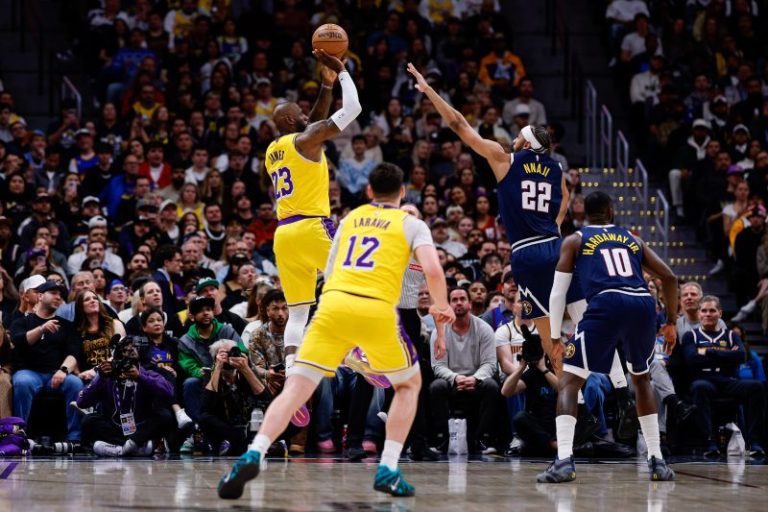
LeBron James has broken yet another NBA record held by Kareem Abdul-Jabbar.

In the final seconds of the first quarter of the Los Angeles Lakers’ game against the Denver Nuggets on Thursday night, James posted up Zeke Nnaji along the baseline before hitting him with a turnaround fadeaway for the 15,838th made field goal of his career — the most all-time by a player.

Though he passed Abdul-Jabbar as the NBA’s all-time leading scorer in 2023, the fact that it took another three years to surpass him in made field goals speaks to the evolution of the game, and the power that the 3-ball and the free throw line have in today’s NBA.

James and Abdul-Jabbar are the only two players to score at least 15,000 career field goals; the next closest is Karl Malone with 13,528. The only other active player in the top 10 is Kevin Durant, who is in ninth with 11,075.

Most field goals made in NBA history

Here’s the top 10 list, per the NBA:

This post appeared first on USA TODAY