Author

admin

Browsing

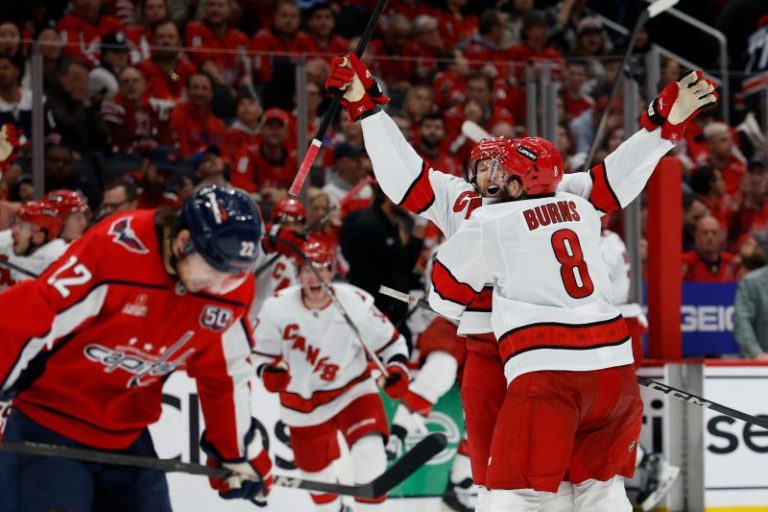
Jacob Slavin’s goal 3:06 into overtime gave the Carolina Hurricanes a 2-1 victory Tuesday over the host Washington Capitals in Game 1 of their Stanley Cup Playoff second-round matchup.

The defenseman’s first overtime playoff goal came on the Hurricanes’ 94th shot attempt of the game (their 33rd on net). Logan Stankoven scored his third goal of the postseason and Jesperi Kotkaniemi set it up. Jordan Martinook and Dmitry Orlov assisted on the game-winner.

Frederik Andersen made 13 saves in his first action since leaving in the second period of Game 4 of Carolina’s first-round series with the New Jersey Devils on April 27.

Aliaksei Protas scored his first career playoff goal for the Capitals, with Brandon Duhaime and John Carlson earning assists. Thompson, meanwhile, stopped 31 shots while under pressure all night.

Carolina set the tone in the first period, outshooting the Capitals 12-5. None went past Thompson, though, as just three of those came from near the net. Washington also blocked 15 shot attempts in the period and had 32 for the game.

Despite that control, it was the Capitals who struck first 3:52 into the second. Carlson cleared the puck from the Carolina attack zone and Duhaime was able to spring Protas, who skated along the boards and beat the drawn-out netminder on a wrist shot from the right circle.

Protas scored in just his second game back after recovering from a deep cut he suffered to his left foot in an April 4 game against the Chicago Blackhawks.

The goal did not change the style of play as the Hurricanes continued to pepper shot attempts. They had 70 through the first two periods. However, it took a turnover near the Capitals’ net midway through the third period that allowed the Hurricanes to even the score.

Kotkaniemi got the puck after Capitals defenseman Alexander Alexeyev lost it in the left faceoff circle. The Finnish forward found Stankoven in the slot, and the 22-year-old, acquired in the Mikko Rantanen trade two months ago, capitalized on the Capitals’ mistake with 10:18 left in regulation.

Carolina won despite losing center Mark Jankowski, who sustained an undisclosed injury.

Jankowski, appearing in his third game of this year’s playoffs, was last on the ice with 4:42 remaining in the second period.

Edmonton Oilers rally past Vegas Golden Knights

Zach Hyman scored the go-ahead goal with 3:02 remaining and Connor Brown sealed the win 76 seconds later as the Edmonton Oilers rallied to defeat the Vegas Golden Knights, 4-2, in Game 1 of the Western Conference second round on Tuesday night in Las Vegas.

Hyman buried a wrist shot from the slot past goalie Adin Hill’s glove side for the game-winner — his third tally of the playoffs.

Brown added his fourth goal when he deked defenseman Shea Theodore at the blue line, broke down the slot and fired a wrist shot past Hill’s glove side. That completed the Oilers’ fifth straight comeback victory in the playoffs.

Leon Draisaitl had a goal and an assist, Connor McDavid and Evan Bouchard each had two assists and Corey Perry also scored for Edmonton, which had a four-game playoff winning streak snapped. Calvin Pickard finished with 15 saves.

Mark Stone scored both goals and Hill made 24 saves for Vegas, which had a streak of five Game 1 playoff wins snapped. Stone moved into a tie with Jonathan Marchessault for the franchise record with 36 postseason goals.

Vegas took a 1-0 lead at the 2:13 mark of the first period on a power-play goal by Stone. Vegas took advantage of an early double-minor penalty on Ryan Nugent-Hopkins for high-sticking Tomas Hertl along the end boards.

The score came on a double deflection of Theodore’s point shot, which changed direction off the stick of William Karlsson and then deflected off Stone’s stick, clanged off the left post and went into the net.

Stone made it 2-0 midway through the period with a wrist shot from the low slot five-hole. It came off Jack Eichel’s pass.

The Oilers cut the deficit to 2-1 near the end of the period when Perry took a pass from McDavid by the left side of the crease and then wrapped a wrist shot around Hill’s left pad. It was his third goal of the playoffs.

Edmonton dominated a scoreless second period, outshooting the Golden Knights 12-1, but couldn’t take advantage of two power plays. Adam Henrique had the best chance to tie it, but his wrist shot from the high slot caromed off the crossbar.

The Oilers tied it 2-2 just 57 seconds into the third period when Draisaitl, behind the goal line, backhanded a rebound of Bouchard’s shot that banked in off the back of Hill’s right leg. It was his fourth goal of the playoffs.

The USA TODAY app gets you to the heart of the news fast. Download for award-winning coverage, crosswords, audio storytelling, the eNewspaper and more.


This post appeared first on USA TODAY

Shedeur Sanders wasn’t the first player in NFL draft history to be taken later than expected and he won’t be the last. At the very least, he won’t be alone.

In some ways, Sanders joined some good company after sliding down the board.

Sanders was selected by the Cleveland Browns with the 144th overall pick in the 2025 NFL Draft. Rumors swirled that the Colorado quarterback could’ve been taken 142 picks earlier by the same team, but landing in the fifth round was clearly a shock.

Tom Brady knows a thing or two about being drafted late in the process after he was famously selected with the 199th pick in the 2000 NFL Draft. The future Hall of Fame quarterback turned NFL on Fox broadcaster and part-owner of the Las Vegas Raiders had some words for the prospect.

During an appearance on the IMPAULSIVE podcast, Brady shared that he spoke with Sanders via text.

‘I actually texted Shedeur because I know him very well,’ Brady said. ‘And I said, ‘Dude, whatever happens, wherever you go, that’s your first day. Day 2 matters more than the draft.’ I was 199. So who can speak on it better than me? Like what that really means. Use it as motivation, you’re going to get your chances and go take advantage of it.’

Brady added that it’s about Sanders’ performance at this point, highlighting some of his teammates that also weren’t picked early in the draft.

‘I was around some of the best players who were undrafted free agents. They were Rodney Harrison. Rodney Harrison wasn’t a high pick. Julian Edelman wasn’t a high pick. Wes Welker wasn’t a high pick. Danny Amendola. All those guys were phenomenal players. So what’s it matter than some overhyped day where a lot of people are selling stories and saying, ‘Alright this is the big day and this is the draft and it’s an important day and it’s fun and I love you know watching it and seeing it?”

The seven-time Super Bowl champion pointed out that he’s been there on Day 2 when those players are tasked with learning a playbook and becoming part of the locker room.

Sanders will have a long road ahead of him in order to compete for the Browns’ starting gig. Heading into training camp, he’s likely the fifth quarterback on the depth chart. He’ll likely slide up to fourth as long as Deshaun Watson remains sidelined.

Still, Sanders will have to leap over Joe Flacco, Kenny Pickett and fellow 2025 draft pick Dillon Gabriel to land a roster spot.

The odds for a fifth-round pick to do that are certainly stacked against him. Of course, Sanders isn’t a normal fifth-round pick.

He also has the greatest quarterback of all time in his corner. It remains to be seen if that will count for something in Cleveland.

All the NFL news on and off the field. Sign up for USA TODAY’s 4th and Monday newsletter. Check out the latest edition: Looking ahead to the 2025 NFL schedule release.

This post appeared first on USA TODAY

Indiana Pacers star Tyrese Haliburton had an injury scare during Game 2 against the Cleveland Cavaliers.

In the second quarter of Indiana’s Eastern Conference semifinal matchup against the Cavaliers, Haliburton was awaiting a defensive rebound when he got bumped by Jarrett Allen and Craig Porter Jr. It appeared he got his left hand caught in the the bump and he ran off toward his team’s bench in visible pain.

Haliburton was then holding his left hand as he made his way back down the court.

Haliburton didn’t miss any action, but he got X-rays on his left wrist at halftime, according to TNT sideline reporter Jared Greenberg. His left wrist was taped up as he came out for the second half but he continued to play in Game 2.

The injured wrist turned out not to be a major concern for the rest of Tuesday night’s game. After a pedestrian start to the night, Haliburton picked up his game in the second half as he propelled his team back from an 11-point halftime deficit.

Down two points in the final seconds, Haliburton hit a step back 3-pointer with one second left to stun Cleveland and give the Pacers the victory and a 2-0 series lead. He finished with 19 points, nine rebounds and four assists.

Tyrese Haliburton update on wrist

There wasn’t much concern from Haliburton his left wrist postgame. He told reporters the wrist is sore but indicated he will be good for Game 3.

‘It’s fine,’ Haliburton said. ‘Obviously, a little sore.’

Haliburton will also get some time to rest the left wrist before Indiana’s next contest. Game 3 against Cleveland will be Friday at Gainbridge Fieldhouse.

(This story was updated to add new information.)

This post appeared first on USA TODAY

Amazon’s Zoox issued a software recall for 270 of its robotaxis after a crash in Las Vegas last month, the company said Tuesday.

The recall surrounds a defect with the vehicle’s automated driving system that could cause it to inaccurately predict the movement of another car, increasing “the risk of a crash,” according to a report submitted to the National Highway Traffic Safety Administration.

Zoox submitted the recall after an April 8 incident in Las Vegas where an unoccupied Zoox robotaxi collided with a passenger vehicle, the NHTSA report states. There were no injuries in the crash and only minor damage occurred to both vehicles.

“After analysis and rigorous testing, Zoox identified the root cause,” the company said in a blog post. “We issued a software update that was implemented across all Zoox vehicles. All Zoox vehicles on the road today, including our purpose-built robotaxi and test fleet, have the updated software.”

Zoox paused all driverless vehicle operations while it reviewed the incident. It’s since resumed operations after rolling out the software update.

Amazon acquired Zoox in 2020 for over $1 billion, announcing at the time that the deal would help bring the self-driving technology company’s “vision for autonomous ride-hailing to reality.” However, Amazon has fallen far behind Alphabet’s Waymo, which has robotaxi services operating in multiple U.S. markets. Tesla has also announced plans to launch a robotaxi offering in Austin in June, though the company has missed many prior target dates for releasing its technology.

Zoox has been testing its robotaxis in Las Vegas, Nevada, and Foster City, California. Last month, Zoox began testing a small fleet of retrofitted vehicles in Los Angeles.

Last month, NHTSA closed a probe into two crashes involving Toyota Highlanders equipped with Zoox’s autonomous vehicle technology. The agency opened the probe last May after the vehicles braked suddenly and were rear-ended by motorcyclists, which led to minor injuries.

This post appeared first on NBC NEWS

In this video, Dave reveals four key charts he’s watching to determine whether the S&P 500 and Nasdaq 100 will be able to power through their 200-day moving averages en route to higher highs. Using the recently updated StockCharts Market Summary page, he covers moving average breadth measures, his proprietary Market Trend Model, offense vs. defense ratios, and the Bullish Percent Indexes.

This video originally premiered on May 5, 2025. Watch on StockCharts’ dedicated David Keller page!

Previously recorded videos from Dave are available at this link.

Communication Services Drops to #5

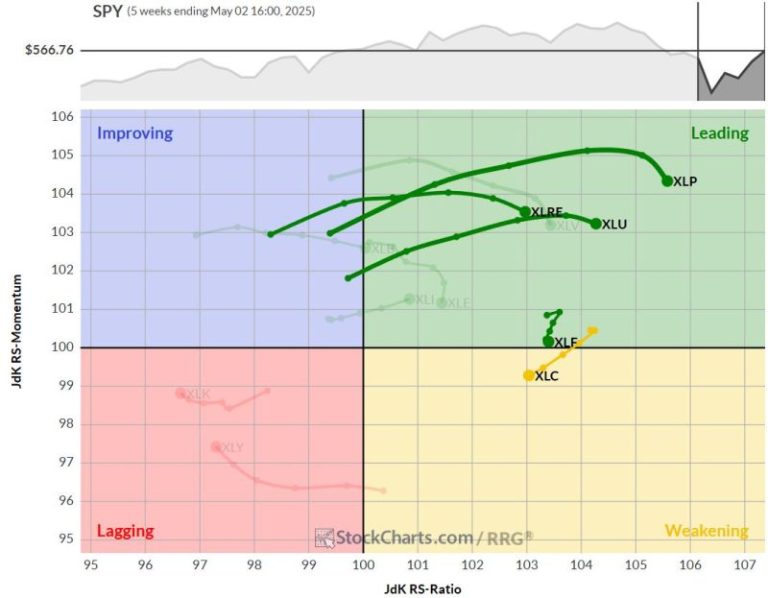
The composition of the top five sectors remains largely stable this week, with only slight adjustments in positioning. Consumer staples continue to lead the pack, followed by utilities, financials, real estate (moving up one spot), and communication services (dropping to fifth). This defensive lineup persists despite a rallying market, presenting an interesting dilemma for sector rotation strategies.

  1. (1) Consumer Staples – (XLP)
  2. (2) Utilities – (XLU)
  3. (3) Financials – (XLF)
  4. (5) Real-Estate – (XLRE)*
  5. (4) Communication Services – (XLC)*
  6. (6) Healthcare – (XLV)
  7. (7) Industrials – (XLI)
  8. (8) Materials – (XLB)
  9. (11) Technology – (XLK)*
  10. (10) Energy – (XLE)
  11. (9) Consumer Discretionary – (XLY)*

Weekly RRG

The weekly Relative Rotation Graph (RRG) paints a picture of potential change on the horizon.

While staples, utilities, real estate, and financials maintain their positions in the leading quadrant, they show signs of losing relative momentum over the past few weeks.

Financials, particularly, are teetering on the edge of rolling into the weakening quadrant.

Communication services have already shifted, now firmly in the weakening quadrant and traveling on a negative RRG heading. This movement explains its drop to the fifth position in our sector rankings.

Daily RRG

Switching to the daily RRG, we see a slightly different picture for our top sectors.

Staples, utilities, real estate, and financials are all positioned in the weakening quadrant, traveling on negative RRG headings.

This short-term view indicates that we must closely monitor these sectors to determine if they can regain momentum before potentially dropping out of the top five.

Interestingly, communication services is showing signs of life on the daily chart. Despite falling to the fifth position overall, its tail is now in the improving quadrant and moving toward leading.

The caveat? It’s a very short tail, close to the benchmark—essentially moving in line with the market. This makes communication services the sector most at risk of losing its top-five status in the near term.

Consumer Staples

Consumer staples is bumping up against overhead resistance between $82.50 and $83.

This hesitation in upward price movement is causing weakness in the RS line, which has started to dip.

Consequently, the RS momentum line is rolling over. However, the high RS ratio—indicating a strong relative trend—is keeping staples at the top of our list for now.

Utilities

Utilities has been flirting with a breakout since the start of 2025, pushing against overhead resistance around $80 about four times already.

When it breaks, we’ll likely see an acceleration towards the all-time high just above $82.50.

Like staples, the inability to break resistance is causing a stall in the RS line and a rollover in relative momentum.

Financials

After a strong rally off the $42 support level, previously resistance (the old technical adage holds true), financials is now facing a challenge.

The rally is approaching the former rising support level that marked the uptrend channel. This could cause some hesitation in both price and relative strength.

The RS line remains within its rising channel, but momentum has waned, causing the green RS momentum line to roll over.

Real-Estate

Real estate moved up one position to fourth and is still emerging from a long relative downtrend that began in April 2022.

The RS ratio line has picked up the relative strength rally that started in early 2025 but is now stalling.

This has resulted in the green RS momentum line rolling over. On the price chart, real estate is mid-range with room to move higher.

Communication Services

Communication services have dropped to the fifth position, but the price chart has an interesting development.

Last week, the price broke back above the old neckline of a small head-and-shoulders pattern. The fact that we’re now rallying above this neckline could indicate a failed head-and-shoulders pattern—usually a very strong bullish sign.

However, recent weakness in relative strength has pushed the sector deeper into the weakening quadrant on the RRG.

This sector must pick up rapidly in the coming weeks to maintain its position in the top five.

Portfolio Performance

The defensive positioning of our top five sectors is leading to underperformance as the broader market rallies.

Currently, we remain at approximately a 3% underperformance compared to SPY just like last week.

However, from the perspective of sector rotation, we must still consider this rally in the S&P 500 to be temporary.

The underlying message continues to emphasize defense.

It’s important to remember that there is always a lagging element in RRGs and this strategy.

If the market has truly turned, we will see that shift reflected in our sectors, and at some point, we will start to make up the difference.

These performance gaps can change very rapidly in favor of the RRG portfolio when the market comes under pressure and our defensive sectors start to lead again.

#StayAlert and have a great week — Julius

Investing in rare earth minerals can seem tricky, but there are a variety of rare earth stocks and exchange-traded funds (ETFs) available for metals investors.

The rare earth sector may seem daunting, as many elements fall under the umbrella, and the 17 rare earth elements (REEs) are as diverse as they are challenging to pronounce.

The group is made up of 15 lanthanides, plus yttrium and scandium, and each element has different applications, pricing and supply and demand dynamics. Sound complicated? While the REE space is undeniably complex, many investors find it compelling and are interested in finding ways to get a foot in the door.

Read on for a more in-depth look at the rare earth metals market and the many different types of rare earth minerals, plus rare earth stocks and ETFs you can invest in.

In this article

    What are the types of rare earth minerals?

    There are a number of ways to categorize and better understand rare earths, which will help you know which companies to invest in based on what they’re targeting.

    For example, they are often divided into “heavy” and “light” categories based on atomic weight. Heavy rare earths are generally more sought after, but light REEs are important too.

    Rare earths can also be grouped together according to how they are used. Rare earth magnets include praseodymium, neodymium, samarium and dysprosium, while phosphor rare earths — those used in lighting — include europium, terbium and yttrium. Cerium, lanthanum and gadolinium are sometimes included in the phosphor category as well. For a detailed breakdown of rare earth uses, check out our guide.

    One aspect that is common to all the rare earths is that price information is not readily available — like other critical metals, rare earth materials are not traded on a public exchange. That said, some research firms do make pricing details available, usually for a fee, including Strategic Metals Invest, Fastmarkets and SMM.

    What factors affect supply and demand for rare earths?

    As mentioned, each REE has different pricing and supply and demand dynamics.

    However, there are definitely overarching supply and demand trends in the sector. Most notably, China accounts for the vast majority of the world’s supply of rare earth metals. As the world’s leading producer, the Asian nation accounted for roughly 70 percent of rare earths production in 2024, or 270,000 metric tons (MT), with the US coming in a very distant second at 45,000 MT. After the US, Myanmar is the third largest rare earths producer with total output of 31,000 MT last year. On top of that, China is also responsible for 90 percent of refined rare earths output.

    The strong Chinese monopoly on rare earths production has created problems in the sector in the past. For instance, prices in the global market spiked in 2010 and 2011 when the country imposed export quotas.

    The move sparked a boom in global rare earth metals exploration outside of China, but many companies that entered the space at that time fell off the radar when rare earths prices eventually sank again. Molycorp, once North America’s only producer of rare earths, is a notable example of how hard it is for companies to set up shop outside China. It filed for bankruptcy in 2015. But the story didn’t end there — MP Materials (NYSE:MP), the company that now owns Molycorp’s assets, went public in mid-2020 in a US$1.47 billion deal, and a year later was a US$6 billion company.

    MP Materials is now the western hemisphere’s largest rare earths miner, putting out high-purity separated neodymium and praseodymium oxide; a heavy rare earths concentrate; and lanthanum and cerium oxides and carbonates.

    Concerns about China’s dominance are ongoing as the US/China trade war continues and as supply chain stability grows in importance. The Asian nation has tightly controlled how much of its rare earths products make it into global markets through a quota system initiated in 2006.

    US President Donald Trump’s high tariffs targeting Chinese goods has resulted in China enacting further rare earth export restrictions. In April 2025, the Government of China placed strict export controls on samarium, gadolinium, terbium, dysprosium, lutetium, scandium and yttrium — all crucial for the production of electric vehicles, smartphones, fighter jets, missiles and satellites.

    Sharing a border with China, Myanmar is the source of at least 70 percent of its neighbor’s medium to heavy rare earths feedstock. With that in mind, it’s not surprising that a temporary halt in Myanmar’s production in late summer of 2023 sent rare earths prices to their highest level in 20 months, as per OilPrice.com.

    Myanmar’s rare earths production experienced further disruptions in late 2024 as the Kachin Independence Army seized two towns in Kachin state, near China’s Yunnan province, that are critical suppliers of rare earth oxides to China.

    Outside of China, one of the world’s leading rare earths producers is Australian company Lynas (ASX:LYC,OTC Pink:LYSCF), which sends mined material for refining and processing at its plant in Malaysia. In 2023, Japan Australia Rare Earths, a joint venture between the Japan Organization for Metals and Energy Security and Sojitz (TSE:2768), inked an agreement to invest AU$200 million in the production and supply of heavy rare earths from Lynas.

    This has allowed the mining company to expand its light rare earths production and begin production of heavy rare earths. Lynas brought its large-scale downstream Kalgoorlie rare earths processing facility online in November 2024. According to its H1 2025 fiscal year results, the company’s neodymium and praseodymium (NdPr) production volume increased by 22 percent.

    In the US, MP Materials is making good use of US$58.5 million awarded in April to support construction of the first fully integrated rare earth magnet manufacturing facility in the US. The funding is part of the Section 48C Advanced Energy Project tax credit granted by the Internal Revenue Service, Department of Treasury and Department of Energy.

    The Fort Worth, Texas, magnet facility began producing the NdFeB magnets crucial for EVs, wind turbines and defense systems at the start of 2025. First commercial deliveries are expected by the end of the year.

    Looking at demand, many analysts believe the need for rare earths is set to boom on accelerating growth from top end-use categories, including the electric vehicle market and other high-tech applications.

    As an example, demand for dysprosium, a key material in steel manufacturing and the production of lasers, has grown as countries increase their steel standards. Aside from that, rare earths have long been used in televisions and rechargeable batteries, two industries that accounted for much demand before the proliferation of new technologies. Other rare earth metals can be found in wind turbines, aluminum production, catalytic converters and many high-tech products.

    As can be seen, securing rare earths supply is an increasingly important issue. In addition to traditional rare earths mining, there has been growth in the rare earths recycling industry, which aims to recover REE raw materials from electronics and high-tech products in order to reuse them in new ways.

    Exploring and extracting rare earth materials from deep-sea mud is one of the newest recovery methods, although deep sea mining of mud and nodules comes with significant environmental concerns. However, it is gaining traction as more mining companies look offshore for resources and US President Trump pushes for fast tracking of deep-sea mining permits.

    How to invest in rare earth minerals

    Investors are increasingly wondering how they can invest in rare earth metals as demand ramps up and the US-China trade war has caused further concerns about rare earth supply chains. The possibility of higher rare earth prices in the coming years is one of the catalysts for investors wondering how they can invest in rare earths. As it’s not possible to buy physical rare earth metals, the most direct way to invest in the rare earth market is through mining and exploration companies.

    Investing in rare earth stocks

    While many rare earth minerals companies are located in China and are not publicly traded, there are a variety of rare earth companies listed on US, Canadian and Australian stock exchanges.

    Below is a selection of companies with rare earths assets or operations trading on the NYSE, NASDAQ, TSX and ASX; all had market caps of over $500 million as of April 22, 2025.

      Small-cap REE companies are also listed on those exchanges.

      Here’s a hefty list of junior rare earths stock and companies with rare earths projects. The rare earths stocks on this list had market caps between $5 million and $500 million as of April 22, 2025:

        To learn more about investing in rare earths, check out our stocks lists on the 9 Biggest Rare Earth Stocks in the US, Canada and Australia, Top Canadian Rare Earths Stocks, and the 5 Biggest ASX Rare Earth Stocks.

        Investing in rare earth ETFs

        Rare earth exchange-trade funds (ETFs) offer investors a diversified position in this market space, mitigating the risks of investing in specific companies.

              Securities Disclosure: I, Melissa Pistilli, hold no direct investment interest in any company mentioned in this article.

              Keep reading…Show less
              This post appeared first on investingnews.com

              White Cliff Minerals Limited (“WCN” or the “Company”) (ASX: WCN; OTCQB: WCMLF) is pleased to announce further assay results from the reverse circulation drilling campaign at the Company’s 100% owned Rae Copper Project in Nunavut, Canada.

              • Further assay results confirm and validate the strategy to explore previously untested high-grade zones and vertical depth extension of mineralisation at Danvers
              • Highlights from DAN25008:
                • 175m @ 2.5% Cu & 8.66g/t silver (Ag) from 7.6m, including 14m @ 7.55% Cu & 25.8g/t Ag from 138m
                • the last 60m of the hole averaged 3.9% Cu & 14.96g/t Ag to final depth of 182.88m
                • hole ended in mineralisation with the last 1.5m sample recording 4.46% Cu & 11.58g/t Ag, open at depth
              • DAN25001 returned 52m @ 1.16% Cu & 3.43g/t Ag from surface, including 7.6m at 3% Cu & 9.5g/t Ag from 18.28m
              • Drilling demonstrates potential for significant expansion to historic non-compliant resource. With the initial objectives of Danvers drilling achieved, to begin to understand the significance of this discovery, new drilling data will feed into a maiden JORC compliant mineral resource
              • Mineralisation remains open in all directions. Follow up diamond drilling now being planned to drill out the mineralisation boundaries at Danvers and begin testing of the massive sedimentary structure at Hulk
              • The next five (5) assays along strike from DAN25008 are due in the coming weeks

              “DAN25008 was prioritised for assay due to the abundance of visual sulphides observed during drilling, and these results have underpinned our confidence in those visuals prevalent in the Company’s prior work. We believe this drill hole ranks among the most significant copper intersections globally within the last 50 years and comfortably sits within the top 10 globally reported “grade-metre” copper results.

              This discovery and outstanding results from Danvers is a clear testament to our technical team’s expertise and geological understanding, in particular the professionalism and persistence of Olga Solovieva and Sam Vaughan.

              Our improved geological understanding of the Danvers area indicates a mineralised system that extends from surface over more than 175m vertically and potentially 7km in strike length – both to the northeast and southwest, providing scope for further high-impact intercepts from upcoming drilling. With our work updating the geological understanding at Danvers, we adapted our drill targets and DAN25008 resulted in mineralisation at least 30 metres below historical limits, with the hole terminating in high-grade copper mineralisation – suggesting considerable additional potential at depth. The increase in grade toward the bottom of the hole is encouraging and is validation of our methodology.

              To illustrate the magnitude of this result, the DAN25001 intercept of 52m at 1.2% Cu – a strong result in its own right – now appears modest when viewed alongside the 175m @ 2.5% Cu from DAN25008. In the context of global copper supply constraints, the Company is well positioned to leverage these results with mineralisation from surface, supporting potential open pit mining activities and an open water port less than 80km from the deposit.

              Troy Whittaker – Managing Director

              FURTHER INFORMATION

              Drillhole DAN25008 is an important step in the development of the Danvers copper deposit. An intercept of 175.26m at 2.5% copper is an outstanding result illustrating the continuous mineralisation which commences just below surface at 7.62m downhole. The final 30m of DAN25008 which averages 2.37% Cu and 10.51g/t Ag exists below the trace of historic drilling, effectively extending the known high-grade mineralisation.

              Click here for the full ASX Release

              This post appeared first on investingnews.com

              Riverside Resources Inc. (TSXV: RRI) (OTCQB: RVSDF) (FSE: 5YY) (‘Riverside’ or the ‘Company’), is pleased to announce that further to its press release dated September 6, 2024, Riverside’s wholly-owned subsidiary, RRM Exploracion, S.A.P.I. DE C.V. (the ‘Vendor’) has entered into a definitive option agreement (the ‘Option Agreement’) with Questcorp Mining Inc. (‘Questcorp’) dated May 5, 2025, for the 2,520.2 hectare La Union carbonate replacement gold- polymetallic project (the ‘Project’ or ‘La Union’) located in Sonora, Mexico (the ‘Transaction’).

              ‘We are thrilled to finalize this agreement for the La Union Project, which is a strong asset in Riverside’s portfolio. Securing up to C$5,500,000 in exploration funding from Questcorp is an excellent step forward in advancing this larger Carbonate Replacement Deposit (‘CRD‘) project,’ said John-Mark Staude, CEO of Riverside Resources. ‘Riverside is pleased to have the updated NI 43-101 Technical Report completed and we see an active exploration program launching in the coming weeks with Riverside as the Operator of the exploration program. Riverside is expected to become a shareholder of Questcorp with an initial 9.9% equity interest, subject to final approval by the Canadian Securities Exchange or confirmation that such approval is not required. The first-year work program of C$1,000,000 in exploration expenditures will launch the first round of exploration at the project.’

              The La Union Project

              The Project is summarized on the Riverside website and is a project that Riverside acquired and further consolidated additional inlier mineral claims. The Project initially identified from Riverside’s work in the western Sonora gold belt through work with AngloGold Ashanti Limited, Centerra Gold Inc., and Hochshild Mining Plc, among others as partners and funding relationships for gold exploration. Initial work by members of the Riverside team, drawing on more than two decades of geological compilation and analysis, identified this region as highly prospective. At the Project, historical mining by the Penoles Mining Company focused on chimney and manto replacement bodies within the upper oxide zones. As a result, the underlying sulfide zones present immediate drill targets for further exploration.

              Riverside has spent the past five years consolidating this highly prospective land package, which totals over 22 square kilometers. The Project features favorable limestone host rocks, an extensive alteration footprint, and multiple small-scale historical workings, providing more than eight drill-ready target areas. Key immediate targets include the central Union Mine and the nearby Famosa Mine. With drive-up access, private ranch surface rights, and strong geologic similarities to other major CRDs in Arizona and eastern Mexico, La Union is well positioned for near-term exploration success targeting both oxide and deeper sulfide mineralization.

              The Option Agreement

              In accordance with the terms of the Transaction, Questcorp can acquire a one-hundred percent (100%) interest in the Project in consideration for completion of a series of cash payments totaling $100,000 CAD, making staged issuances of common shares of Questcorp totaling 19.9%, and incurring $5,500,000 CAD of exploration expenditures on the Project as outlined immediately below:

              Deadline Cash Payment Share Issuance Exploration Expenditures
              Within two (2) business days of the date of the Option Agreement $25,000 N/A N/A
              On the Effective Date(1) N/A 9.9%(2) N/A
              On or before the first anniversary of the Effective Date N/A 14.9%(2)(3) $1,000,000
              On or before the second anniversary of the Effective Date $25,000 19.9%(2)(3) $1,250,000
              On or before the third anniversary of the Effective Date $25,000 19.9%(2)(3) $1,500,000
              On or before the fourth anniversary of the Effective Date $25,000 19.9%(2)(3) $1,750,000
              Total $100,000 19.9%(2)(3) $5,500,000
              Notes:

              1. ‘Effective Date’ means the date on which Questcorp delivers to the Vendor a copy of the written approval of the Canadian Securities Exchange in respect of the transactions contemplated by the Option Agreement.
              2. Issuable within the fifth business day after the applicable date.
              3. Expressed as a cumulative total percentage of the undiluted issued and outstanding common shares of Questcorp as of the applicable payment date, and assuming Riverside has not previously disposed of any common shares.


              During the term of the Option Agreement, Riverside, through the Vendor, will remain the program operator for the Project using its local team based in Hermosillo, Sonora. Following exercise of the option under the Option Agreement, Questcorp will grant Riverside a two-and-one half percent (2.5%) net smelter return royalty on commercial production from the Project.

              Figure 1. Geologic map with the tenure of the Union internal concession shown in pink. Manto and chimney type CRD targets are shown as red polygons. Riverside now controls all mineral tenures on this map.

              To view an enhanced version of this graphic, please visit:
              https://images.newsfilecorp.com/files/6101/250896_df59d6431499eba6_002full.jpg

              Figure 2. Cross section looking west with proposed drill sites and drillhole traces. Assays from Riverside’s sampling of rock dump materials from the two mine areas are labeled in black. Red areas are interpreted as manto and chimney target bodies that are now well defined and drill ready. Assays shown on figures 1 and 2 have been previously released and disclosed as summarized below the geochemical QA/QC. 

              To view an enhanced version of this graphic, please visit:
              https://images.newsfilecorp.com/files/6101/250896_df59d6431499eba6_003full.jpg

              Qualified Person & QA/QC:

              The scientific and technical data contained in this news release pertaining to the Project was reviewed and approved by Freeman Smith, P.Geo, VP Exploration, a non-independent qualified person to Riverside Resources Inc., who is responsible for ensuring that the information provided in this news release is accurate and who acts as a ‘qualified person’ under National Instrument 43-101 Standards of Disclosure for Mineral Projects.

              Rock samples from previous exploration programs discussed above at the Project were taken to the Bureau Veritas Laboratories in Hermosillo, Mexico for fire assaying for gold. The rejects remained with Bureau Veritas in Mexico while the pulps were transported to Bureau Veritas laboratory in Vancouver, BC, Canada for 45 element ICP/ES-MS analysis using 4-acid digestion methods. A QA/QC program was implemented as part of the sampling procedures for the exploration program. Standards were randomly inserted into the sample stream prior to being sent to the laboratory.

              About Riverside Resources Inc.:

              Riverside is a well-funded exploration company driven by value generation and discovery. The Company has over $4M in cash, no debt and less than 75M shares outstanding with a strong portfolio of gold-silver and copper assets and royalties in North America. Riverside has extensive experience and knowledge operating in Mexico and Canada and leverages its large database to generate a portfolio of prospective mineral properties. Riverside has properties available for option, with information available on the Company’s website at www.rivres.com.

              ON BEHALF OF Riverside Resources Inc.

              ‘John-Mark Staude’

              Dr. John-Mark Staude, President & CEO

              For additional information contact:

              John-Mark Staude
              President, CEO
              Riverside Resources Inc. 
              info@rivres.com
              Phone: (778) 327-6671
              Fax: (778) 327-6675
              Web: www.rivres.com
              Eric Negraeff
              Corporate Communications
              Riverside Resources Inc.
              Eric@rivres.com
              Phone: (778) 327-6671
              TF: (877) RIV-RES1
              Web: www.rivres.com


              Certain statements in this press release may be considered forward-looking information. These statements can be identified by the use of forward-looking terminology (e.g., ‘expect’,’ estimates’, ‘intends’, ‘anticipates’, ‘believes’, ‘plans’). Such information involves known and unknown risks — including the risk that the Transaction will not be completed as contemplates, or at all, availability of funds, the results of financing and exploration activities, the interpretation of exploration results and other geological data, or unanticipated costs and expenses and other risks identified by Riverside in its public securities filings that may cause actual events to differ materially from current expectations. Readers are cautioned not to place undue reliance on these forward-looking statements, which speak only as of the date of this press release.

              Neither the TSX Venture Exchange nor its Regulation Services Provider (as that term is defined in the policies of the TSX Venture Exchange) accepts responsibility for the adequacy or accuracy of this release.

              To view the source version of this press release, please visit https://www.newsfilecorp.com/release/250896

              News Provided by Newsfile via QuoteMedia

              This post appeared first on investingnews.com