Author

admin

Browsing

(TheNewswire)

Brossard, Quebec TheNewswire – April 30, 2025 Charbone Hydrogen Corporation (TSXV: CH; OTCQB: CHHYF; FSE: K47) (the ‘Company’ or ‘CHARBONE’), North America’s sole publicly traded pure-play company specialized in green hydrogen production and distribution, today announces its financial and operating results for the year ending December 31, 2024, highlighted by a 15% year-over-year revenue increase and critical progress toward commencing green hydrogen production at its Sorel-Tracy facility in 2025.

All necessary permits for the Sorel-Tracy facility have been obtained, and Hydro-Québec, the provincial grid company, is completing interconnection, keeping the project on track for 2025 production.

2024 HIGHLIGHTS:

  • Spending decreased 16% to $2,474,516 in 2024 compared to $2,961,451 in 2023 (activities refocused and tightening of general and administrative expenses);

  • Revenue rose by 15% to $325,753 in 2024, up from $282,724 in 2023 (generated from the Wolf River acquisition on December 1, 2022). There is a temporary service reduction at the dam following an equipment failure that will be repaired, but creating an impairment of assets of $93,528;

  • The Company has closed private financings for gross proceeds amounting to $1,773,538 ($1,258,297 in 2023), Units for debt settlement of $352,214 ($747,228 in 2023) and exercises of warrants/options of $889,494 ($nil in 2023);

  • The Company made acquisitions of storage hydrogen equipment, upgraded its Sorel-Tracy electrolyzer capacity to 1.75MW and made a deposit on two 2.5MW electrolyzers;

  • The Company completed a $2.1M unsecured convertible notes financing with a 36-month term at a rate of 12% per annum, accrued until maturity or conversion, in which the principal amount is convertible into common shares at a conversion price of the greater of $0.10 CAD (or USD equivalent) or a price per share representing a discount of 20% per common share; and

  • The Company also received an additional $100,000 in 2024 from Finexcorp secured convertible debentures at a deemed price of $0.10 and agreed to extend the $1.2 million CAD 14% (now 12%) secured convertible debentures maturity date that were issued by the Company with better terms.

Charbone’s disciplined financial management, and strategic partnerships position the company to realize its vision of creating a North American green hydrogen network. These advancements underscore its commitment to becoming a leader in the energy transition.

‘Management’s efforts to shore up and strengthen our balance sheet have been focused and deliberate,’ said Benoit Veilleux, Chief Financial Officer and Corporate Secretary of CHARBONE . ‘Ongoing talks with strategic partners are advancing well to support and execute CHARBONE’s growth potential with our financial partners and investors.’


Click Image To View Full Size


Click Image To View Full Size

About Charbone Hydrogen Corporation

CHARBONE is an integrated green hydrogen company with strategic distribution capabilities of industrial gases across North America. While continuing to develop its modular green hydrogen production network, CHARBONE also leverages commercial partnerships to supply hydrogen, helium, and other industrial gases without the capital-intensive requirements of production facilities. This approach enhances revenue streams, reduces operational risks, and increases market flexibility. CHARBONE remains North America’s only publicly traded pure-play green hydrogen company, with shares listed on the TSX Venture Exchange (TSXV: CH), the OTC Markets (OTCQB: CHHYF), and the Frankfurt Stock Exchange (FSE: K47). For more information, visit www.charbone.com .

Forward-Looking Statements

This news release contains statements that are ‘forward-looking information’ as defined under Canadian securities laws (‘forward-looking statements’). These forward-looking statements are often identified by words such as ‘intends’, ‘anticipates’, ‘expects’, ‘believes’, ‘plans’, ‘likely’, or similar words. The forward-looking statements reflect management’s expectations, estimates, or projections concerning future results or events, based on the opinions, assumptions and estimates considered reasonable by management at the date the statements are made. Although Charbone believes that the expectations reflected in the forward-looking statements are reasonable, forward-looking statements involve risks and uncertainties, and undue reliance should not be placed on forward-looking statements, as unknown or unpredictable factors could cause actual results to be materially different from those reflected in the forward-looking statements. The forward-looking statements may be affected by risks and uncertainties in the business of Charbone. These risks, uncertainties and assumptions include, but are not limited to, those described under ‘Risk Factors’ in the Corporation’s Filing Statement dated March 31, 2022, which is available on SEDAR at www.sedar.com; they could cause actual events or results to differ materially from those projected in any forward-looking statements.

Except as required under applicable securities legislation, Charbone undertakes no obligation to publicly update or revise forward-looking information.

Neither TSX Venture Exchange nor its Regulation Services Provider (as that term is defined in policies of the TSX Venture Exchange) accepts responsibility for the adequacy or accuracy of this release .

Contact Charbone Hydrogen Corporation

Telephone: +1 450 678 7171

Email: ir@charbone.com

Copyright (c) 2025 TheNewswire – All rights reserved.

News Provided by TheNewsWire via QuoteMedia

This post appeared first on investingnews.com

(TheNewswire)

Brossard (Québec) TheNewswire – le 30 avril 2025 – CORPORATION CHARBONE HYDROGÈNE (TSXV: CH OTCQB: CHHYF, FSE: K47 ) (« Charbone » ou la « Société »), la seule compagnie d’Amérique du Nord cotée en bourse spécialisée dans la production et la distribution d’hydrogène vert, a annoncé aujourd’hui ses résultats financiers et opérationnels pour l’exercice se terminant le 31 décembre 2024, marqués par une augmentation de 15 % des revenus sur l’année précédente ainsi que des progrès essentiels vers le démarrage de la production d’hydrogène vert à son usine de Sorel-Tracy en 2025.

Tous les permis nécessaires pour l’usine de Sorel-Tracy ont été obtenus et Hydro-Québec, la société du réseau électrique provinciale, complète l’interconnexion, maintenant le projet sur la bonne voie pour la production de 2025.

FAITS SAILLANTS 2024:

  • Les dépenses ont diminué de 16% à 2 474 516 $ en 2024 comparativement à 2 961 451 $ en 2023 (recentrage des activités et resserrement des frais généraux et administratifs) ;

  • Les revenus ont augmenté de 15% à 325 753 $ en 2024, à partir de 282 724 $ en 2023 (générés par l’acquisition de Wolf River le 1 er décembre 2022). Il y a un arrêt temporaire de service à la centrale à la suite d’une panne d’équipement qui sera réparée, mais créant une dévaluation des actifs de 93 528 $;

  • La Société a clôturé des financements privés pour des produits bruts s’élevant à 1 773 538$ (1 258 297$ en 2023), des unités pour le règlement de dettes de 352 214 $ (747 228 $ en 2023) et l’exercice de bons de souscription/options pour 889 494 $ (néant $ en 2023) ;

  • La Société a fait l’acquisitions d’équipement de stockage d’hydrogène, a augmenté la capacité de son électrolyseur de Sorel-Tracy à 1,75 MW et a fait un dépôt sur deux électrolyseurs de 2,5 MW ;

  • La Société a conclu un financement par billets convertibles non garantis de 2,1 M$ d’une durée de 36 mois à un taux de 12 % par an, couru jusqu’à l’échéance ou la conversion, dans lequel le montant principal est convertible en actions ordinaires à un prix de conversion égal au plus élevé de 0,10 $ CA (ou l’équivalent en dollars américains) ou d’un prix par action représentant une décote de 20 % par action ordinaire ; et

  • La Société a également reçu un montant supplémentaire de 100 000 $ en 2024 de Finexcorp en débentures convertibles garanties à un prix réputé de 0,10 $ et a accepté de prolonger la date d’échéance des débentures convertibles garanties à 14 % (maintenant à 12 %) de 1,2 million de dollars canadiens qui ont été émises par la Société avec de meilleures conditions.

La gestion financière rigoureuse de Charbone et ses partenariats stratégiques permettent à l’entreprise de réaliser sa vision de créer un réseau nord-américain d’hydrogène vert. Ces avancées soulignent son engagement à devenir un leader de la transition énergétique.

Les efforts de la direction pour consolider et renforcer notre bilan ont été bien ciblés et délibérés , a déclaré Benoit Veilleux, Chef de la direction financière et secrétaire corporatif de Charbone. Les discussions en cours avec des partenaires stratégiques progressent positivement pour supporter et concrétiser le potentiel de croissance de Charbone avec nos partenaires financiers et investisseurs.


Click Image To View Full Size


Click Image To View Full Size

À propos de Charbone Hydrogène Corporation

Charbone est une entreprise intégrée d’hydrogène vert disposant de capacités stratégiques de distribution de gaz industriels en Amérique du Nord. Tout en poursuivant le développement de son réseau modulaire de production d’hydrogène vert, Charbone s’appuie également sur des partenariats commerciaux pour fournir de l’hydrogène, de l’hélium et d’autres gaz industriels sans les exigences en capital élevées des usines de production. Cette approche améliore les sources de revenus, réduit les risques opérationnels et accroît la flexibilité sur le marché. Charbone reste la seule société purement axée sur l’hydrogène vert cotée en bourse en Amérique du Nord, avec des actions cotées à la Bourse de croissance TSX (TSXV: CH); sur les marchés OTC (OTCQB: CHHYF); et à la Bourse de Francfort (FSE: K47). Pour plus d’informations, visiter www.charbone.com .

Énoncés prospectifs

Le présent communiqué de presse contient des énoncés qui constituent de « l’information prospective » au sens des lois canadiennes sur les valeurs mobilières (« déclarations prospectives »). Ces déclarations prospectives sont souvent identifiées par des mots tels que « a l’intention », « anticipe », « s’attend à », « croit », « planifie », « probable », ou des mots similaires. Les déclarations prospectives reflètent les attentes, estimations ou projections respectives de la direction de Charbone concernant les résultats ou événements futurs, sur la base des opinions, hypothèses et estimations considérées comme raisonnables par la direction à la date à laquelle les déclarations sont faites. Bien que Charbone estime que les attentes exprimées dans les déclarations prospectives sont raisonnables, les déclarations prospectives comportent des risques et des incertitudes, et il ne faut pas se fier indûment aux déclarations prospectives, car des facteurs inconnus ou imprévisibles pourraient faire en sorte que les résultats réels soient sensiblement différents de ceux exprimés dans les déclarations prospectives. Des risques et des incertitudes liés aux activités de Charbone peuvent avoir une incidence sur les déclarations prospectives. Ces risques, incertitudes et hypothèses comprennent, sans s’y limiter, ceux décrits à la rubrique « Facteurs de risque » dans la déclaration de changement à l’inscription de la Société datée du 31 mars 2022, qui peut être consultée sur SEDAR à l’adresse www.sedar.com; ils pourraient faire en sorte que les événements ou les résultats réels diffèrent sensiblement de ceux prévus dans les déclarations prospectives.

Sauf si les lois sur les valeurs mobilières applicables l’exigent, Charbone ne s’engage pas à mettre à jour ni à réviser les déclarations prospectives.

Ni la Bourse de croissance TSX ni son fournisseur de services de réglementation (tel que ce terme est défini dans les politiques de la Bourse de croissance TSX) n’acceptent de responsabilité quant à la pertinence ou à l’exactitude du présent communiqué.

Pour contacter Corporation Charbone Hydrogène :

Téléphone bureau: +1 450 678 7171

Courriel: ir@charbone.com

Copyright (c) 2025 TheNewswire – All rights reserved.

News Provided by TheNewsWire via QuoteMedia
This post appeared first on investingnews.com

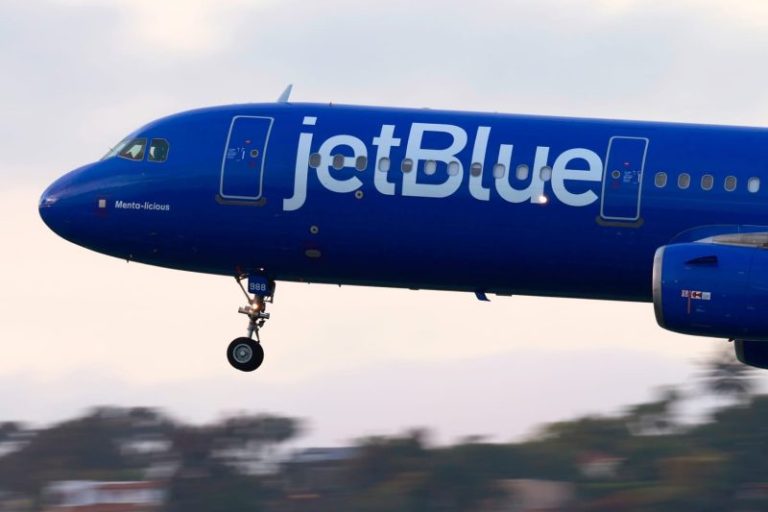
JetBlue Airways is getting ready to announce a partnership with another U.S. airline with a larger network in the coming weeks, the carrier’s president said Tuesday. One possibility: United Airlines.

JetBlue’s leaders have repeatedly said they need a partnership to better compete against larger airlines like Delta Air Lines and United.

JetBlue’s planned acquisition of Spirit Airlines was blocked by the Justice Department last year, while its partnership in the Northeast with American Airlines unraveled after the carriers lost an antitrust lawsuit in 2023.

The New York airline has been in talks with several carriers this year about a partnership. JetBlue’s president, Marty St. George, said on an earnings call on Tuesday that the company expects to make an announcement this quarter. He emphasized that the partner’s bigger network would allow customers to earn and burn loyalty points on JetBlue.

“If you are a customer in the Northeast and you love JetBlue for leisure, but twice a year you have to go to Omaha or Boise, these are places that you can’t earn TrueBlue points on now and when this partnership goes forward, you will be able to,” St. George said.

United Airlines could possibly get a foothold (again) into JetBlue’s home hub of John F. Kennedy International Airport in New York through the partnership. “We don’t engage in industry speculation,” a United Airlines spokeswoman said.

An Alaska Airlines spokeswoman said the carrier doesn’t have plans to partner with JetBlue and is focused on its recent merger with Hawaiian Airlines.

Southwest Airlines declined to comment. A Delta Air Lines spokesman said there was no pending announcement from the carrier about a partnership with another airline.

JetBlue declined to comment further.

American had been in talks to revive a different version of its partnership with JetBlue, but those failed and American said Monday that it sued JetBlue.

“Ultimately, we were unable to agree on a construct that preserved the benefits of the partnership we envisioned, made sense operationally or financially,” American Airlines Vice Chair Steve Johnson said in a letter to employees on Monday.

This post appeared first on NBC NEWS

Pfizer CEO Albert Bourla on Tuesday said uncertainty around President Donald Trump’s planned pharmaceutical tariffs is deterring the company from further investing in U.S. manufacturing and research and development. 

Bourla’s remarks on the company’s first-quarter earnings call came in response to a question about what Pfizer wants to see from tariff negotiations that would push the company to increase investments in the U.S. It comes as drugmakers brace for Trump’s levies on pharmaceuticals imported into the country — his administration’s bid to boost domestic manufacturing.

“If I know that there will not be tariffs … then there are tremendous investments that can happen in this country, both in R&D and manufacturing,” Bourla said on the call, adding that the company is also hoping for “certainty.”

“In periods of uncertainty, everybody is controlling their cost as we are doing, and then is very frugal with their investment, as we are doing, so that we are prepared for remit. So that’s what I want to see,” Bourla said.

Bourla noted the tax environment, which had previously pushed manufacturing abroad, has “significantly changed now” with the establishment of a global minimum tax of around 15%. He said that shift hasn’t necessarily made the U.S. more attractive, saying “it’s not as good” to invest here without additional incentives or clarity around tariffs.

“Now [Trump] I’m sure — and I know because I talked to him — that he would like to see even a reduction in the current tax regime particularly for locally produced goods,” Bourla said, adding a further decrease would be would be a strong incentive for manufacturing in the U.S.

Unlike other companies grappling with evolving trade policy, Pfizer did not revise its full-year outlook on Tuesday. However, the company noted in its earnings release that the guidance “does not currently include any potential impact related to future tariffs and trade policy changes, which we are unable to predict at this time.”

But on the earnings call on Tuesday, Pfizer executives said the guidance does reflect $150 million in costs from Trump’s existing tariffs.

“Included in our guidance that we didn’t really speak about is there are some tariffs in place today,” Pfizer CFO Dave Denton said on the call.

“We are contemplating that within our guidance range and we continue to again trend to the top end of our guidance range even with those costs to be incurred this year,” he said.

This post appeared first on NBC NEWS

LOS ANGELES — For the past year, Joe Hendry has been doing a lot of moving. Constantly on the go, not giving himself much time to think.

So, when he sat inside the Galen Center as TNA Wrestling prepared for its Rebellion pay-per-view, he actually paused and thought about everything that’s transpired in the past 365 days.

It’s quite a list: He became a viral sensation thanks to his catchy entrance song. He was in the main event of Slammiversary 2024. He made an anticipated crossover to WWE with a thunderous debut in NXT in June, and for extra measure, appeared in the main event match of NXT No Mercy 2024. He won the TNA World Championship in January, and the same month, was the surprise entrant in the 2025 men’s Royal Rumble match.

Just when it seemed like Hendry had done all he could do, he reached another mountain top; he was the mystery opponent for Randy Orton at WrestleMania 41, becoming the first champion from a non-WWE company to appear at its grand event in 27 years.

Not a bad year for a guy critics believed would be a one-hit wonder. Instead, the world has found out what happens if you say his name; he not only appears, he makes history.

“I’ve been fortunate to be part of so many things that would have seemed previously impossible,” Hendry told USA TODAY Sports. “I feel like we’re really doing something unprecedented and breaking new ground.”

It wasn’t a surprise Hendry was in Las Vegas for WrestleMania weekend, since TNA held Unbreakable 2025 in the city and he was going to make appearances at WrestleCon. But he didn’t anticipate his weekend ending with him performing at WWE’s flagship event.

A week before WrestleMania 41, Hendry got a call from WWE chief content officer Paul “Triple H” Levesque. He figured it was going to be about doing a promo somewhere, but was completely thrown off when Levesque brought up that Orton didn’t have an opponent for the event due to Kevin Owens’ injury. The decision was for Hendry to take the spot.

Hendry was an initially shocked. Orton was someone he loved watching when he was starting his wrestling career. Now there was a chance to have a match with him? He couldn’t turn down something he didn’t think could happen even in his wildest dreams.

“I immediately said yes to the opportunity, and then it just became about understanding there’s a job to be done, and I will do the job to the best of my ability,” he said. 

It could have been nerve-wracking for Hendry, stepping up to the plate in a grand event like WrestleMania. But Levesque’s trust in Hendry to take the honor gave him confidence and faith in himself.

There was plenty of speculation as to who Orton would face, but Hendry wasn’t really a name being considered — even though he was the surprise at the Royal Rumble.

That’s why when the doors finally opened on the WrestleMania stage, that sweet melodic tune played and Hendry’s face was plastered on all of the jumbotrons inside Allegiant Stadium, the crowd and viewers around the world went into a frenzy.

When Hendry does his signature spin to reveal himself to the crowd, the first thing he always does is look around the venue and soak in the atmosphere. This was the biggest crowd he’d performed in front of, with more than 60,000 people in the stadium. He was overwhelmed by the rousing support and thousands singing “I Believe in Joe Hendry.”

“It felt like a literal, physical wave of energy that was pushing against me,” he said. “I’ll never forget that feeling. It was like a wave of energy. It’s hard to put into words what that felt like, making that walk down the ramp. It took me probably about 30 seconds to a minute to just calibrate.”

After that shock, Hendry still had the job of competing in the match. He got some shots in against the future WWE Hall of Famer, but Orton had little trouble. He pulled out his vintage move set, and when Hendry did his spin toward the camera in the ring, “The Viper” pulled off one of the top moments of the weekend with an RKO out of nowhere. 

Orton got the victory, and after the match he gave Hendry his flowers for stepping up to the plate. But in true Orton fashion, he surprised him with another RKO before he did his own version of Hendry’s spin.

There have been varying opinions on the match. Some praised Hendry for stepping up and the entertainment it provided, but others thought the match was unnecessary, took away from the event and made Hendry look weak as TNA’s top guy.

Hendry said he just wanted to do “the absolute best job” he could in his role and he felt like he delivered.

“The RKO from out of shot was just one of the iconic moments from that weekend. That’s what I wanted to achieve, was to have people talk and have some excitement,” he said. “ I was really proud of that.”

Even though he had a WrestleMania match, the thing that stood out from the weekend for Hendry was the respect he felt from the big names in the business. Orton applauded him, he spoke with Stephanie McMahon and he was able to have a conversation with John Cena, someone that was influential to him becoming a wrestler. Cena shared words of advice with Hendry after the Royal Rumble. 

Cena noted that Hendry followed the exact advice he gave him in February, and turned it into a brilliant performance. He also told Hendry he believes Hendry is “going to be a major player in the industry.”

Levesque was a little more direct with his vision of Hendy’s future, picturing more WrestleMania appearances for “The Prestigious One.” 

“He’s got a bright future, and I was really, really happy that we could put him in this spot and showcase him for everybody, on a bigger platform in the world,” Levesque said at the WrestleMania 41 press conference. “I told him right before he walked out, I said, ‘You will be here again, so enjoy this one, because the pressure gets heavy from here, this will be the easiest WrestleMania you ever do, and you will do more.’’

Safe to say there are plenty of people who believe in Hendry.

What’s next for Joe Hendry?

As the top champion in TNA, there’s a heavy responsibility to represent the company. For Hendry, his plan of bringing the prestige up is working, capitalizing on the partnership it has with WWE. WrestleMania was just another way to help bring more attention to his home.

“This title reign is about big business, and it’s bringing eyeballs and building TNA wrestling,” Hendry said. “I’ve seen the indicators of what that performance will do for TNA Wrestling. So I know that it was the right thing to do.

“The sky’s the limit regarding the growth of TNA Wrestling.”

There’s no limit to Hendry’s aspirations, either. It’s almost as if he knew his moment in Las Vegas would come. After the Royal Rumble, he told friends he thought he could do WrestleMania. Months later, it came to fruition.

Hendry has done more things in one year than most wrestlers do in their entire career. But he isn’t satisfied with just one shining moment. He’s already on to the next thing, including appearing in NXT more and possibly facing Trick Williams.

There’s also a bigger goal he has his sights on. He wouldn’t divulge what it is – because what’s the fun in that? – but it appears to be something even bigger than WrestleMania, if that’s possible.

“I have a ridiculous goal in my mind right now, and I won’t say what it is,” he said. “I think it’s gonna happen. I think I’m gonna get the thing that I’m fighting for.”

It’s anyone’s guess as to what it could be, but one thing does come to mind: Hendry has been vocal about wanting to face Cena. It could certainly be a match against the 17-time WWE Champion in his final year of wrestling.

So don’t think the best of Hendry has happened. As far as he’s concerned, the standing ovation has only just begun.

This post appeared first on USA TODAY

Life in the Big 12 isn’t for the weak.

If there’s any conference that’s the most chaotic, it’s certainly the Big 12. Every year, it seems like there’s surprises, teams that come from out of nowhere to contend while those expected to be good fall flat. That makes it tough to coach in the league, where the window of success can close rather quickly. Still, there are some that have shown they can stay afloat.

The Big 12 has coaches of all experience levels; those that are entering year 20 on the job and others that are still in the early stages of building their programs. The pecking order of coaches in the league reflect that, as you’ll see some veteran coaches have built continued success, while new ones have quickly found their footing and could be heading toward successful tenures.

In a league that seems to always be shifting in who’s in the hunt, here’s a breakdown of the the 16 head coaches in the Big 12:

1. Kenny Dillingham, Arizona State

This may be a case of recency bias, but Dillingham has orchestrated one of the great turnarounds in college football. Returning to his alma mater, he inherited a team reeling from the Herm Edwards era, and it showed with a 3-9 debut season. But after Arizona State was picked to finish last in the Big 12 in 2024, it won the conference and made the College Football Playoff. Dillingham has brought fire back to the Sun Devils and at just 34-years-old, he’s setting the path for a long, successful career.

2. Kalani Sitake, Brigham Young

Sitake took over his alma mater when it was navigating its path as an independent. He was able to raise BYU’s profile with a pair of double-digit win seasons prior to joining the Big 12 for the 2023 season. After a uneventful debut, the Cougars went 11-2 last season and were just a few plays from being in the College Football Playoff. BYU is back to maintaining winning as it has seven bowl appearances in Sitake’s nine seasons, and he’s an impressive 45-18 since 2020.

LOOKING AHEAD: Big Ten leads too-early Top 25 after spring practice

COACHES RANKINGS: Two clear favorites in SEC | Ryan Day leads Big Ten

3. Matt Campbell, Iowa State

Think about where Iowa State was when it hired Campbell; it was coming off three consecutive seasons with at least nine losses. Since then, Campbell has turned the Cyclones from an afterthought to a team consistently punching above its weight. After nine seasons, he’s the winningest coach in school history with 64 wins, and last season, achieved the team’s first 11-win campaign. Campbell could have gone to program’s with more funding and resources, but he’s opted to stay and build a strong foundation at Iowa State.

4. Chris Klieman, Kansas State

All Klieman knows is success. He’s had winning seasons every year but one since he started at North Dakota State in 2014, including a 48-28 record in six seasons at Kansas State. The Wildcats are consistently in the conference title picture and won the league in 2022. Last season was considered a down year, and Kansas State still won nine games for the third season in row. Expect the Wildcats to continue to be contenders under Klieman’s watch.

5. Deion Sanders, Colorado

After bringing prime time to Colorado, Sanders finally delivered with success with nine wins last season – the school’s most since 2016 – and Heisman Trophy winner Travis Hunter. Now the question is whether can Sanders can sustain success without his son, Shedeur, and Hunter. The allure of playing for Sanders is strong, giving the Buffaloes a chance to continue their with more positive results.

6. Joey McGuire, Texas Tech

Texas Tech has become a winning program in Big 12 play since McGuire took over the program, and he’s shown glimpses of success with three consecutive seasons of at least seven wins. Now the real challenge is whether McGuire can get the Red Raiders over the hump to contend for their first conference title. He’s been able to attract top transfers, so now is the time to match the potential.

7. Kyle Whittingham, Utah

Whittingham has turned Utah into a perennial power backed by a tough defense. The Utes were picked to win the Big 12 in the 2024 preseason poll before offensive struggles resulted in a 5-7 finish – Whittingham’s worst record since 2013. The veteran coach has hinted his retirement could be coming soon, so he could be trying to find one solid season to be his swan song to ensure the program is headed in the right direction.

8. Sonny Dykes, TCU

Following the team’s College Football Playoff run in 2022, TCU struggled to build on them momentum and won just five games in 2023. However, Dykes got TCU back on the right track with a 9-4 mark last year. Dykes has won at least seven games in five of his last six seasons, going back to his time at SMU. Dykes and Dillingham are the only coaches in the conference to make the College Football Playoff, and one could argue Dykes’ run is the most impressive given he did it in the four-team playoff.

9. Mike Gundy, Oklahoma State

With the track record Gundy has at Oklahoma State − eight 10+ win seasons − he should be up higher on this list. However, last season was awful for the Cowboys, it’s created doubt about his future. Oklahoma State entered 2024 with its sights on the College Football Playoff, but failed to win a Big 12 game and finished 3-9, the worst record in the Gundy-era. Now the pressure is on to get back to rebound with the Cowboys seemingly poised to be one of the teams to benefit from the departure of Oklahoma and Texas from the league.

10. Rich Rodriguez, West Virginia

West Virginia hopes bringing back Rodriguez could revive the success the program had in the 2000s when it was playing in the BCS bowl games. Rodriguez revitalized his career by guiding Jacksonville State into the Bowl Subdivision success, capturing the Conference USA title in 2024. Now in a Power Four conference again, Rodriguez has to prove he can win at the level again after disappointing tenures at Michigan and Arizona.

11. Dave Aranda, Baylor

There was concern for Aranda’s job security after the 2021 Big 12 title got overshadowed by the horrid 2023 season when Baylor went 3-9. But Aranda went back to calling the defense and hired Jake Spavital to man the offense and it paved the way for an 8-5 season that included six wins in the final seven games. Now the key for Aranda is to maintain success. He has yet to finish over .500 in back-to-back seasons in Waco.

12. Lance Leipold, Kansas

Give Leipold credit for giving Kansas football life when it hadn’t existed in some time. He was able to generate enough investment with a stadium renovation after the Jayhawks won nine games in 2023. There was hype coming in 2024, but quickly ended with a 2-6 start to the season. However, Kansas showed glimpses of promise with a 3-1 finish to the season, including three consecutive wins over ranked opponents. With quarterback Jalon Daniels back, Leipold has a great chance to get Kansas back into a bowl game and revive the hype.

13. Willie Fritz, Houston

There wasn’t much for Fritz to work with in his first season at Houston as the Cougars went 4-8, but there were positive signs that should carry over to the upcoming season. Fritz has a track record of turning teams around − especially at Tulane − so a step in the right direction could be on the horizon for a team that’s 5-13 conference play since joining the Big 12.

14. Scott Satterfield, Cincinnati

It appeared Satterfield had things going in the right direction with the Bearcats starting last 5-2 before five losses to end the season. The Satterfield era has been mostly unimpressive with an 8-16 record in two seasons and he hasn’t been able to capture the same success he had at Appalachian State with a 33-40 mark going back to his Louisville days. A bowl game is at least needed to assure Satterfield some job security.

15. Brent Brennan, Arizona

Brennan inherited an Arizona team that won 10 games in 2023 and retained quarterback Noah Fifita and receiver Tetairoa McMillan. The Wildcats were expected to contend for a Big 12 title, but instead lost seven of their last eight games to finish 4-8. Fumbling the keys to what was a good situation has hurt Brennan’s position with the fanbase and starts the season on the hot seat.

16. Scott Frost, Central Florida

Can Frost recapture magic in Orlando? Frost led UCF to its dream perfect season in 2017 before he had a failed stint at Nebraska, ending his tenure in Lincoln with a 16-31 record in four-plus seasons. Now back at the school he led to a 14-0 season eight years ago, Frost takes over a team that’s struggled in the Big 12 with a 5-13 conference record the past two seasons.

This post appeared first on USA TODAY

‘Never miss out on an opportunity like a recession’ — Jack Welch, former chairman and CEO of General Electric.

US President Donald Trump’s plans to overhaul the current global trade structure through sweeping tariffs have once again ignited recession fears. With both businesses and consumers considering pulling back on spending if costs rise, many economists are forecasting a higher risk of a deep economic downturn.

Goldman Sachs’ (NYSE:GS) seesaw recession predictions on April 9 are a clear indication that much remains unclear when it comes to the possible implications for the US economy. That day, the firm forecasted a GDP loss of 1 percent in 2025 and a 65 percent probability of a recession in the next 12 months.

However, within an hour, Trump announced a 90 day pause on his reciprocal tariffs and the group returned to its previous non-recession baseline forecast, with GDP growth of 0.5 percent and a 45 percent probability of recession.

Goldman Sachs isn’t alone in its reluctance to say a recession is in the cards. During an April 14 Fox Business interview, Bank of America (NYSE:BAC) CEO Brian Moynihan said his firm does not expect to see a recession in 2025, although he acknowledged that BoA did lower its GDP forecast for the year and that continued uncertainty around tariffs could change its outlook.

However, others believe the country has already entered a recession.

“I think we’re very close, if not in, a recession now,” Blackrock (NYSE:BLK) CEO Larry Fink told CNBC during an April 11 interview. “I think you’re going to see, across the board, just a slowdown until there’s more certainty. And we now have a 90-day pause on the reciprocal tariffs — that means longer, more elevated uncertainty.”

So — are we in a recession? Even though nailing down an answer is tricky, investors educate themselves on what a recession is, how long they last and what strategies may work well during these difficult economic periods.

In this article

    What is a recession?

    When a country’s economic activity experiences a serious and persistent decline over an extended period, often over two consecutive quarters, economists often call it a recession. Recessions involve a broad array of economic sectors, not just a decline among one or two industries.

    Some of the key indicators of a recession include rising unemployment levels, negative GDP, stock market selloffs and falling manufacturing data, as well as declining consumer confidence as evidenced by dropping retail sales.

    Answering the question of whether we’re in a recession is difficult because so many factors are at play — while one expert might weigh GDP declines heavily in their analysis, another might feel other elements are more important.

    Watch the video from mid-2023 below to get a sense of why getting a consensus on whether we’re in a recession can be tough.

    Experts Rick Rule, Adrian Day and Mike Larson explain why it’s hard to get an answer on whether the US is in a recession.

    What causes a recession?

    Forbes lists a number of catalysts that can spark a recession: sudden economic shock, excessive debt (think the US mortgage debt crisis that fueled the Great Recession in 2008), asset bubbles, uncontrolled inflation (which leads central banks to raise interest rates, making it more expensive to do business or pay down debts), runaway deflation and technological changes. Tariffs have also historically been linked with recession.

    How can tariffs cause a recession?

    Tariffs can cause a recession through a domino effect of increased costs, supply chain disruptions, inflationary pressures and investment uncertainty — all of which can bring about massive layoffs in critical sectors of the economy.

    Economic historians, such as Dr. Phillip Magness of the Independent Institute, have pointed to the worsening of the Great Depression following the passing of the Smoot-Hawley Tariff Act of 1930 as offering a potent warning about the potential outcome of the sweeping tariffs being enacted under US President Trump.

    Watch the video below to learn more about the potential for tariffs to spark a recession and why investors are looking to gold for safety.

    Magness said there’s still a chance to avoid a recession if Trump reverses course on his tariff policy.

    Are there signs before a recession?

    What are the telltale signs that warn of a recession in advance? Much like accurately forecasting the weather, making any sort of economic forecast is difficult. But there are certain signals economists look out for.

    Aside from the previously mentioned slumping GDP and falling copper prices, one of the most prominent harbingers of a looming recession is an inverted bond yield curve.

    “The bond market can help predict the direction of the economy and can be useful in crafting your investment strategy,” Investopedia states. “This metric — while not a guarantee of future economic behavior — has a strong track record.”

    In addition, declining unemployment figures, shrinking industrial output, falling retail sales and dramatic stock market selloffs are often considered classic indicators of a potential recession.

    Will there be a recession in 2025?

    Forecasting recessions can be tricky. There are extenuating circumstances that may allow for a reversal of fortunes before a deeper recession takes hold, but in the meantime many historical recession signals are currently flashing red.

    Newsweek has cited a number of US economists who identified five critical recession indicators on display, including declining consumer confidence, increasing credit card late payments and defaults, higher business and trade policy uncertainty, and rising inflation expectations.

    ‘The layoff cycle is indeed accelerating into 2025,’ she said. ‘The biggest determination of prices (for goods and services) that can or cannot be paid is what your paycheck is. What we’re seeing is average weekly earnings have stagnated starting in December, and have begun to fall on an inflation adjusted basis.’

    DiMartino Booth sees the central bank potentially cutting rates four to five times in 2025.

    Is Warren Buffett predicting a recession?

    Warren Buffett is not known for his direct forecasts. In fact, he’s likely to say, “Nothing is sure tomorrow, nothing is sure next year and nothing is ever sure, either in markets or in business forecasts, or in anything else.” For that reason, his investment decisions are often read like tea leaves by market watchers looking for signs on where to invest.

    So when the Oracle of Omaha called tariffs ‘an act of war to some degree’ during a March 2025 CBS interview, it was not a good sign. Market watchers will certainly be on the lookout for new clues when Buffet speaks to shareholders at Berkshire Hathaway’s (NYSE:BRK.A,NYSE:BRK.B) annual meeting in May.

    Another move by Buffett that’s being interpreted as a recession signal? Berkshire Hathaway’s decision to sell off of US$134 billion in equity positions in 2024 in order to beef up its cash holdings, which came in at a record US334 billion as of March 2025.

    How long do recessions last?

    Recessions are considered a part of the normal expansions and contractions of the business cycle.

    While not as catastrophic as depressions, recessions can last for several months and even years, with significant consequences for governments, companies, workers and investors. Each of the four global recessions since World War II lasted about one year.

    That said, there have been a few short-lived recessions in the US, including the 2020 pandemic recession. Stock markets around the world crashed at the onset of the COVID-19 outbreak. A record 20.5 million jobs were lost in the US alone in April 2020 as the nation’s unemployment rate reached 14.7 percent.

    The Fed responded by cutting interest rates, and the US federal government issued trillions of dollars in financial aid to laid-off workers and impacted businesses. By October 2020, US GDP was up 33.1 percent, marking an end to the recession.

    What sectors are hardest hit by a recession?

    Businesses often tighten their belts during recessions by postponing expansion plans, reducing worker hours and benefits or laying off employees. Those same workers are the consumers who play a vital role in the strength of a nation’s economic activity.

    With less disposable income, consumers stop spending on large appliances, vehicles, new homes, evenings out and vacations. The focus shifts to low-priced necessities, food and medical needs. Declining consumer spending and demand for goods and services pushes the economy into a deeper recession, resulting in more layoffs and rising unemployment. Small- and medium-sized business owners may even find themselves unable to operate entirely.

    Typically, retail, manufacturing, restaurants, technology, travel and entertainment are hit the hardest during a recession. The real estate and mortgage lending sectors may also feel the pain.

    As the recession worsens, some homeowners may not be able to pay their mortgages and could face defaults, which can bring further downward pressure on real estate prices. Those still shopping for a home or new car may find that banks have instituted much tighter lending policies on mortgages and car loans.

    Meanwhile, investors can lose money as their stock holdings and real estate assets lose their value. Retirement savings accounts linked to the stock market can also suffer.

    All of these forces can contribute to a deflationary environment that leads central banks to cut interest rates in an effort to stimulate the economy out of a recession.

    How to prepare for a recession?

    There is no perfect answer for how to invest during a recession, and no stock remains recession-proof. But for those who know how to practice due diligence through fundamental analysis, recessions do offer an opportunity to pick quality stocks at a discount.

    “The stock market is the only store where when things go on sale, everyone runs out the door. You don’t want to be one of those people,” said Shawn Cruz, head trading strategist at TD Ameritrade. “So if you have a long term focus and some specific names you’re looking at, this is a good time to pick up some quality shares for your portfolio.”

    It’s better to look at well-established publicly traded companies with strong balance sheets and minimal debt that still have the ability to generate cash and pay dividends. Companies to avoid include those with high debt loads and little cashflow, as they have a difficult time managing operating costs and debt payments during recessions.

    Danielle DiMartino Booth advises investors to watch the data closely if they want to stay ahead of the curve, particularly payroll levels, layoff announcements, bankruptcies and store closures.

    Industry matters, too. As mentioned, real estate, retail, manufacturing, restaurants, technology, travel and entertainment are hit the hardest during a recession. On the other hand, stocks in the consumer staples (food and beverage, household goods, alcohol and tobacco) and healthcare (biotech and pharmaceutical) sectors tend to do well in recessionary environments.

    Inventors can further mitigate the risks that a recession brings by building a diversified portfolio that considers stocks across varying sectors and geographic regions. Rather than investing in individual stocks, exchange-traded funds with low management fees are another way to spread risk. The Vanguard Consumer Staples ETF (ARCA:VDC) and the Consumer Staples Select Sector SPDR Fund (ARCA:XLP) are two examples to consider.

    Should I wait to invest until after a recession?

    This question brings us back to the quote from General Electric’s Welch that’s cited at the beginning of this article. For long-term investors who understand the popular adage, “buy low, sell high,” a recession and its impact on share prices offers up those ‘buy low’ opportunities. That’s because all things come to an end, even recessions, and when that happens those who bought the dip will be well positioned to benefit from the rebound.

    That said, due diligence never goes out of style. Not all companies will make it through a market downturn unscathed. To truly see returns from this investment strategy it’s critical to look for companies with strong balance sheets, experienced management and a history of performing well in bear markets. Opting for revenue-generating and dividend-paying stocks over growth stocks during a recession is another smart play.

    Overall, experts advise that it’s not necessary to avoid investing during a recession.

    “While (recessions) can be challenging for returns and growing wealth, we also see countercyclical rallies and the market is always forward-looking, so the keys are to remain fully invested, not be whipsawed by short-term market gyrations and to keep (focused) on your long-term goals,” Rajesh Nakadi, head of investments of the Global Family Office at BNY Mellon Wealth Management, told Forbes.

    Danielle DiMartino Booth advises investors to focus on companies’ ability to maintain dividends and cash flow during this period, meaning defensive plays that pay dividends and are able to increase their payrolls are a worth a look.

    What assets can hold their value in a deep recession?

    For long-term investors looking to ride out the worst recessions, stocks and high-yield bonds are best avoided. Safer assets that have historically performed well during recessions include government bonds, managed futures, gold and cash.

    It should be noted that while 10 year US Treasury bonds have an excellent reputation as a reliable safe haven asset, nothing is without risk. In early April 2025, following another round of tariffs announced by Trump, an unprecedented number of sellers, including foreign governments, ditched their US bond holdings, resulting in rising bond yields. Although yields fell a few days later, uncertainty in the bond market remains.

    “There is clearly still a lot of concern over this highly unusual rise in Treasury yields at a time of equity market weakness and global concern over recession,” said Douglas Porter, chief economist at Bank of Montreal. “Notably, the backup in yields was mostly driven by rising real yields and not higher inflation premiums … indicating a more fundamental drop in demand.”

    If you’ve parked your dollars in actual dollars, i.e. cash, instead of the stock market or bonds, the value is not being erased by declining stock prices. The ‘cash is king’ mantra speaks to the importance of keeping liquid assets on hand during a recession.

    Along that same vein, gold has earned its safe-haven status because it is a physical asset that holds its value and can be easily liquidated.

    One last thought — don’t move all your wealth into gold or cash. A diversified portfolio is still the best hedge against a recession.

    Which stocks do well after a recession?

    Once the economy is in the recovery stage and consumer confidence begins to improve, the best performing stocks in the market tend to be tied to the technology, financial, consumer discretionary, industrial, material and energy sectors.

    The consumer discretionary (i.e. cars and appliances), material and industrial segments “are known as cyclicals, because they are closely tied to the fortunes of the economy,” the Royal Bank of Canada (TSX:RY,NYSE:RY) states. The bank explains that once demand improves, manufacturers will begin using up their inventory and will in turn “need to order metal, chemicals and other materials to create more goods to sell.”

    Securities Disclosure: I, Melissa Pistilli, hold no direct investment interest in any company mentioned in this article.

    Keep reading…Show less
    This post appeared first on investingnews.com

    Buy low, sell high. The trend is your friend. Sell in May and go away. Wall Street is teeming with familiar financial adages. But there’s one you may not have heard of: “When the VIX is high, it’s time to buy.”

    Similar to “buy the dip,” the idea is that when the level of fear in the markets has reached its peak, it’s the perfect time to buy because stocks are most likely trading at deep discounts. To quote famed investor Warren Buffet of Berkshire Hathaway (NYSE:BRK.A,NYSE:BRK.B), “Be fearful when others are greedy, and greedy when others are fearful.”

    In this article

      What is the VIX?

      VIX is shorthand for the Volatility Index (INDEXCBOE:VIX) of the Chicago Board Options Exchange (CBOE). Since 1993, the VIX has tracked real-time price changes of near-term S&P 500 (INDEXSP:.INX) options.

      Options are financial contracts that give holders the right to buy or sell an underlying asset — stocks, bonds, exchange-traded funds, contracts, etc. — at a certain price within a certain time period. Options prices for particular stocks are determined by the probability that the stock’s price will reach a certain level, known as the strike price or exercise price.

      The VIX tracks the S&P 500 as opposed to other indexes because it is considered the leading indicator of future volatility in the overall US stock market.

      For many knowledgeable investors, the VIX is a globally recognized go-to benchmark index for measuring the expectation of volatility in the stock market over the next 30 days based on how wide or narrow the swing in prices is for S&P 500 options.

      Why does the VIX go up when the market goes down?

      The VIX has an inverse relationship with the S&P 500, meaning that spikes in the VIX typically occur when stock prices drop.

      The more pronounced the options price swings on the S&P 500, the higher the risk of stock market volatility and the higher the VIX climbs — a signal that a crash may be imminent. On the flip side, a significant drop in the VIX could herald a rally.

      It’s important to note that the VIX is not a crystal ball, but rather a real-time snapshot of how investors are feeling about the level of near-term volatility in the market. Is the current sentiment negative or positive? Confident or fearful?

      “Volatility, or how fast prices change, is often seen as a way to gauge market sentiment, and in particular the degree of fear among market participants,” explains Investopedia. Hence why the VIX is also referred to as the “fear index.”

      Investors can use the VIX to measure the level of fear in the market and employ this information when making investment decisions. The higher the VIX level, the more likely the possibility that fear and uncertainty is driving the markets.

      What is a normal range for the VIX?

      The normal range for the VIX is values ranging between 12 and 20. Forbes advises investors that when the VIX is below a value of 20, that is reflective of a stable investment environment. A VIX value of 12 or lower is indicative of high optimism in the stock market — the mark of extremely bullish investor sentiment.

      Once VIX values rise above 20, the market is said to be experiencing “abnormally high volatility.” Once the VIX is seen pushing above 30, that’s a clear sign of a bear market — when investors fear there is too much uncertainty and risk in the stock market.

      In fact, five of the 10 highest VIX values since the index launched in 1993 occurred in the lead up to the 2008 financial crisis, while the remaining five are associated with the COVID-19-induced stock market crash in 2020.

      The VIX hit an all-time high of 82.69 on March 16, 2020, during the early days of the COVID-19 pandemic. The index’s second highest value, 80.86, was reached on November 20, 2008, as markets reeled from the fallout over mortgage-backed securities.

      What is the all-time highest recorded spike in the VIX index?

      The VIX recorded a record high spike on August 5, 2024, when it jumped 42 points to 65.73 intraday as markets around the world experienced sell offs and recession fears rose. This also marked the highest point of the VIX index since the COVID-19 pandemic.

      The VIX moved down to close at 38.56 by the end of the day, still quite high but well below the top 10 closes discussed above.

      Can you invest in the VIX?

      While you can’t invest directly into the VIX, there are a number of exchange-traded products (ETPs), such as futures contracts, options contracts and ETFs, that are based on the future anticipated value of the index.

      These are three VIX-associated ETPs available to investors:

            If investors are able to get the timing right, VIX futures ETFs can be a hedge against a market crash. However, the opportunities inherent in VIX ETPs don’t negate the fact that they do carry significant risk, and are not for those with a longer-term investment strategy or low risk tolerance.

            Analysts at ETF.com warn that these products “deliver poor long-term exposure to the VIX index … (and) have a history of erasing vast sums of investor capital over holdings periods as short as a few days.”

            In other words, VIX ETPs have a tendency to suffer from contango, which is when a futures price is higher than the current price. If held for too long a period, they lose their value, making them an unsuitable permanent hedge against market volatility.

            Investors with high risk tolerance and a knack for playing the short game can also buy VIX call options as a potential hedge against stock market downturns. But once again, as Investopedia cautions, it’s important to time the market right. Buying in the middle of a market crash can lead to oversized losses.

            Securities Disclosure: I, Lauren Kelly, hold no direct investment interest in any company mentioned in this article

            Keep reading…Show less
            This post appeared first on investingnews.com

            Today, Carl and Erin made a big announcement! They are retiring at the end of June so today was the last free DecisionPoint Trading Room. It has been our pleasure educating you over the years and your participation in the trading room has been fantastic! Be sure and sign up to follow the DecisionPoint Blog on StockCharts.com where we do plan to publish articles periodically. (Subscribers: you will be notified via email as to how your subscription will be handled. Stay tuned.)

            After the big announcement, Carl opened the show with the DP Signal Tables to give us a sense as to the market’s overall trend and condition.

            Carl then went through his regular market overview that included Bitcoin, Bonds, Yields, Crude Oil, Gold, Gold Miners and the Dollar.

            Once finished with the market overview, Carl walked us through the Magnificent Seven in the short and intermediate terms by looking at both the daily and weekly charts.

            The pair took questions including a discussion on relative strength using the Silver Cross Index and Golden Cross Index.

            Erin took the controls and went through the 26 indexes, sectors and industry groups that have under the hood indicators. She walked us through the CandleGlance and explained her findings along the way.

            Questions popped up again with Carl discussing his strategy of using dividend paying stocks in retirement. He mentioned the Dividend Aristocrats and Dividend Kings lists as a great source to find good dividends. Also a shout out to The Bahnsen Group ETF (TBG).

            Erin finished by looking at viewer symbol requests.

            It has been a great run learning and teaching about technical analysis. Thank you again for your support over the years!

            01:10 DP Signal Tables

            03:48 Market Overview

            16:18 Magnificent Seven

            22:53 Questions (Relative Strength with Silver Cross and Golden Cross Indexes)

            29:18 Sector Rotation and Market CandleGlance

            34:57 Question regarding dividend paying stocks

            39:51 Symbol Requests


            Technical Analysis is a windsock, not a crystal ball. –Carl Swenlin


            (c) Copyright 2025 DecisionPoint.com


            Disclaimer: This blog is for educational purposes only and should not be construed as financial advice. The ideas and strategies should never be used without first assessing your own personal and financial situation, or without consulting a financial professional. Any opinions expressed herein are solely those of the author, and do not in any way represent the views or opinions of any other person or entity.

            DecisionPoint is not a registered investment advisor. Investment and trading decisions are solely your responsibility. DecisionPoint newsletters, blogs or website materials should NOT be interpreted as a recommendation or solicitation to buy or sell any security or to take any specific action.


            Helpful DecisionPoint Links:

            Trend Models

            Price Momentum Oscillator (PMO)

            On Balance Volume

            Swenlin Trading Oscillators (STO-B and STO-V)

            ITBM and ITVM

            SCTR Ranking

            Bear Market Rules


            Real Estate and Healthcare Swapping Positions in Top 5

            The top five sectors show remarkable stability, with Consumer Staples, Utilities, Financials, and Communication Services holding steady in the top four positions. The only change is Real Estate replacing Health Care, a shift that underscores the ongoing defensive tilt in the market. In the bottom half of the ranking, Materials and Consumer Discretionary swapped positions.

            1. (1) Consumer Staples – (XLP)
            2. (2) Utilities – (XLU)
            3. (3) Financials – (XLF)
            4. (4) Communication Services – (XLC)
            5. (6) Real-Estate – (XLRE)*
            6. (5) Healthcare – (XLV)*
            7. (7) Industrials – (XLI)
            8. (9) Materials – (XLB)*
            9. (8) Consumer Discretionary – (XLY)*
            10. (10) Energy – (XLE)
            11. (11) Technology – (XLK)

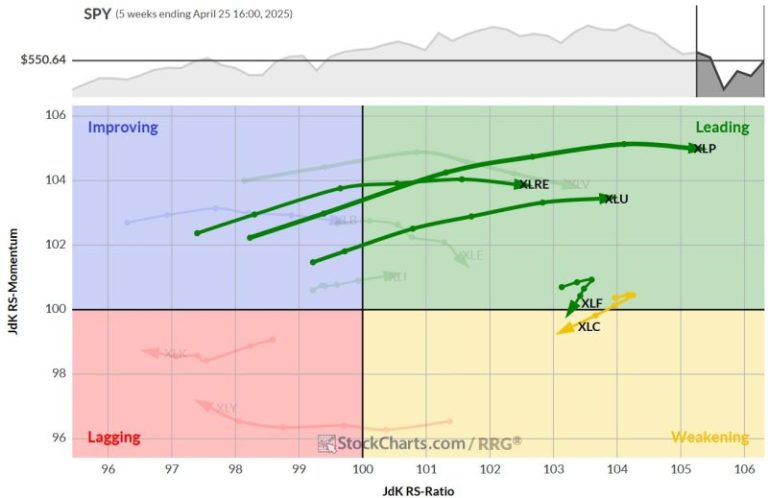
            Weekly RRG

            Looking at the weekly Relative Rotation Graph (RRG), we observe ongoing strength in Consumer Staples and Utilities. Both sectors are advancing further into the leading quadrant and continue to gain on the RS ratio axis.

            Real Estate is also making a notable move deeper into the leading quadrant. Financials and Communication Services are positioned on the brink of the weakening quadrant. However, they are still sustaining elevated RS ratio levels, which keeps them securely in the top five — at least for now.

            Daily RRG

            • Consumer Staples and Utilities: Both reside within the weakening quadrant, but at high RS ratio levels. This combination, along with their strength on the weekly RRG, keeps them well inside the top five.
            • Communication Services: Moved into the lagging quadrant but with a very short tail close to the benchmark. This positioning allows it to remain in the top five — for now.
            • Financials: Similar to Communication Services, close to the benchmark with a slightly longer tail but not showing significant loss of relative strength.
            • Real Estate: Made a significant move, pushing into the leading quadrant on the daily RRG, combining with its strong weekly tail to secure its spot in the top five.

            Consumer Staples

            The Consumer Staples sector remains range-bound on the weekly chart, causing relative strength to stabilize. With RRG lines at high levels, we might see some consolidation in the coming week — definitely something to keep an eye on.

            Financials

            Financials are picking up steam again, closing in the upper half of last week’s bar. This price strength is helping the relative strength line remain well within its rising channel. If the sector can maintain this momentum, it’s likely to stay among the top performers.

            Utilities

            Utilities are trading within their sideways channel, continuing to push relative strength against (or just above) resistance. This strength is keeping the RRG lines above 100. However, imho, we’ll need to see more relative strength in the coming weeks to keep Utilities at the top of the list.

            Communication Services

            Communication Services had a strong week, closing at the top of its range against former support, now acting as resistance. Based on the price chart, we might expect some resistance and difficulty for the sector to move higher this week. Despite this, the relative strength line remains within its rising channel, albeit losing some relative momentum at high RS ratio levels — not concerning at this time.

            Real Estate

            Real Estate — the new entrant in the top five — is benefiting from a strong bounce off the $36 low two weeks ago. It’s now starting to push relative strength higher, although not yet extremely strong. The RS momentum line is beginning to roll over while dragging the RS ratio higher.

            For now, the combination of daily and weekly relative strength has been enough to displace Health Care and secure Real Estate’s spot in the top five.

            Portfolio Performance

            The defensive positioning of our portfolio has put a dent in performance relative to the broader market. We’re now trailing the S&P 500 by almost 3%. However, we’ve seen over the past few weeks that these differences can equalize rapidly when the market moves in the direction of the portfolio. So, I’m not too concerned at the moment — it’s all part of the ebb and flow of market dynamics.

            #StayAlert and have a great week –Julius