Author

admin

Browsing

Easement to Facilitate Near-Term Exploration Logistics for New Amalga Gold Project & Secure Road Route Spanning One-Third of Distance from Public Highway to Project Site

Grande Portage Resources Ltd. (TSXV:GPG)(OTCQB:GPTRF)(FSE:GPB) (‘Grande Portage’ or the ‘Company’) is pleased to announce that it has applied for a State of Alaska easement related to its New Amalga Gold project in southeast Alaska. This easement application incorporates a proposal for development of approximately 1.3 miles (2 km) of gravel road along with two equipment staging areas.

Extending from Glacier Highway across State of Alaska property, development of this road segment will greatly facilitate the Company’s helicopter-supported exploration efforts by establishing an equipment staging area much closer to the project site. The helicopter shuttle distance for transporting drilling equipment and supplies would be reduced by over 60% for each cycle compared to the previous staging area located in the Juneau Mendenhall Valley suburbs.

Ian Klassen, President and CEO comments: ‘The submission of this easement application is an important step for the project. The proposed road development and equipment staging areas will not only enhance the efficiency of our exploration efforts but will also reduce the impact of helicopter noise on residential areas of the Mendenhall Valley. Furthermore, this road segment will comprise a significant proportion of the overall road development required to ultimately establish surface access to the project site.’

This initial road segment would span approximately one-third of the total distance from Glacier Highway to the project site, ending at the boundary between State of Alaska and US Forest Service land. Further road development will require separate federal environmental review and permitting. Baseline environmental studies are ongoing in order to support future federal submissions.

The future facilities at the project site are envisioned to include a small-footprint underground mining operation without an ore processing plant or tailings disposal landfill. Due to the resource location near tidewater and less than 4 miles (6.5km) from existing paved highway (Fig. 1), the Company considers off-site processing by a third party to be the most favorable configuration for the project.

Kyle Mehalek, P.E.., is the QP within the meaning of NI 43-101 and has reviewed and approved the technical disclosure in this release. Mr. Mehalek is independent of Grande Portage within the meaning of NI 43-101.

About Grande Portage:

Grande Portage Resources Ltd. is a publicly traded mineral exploration company focused on advancing the New Amalga Mine project, the outgrowth of the Herbert Gold discovery situated approximately 25 km north of Juneau, Alaska. The Company holds a 100% interest in the New Amalga property. The New Amalga gold system is open to length and depth and is host to at least six main composite vein-fault structures that contain ribbon structure quartz-sulfide veins. The project lies prominently within the 160km long Juneau Gold Belt, which has produced over eight million ounces of gold.

The Company’s updated NI#43-101 Mineral Resource Estimate (MRE) reported at a base case mineral resources cut-off grade of 2.5 grams per tonne gold (g/t Au) and consists of: an Indicated Resource of 1,438,500 ounces of gold at an average grade of 9.47 g/t Au (4,726,000 tonnes); and an Inferred Resource of 515,700 ounces of gold at an average grade of 8.85 g/t Au (1,813,000 tonnes), as well as an Indicated Resource of 891,600 ounces of silver at an average grade of 5.86 g/t Ag (4,726,000 tonnes); and an Inferred Resource of 390,600 ounces of silver at an average grade of 7.33 g/t silver (1,813,000 tonnes). The MRE was prepared by Dr. David R. Webb, Ph.D., P.Geol., P.Eng. (DRW Geological Consultants Ltd.) with an effective date of July 17, 2024.

ON BEHALF OF THE BOARD

‘Ian Klassen’
Ian M. Klassen
President & Chief Executive Officer
Tel: (604) 899-0106
Email: Ian@grandeportage.com

Cautionary Statement Regarding Forward-Looking Information

This news release includes certain ‘forward-looking statements’ under applicable Canadian securities legislation. Forward-looking statements include estimates and statements that describe the Company’s future plans, objectives or goals, including words to the effect that the Company or management expects a stated condition or result to occur. Forward-looking statements may be identified by such terms as ‘believes’, ‘anticipates’, ‘expects’, ‘estimates’, ‘may’, ‘could’, ‘would’, ‘will’, or ‘plan’. Since forward-looking statements are based on assumptions and address future events and conditions, by their very nature they involve inherent risks and uncertainties as described in the Company’s filings with Canadian securities regulators. There can be no assurance that such statements will prove to be accurate, as actual results and future events could differ materially from those anticipated in such statements. Accordingly, readers should not place undue reliance on forward-looking statements. The Company disclaims any intention or obligation to update or revise any forward-looking information, whether as a result of new information, future events or otherwise, other than as required by law.

Please note that under National Instrument 43-101, the Company is required to disclose that it has not based any production decision on NI 43-101-compliant reserve estimates, preliminary economic assessments, or feasibility studies, and historically production decisions made without such reports have increased uncertainty and higher technical and economic risks of failure. These risks include, among others, areas that are analyzed in more detail in a feasibility study or preliminary economic assessment, such as the application of economic analysis to mineral resources, more detailed metallurgical and other specialized studies in areas such as mining and recovery methods, market analysis, and environmental, social, and community impacts. Any decision to place the New Amalga Mine into operation at levels intended by management, expand a mine, make other production-related decisions, or otherwise carry out mining and processing operations would be largely based on internal non-public Company data, and on reports based on exploration and mining work by the Company and by geologists and engineers engaged by the Company.

NEITHER THE TSX VENTURE EXCHANGE NOR ITS REGULATION SERVICE PROVIDER (AS THAT TERM IS DEFINED UNDER THE POLICIES OF THE EXCHANGE) ACCEPTS RESPONSIBILITY FOR THE ADEQUACY OR ACCURACY OF THIS NEWS RELEASE

Source

Click here to connect with Grande Portage Resources Ltd. (TSXV:GPG)(OTCQB:GPTRF)(FSE:GPB) to receive an Investor Presentation

This post appeared first on investingnews.com

Here’s a quick recap of the crypto landscape for Friday (August 22) as of 9:00 p.m. UTC.

Get the latest insights on Bitcoin, Ethereum and altcoins, along with a round-up of key cryptocurrency market news.

Bitcoin and Ethereum price update

Bitcoin (BTC) was priced at US$116,546, a 3.9 percent increase in 24 hours. Its lowest valuation of the day was US$112,019, and its highest was US$117,310.

Bitcoin price performance, August 22, 2025.

Chart via TradingView.

The crypto market rallied after US Federal Reserve Chair Jerome Powell’s speech at the Jackson Hole Symposium offered clues that the Fed may be preparing to lower interest rates in September.

Bitcoin jumped from US$112,000 to US$116,000 in just over an hour. The current situation with inflation and the labor market, Powell said, “may warrant adjusting” the Fed’s monetary policy stance.

Powell cited a “curious balance” in the labor market, with reduced worker supply and demand increasing employment risks, while also noting that tariffs’ visible impact on consumer prices is likely to be short-lived.

However, he signaled that the central bank remains cautious of potential lasting inflation, emphasizing the need to balance its dual mandates when goals conflict.

The Fed also revised its monetary policy, stating that low unemployment alone will not trigger rate hikes. They removed language suggesting tolerance for inflation above 2 percent to offset past undershoots and no longer described low interest rates as a “defining feature” of the economy, offering greater flexibility in a volatile post-pandemic economy.

According to the CME Group Fedwatch tool, the probability of an interest rate cut at the September 17 FOMC meeting has surged to over 83 percent, up from 75 percent just yesterday.

Likewise, Ether (ETH) gained over 10 percent following Powell’s remarks, rising above the week-long US$4,600 resistance and forming a bull flag pattern, with analysts projecting potential highs around US$6,000.

ETH was priced at US$4,843.61, up by 14.5 percent over the past 24 hours, and its highest valuation of the day. Its lowest valuation was US$4,254.24.

Altcoin price update

  • Solana (SOL) was priced at US$199.01, up by 10.5 percent over 24 hours to its highest valuation of the day. Its lowest was US$178.52.
  • XRP was trading for US$3.09, up by 7.9 percent in the past 24 hours, and its highest valuation of the day. Its lowest was US$282.
  • Sui (SUI) was trading at US$3.74, up by 9.5 percent over the past 24 hours, following market trends by reaching its highest valuation as the markets wrapped. Its lowest valuation of the day was US$3.33.
  • Cardano (ADA) was also trading at its highest valuation on Friday at US$0.9334, up by 9.5 percent over 24 hours. Its lowest valuation for the day was US$0.8332.

Today’s crypto news to know

Coinbase approves Trump-backed stablecoin

Coinbase Global (NASDAQ:COIN) has listed USD1, a stablecoin issued by World Liberty Financial, the crypto project linked to US President Donald Trump and his sons. The exchange announced the move on Thursday (August 21), while Eric Trump reposted the news on X and hinted that additional updates on the project are coming soon.

With the addition, Coinbase now offers US users a wide range of stablecoins, including USDT, USDC, PYUSD, DAI and others. World Liberty launched USD1 earlier this year as part of its push into decentralized finance, positioning the token for use in a forthcoming platform built on Ethereum with Aave technology.

The platform is not yet live, but the company has said it will eventually support lending and borrowing services.

The listing comes as the US stablecoin sector gains momentum following the passage of the GENIUS Act, which set national standards for stablecoin issuance and trading.

Still, World Liberty’s political connections remain controversial, especially after reports linked USD1 to a multibillion-dollar investment in Binance from an Abu Dhabi sovereign fund.

House moves to prohibit Fed from issuing CBDC

The US House of Representatives has added a provision to a defense policy bill for the 2026 fiscal year that would ban the Fed from issuing a central bank digital currency (CBDC). On Thursday, the House Rules Committee released a revised version of HR 3838, the House’s rendition of a bill enacting the National Defense Authorization Act.

It incorporates extensive wording that prohibits the Fed from researching or developing digital currency.

In July, the House narrowly passed the Republican-backed Anti-CBDC Surveillance State Act, which aims to prevent the Fed from issuing a digital currency, with a vote of 219 to 210. Its fate in the Senate remains uncertain.

The National Defense Authorization Act and its associated appropriations bills are considered essential national security legislation. They detail the military’s funding and budget allocation. Adding this provision from the anti-CBDC bill is a strategic maneuver by supporters of the CBDC ban to increase the likelihood of it passing into law.

CFTC seeks public input on spot crypto trading regulations

Caroline D. Pham, acting chair of the Commodity Futures Trading Commission (CFTC), is calling for public input from crypto market participants on how the agency can better regulate spot crypto trading.

“The public feedback will assist the CFTC in carefully considering relevant issues for leveraged, margined or financed retail trading on a CFTC-registered exchange as we implement the President’s directive,” Pham said on Thursday.

Comments may be submitted via the commission’s website until October 20.

This marks the second leg of the CFTC’s “crypto sprint,” an initiative to fast track the implementation of a new regulatory framework for cryptocurrencies and other digital assets in the US. Last month, the agency announced that it would explore enabling the trading of spot crypto asset contracts on CFTC-registered futures exchanges.

Ripple, SBI to bring RLUSD to Japan

Ripple and SBI Holdings (TSE:8473) unveiled plans on Thursday to bring Ripple USD (RLUSD) to Japan.

Their aim is to launch the stablecoin in early 2026. The rollout will be handled by SBI VCTrade, a licensed digital payments provider, under Japan’s new regulatory framework for stablecoins.

RLUSD, first introduced in December 2024, is backed by dollar deposits, short-term US treasuries and cash equivalents, with monthly attestations from an independent firm. Ripple says this design ensures regulatory clarity and sets the coin apart as an institutional-grade product. SBI executives described the partnership as a milestone for Japan’s financial system, stressing that the stablecoin will enhance trust and convenience for users.

Ripple officials framed RLUSD as a bridge between traditional finance and decentralized networks, particularly just days after Japan approved its first yen-based stablecoin.

ECB explores public blockchains for digital euro

The European Central Bank (ECB) is reportedly exploring major public blockchain networks, including Ethereum and Solana, in connection with its digital euro design.

Sources familiar with the matter told the Financial Times that EU officials are accelerating plans for a digital euro after the passage of the GENIUS Act deepened concerns regarding the competitive viability of a European digital currency.

Sources familiar with the matter told the news outlet that while a private blockchain was widely expected for the digital euro, a public option is now being considered more seriously.

Meanwhile, the ECB informed the Financial Times that it is exploring both centralized and decentralized technologies, including distributed ledger technologies, in the lead up to a final decision.

Austrac directs Binance to appoint external auditor

Binance is facing renewed scrutiny in Australia after the country’s financial watchdog directed it to appoint an external auditor. AUSTRAC said the exchange has failed to meet standards for anti-money laundering and counter-terrorism financing controls, citing gaps in oversight and risk management. The agency also pointed to Binance’s high staff turnover and limited senior management presence in Australia as red flags.

AUSTRAC Chief Brendan Thomas warned that global crypto exchanges must adapt to local compliance requirements, regardless of their size. The action adds to a growing list of regulatory challenges for Binance worldwide, including a record US$4.3 billion fine in the US last year for failing to block illicit users.

The company’s founder, Changpeng Zhao, is serving a four month prison sentence related to those violations. Meanwhile, in Nigeria, Binance is still battling tax evasion and illegal foreign exchange allegations, with a court trial pushed back to October.

Securities Disclosure: I, Giann Liguid, hold no direct investment interest in any company mentioned in this article.

Securities Disclosure: I, Meagen Seatter, hold no direct investment interest in any company mentioned in this article.

This post appeared first on investingnews.com

Citing a shifting economic situation in the US, Federal Reserve Chair Jerome Powell indicated that the central bank is ready to adjust interest rates during his speech at the Jackson Hole Economic Policy Symposium.

Powell indicated that the Fed’s dual mandate goal is essentially in balance, saying the labor market remains close to maximum employment and that inflation has eased from post-pandemic highs, although it remain elevated.

However, the Fed head also noted that “the balance of risks appears to be shifting,” with significant uncertainty in the economy as a result of higher tariffs, tighter immigration and a slowdown in the pace of growth in the labor market.

“Over the longer run, changes in tax, spending, and regulatory policies may also have important implications for economic growth and productivity,” Powell added in his Friday (August 22) address.

The biggest challenge for the Fed is maintaining its dual mandate of ensuring too much slack doesn’t enter the labor market, which Powell said could happen quickly, while also attempting to ease inflation to the target 2 percent.

“A material slowing in employment growth may not be a signal that the economy is entering a downturn, but a symptom of structural shifts in the economy. For this reason, Powell and others in the Federal Open Market Committee (FOMC) have pointed to the unemployment rate as a more useful indicator of the health of the labor market,” she said.

Although tariffs are likely to take some months to work their way through the economy, with Powell suggesting there is still high uncertainty, he also indicated that “the shifting balance of risks may warrant adjusting our policy stance.”

His remarks are in line with analysts’ expectations of a 25 basis point cut to the benchmark rate in September.

In 2024, the Fed made three cuts: a 50 basis point cut in September, followed by two 25 basis point cuts in October and November. So far, it has not made reductions in 2025; however, it faced dissent from two committee members at its July meeting, the first time more than one member has voted against the committee since December 1993.

The gold price jumped following Powell’s remarks on Friday, gaining nearly 1 percent in morning trading, reaching US$3,370 per ounce by 1:00 p.m. EDT. Silver rose more than 2 percent to hit US$38.94 per ounce.

Equity markets were also in positive territory during morning trading.

The S&P 500 (INDEXSP:INX) climbed 1.49 percent to 6,465 points, and the Nasdaq 100 (INDEXNASDAQ:NDX) rose 1.48 percent to 23,485 points. Meanwhile, the Dow Jones Industrial Average (INDEXDJX:.DJI) surged 2 percent to trade in record territory at 45,687 points.

Securities Disclosure: I, Dean Belder, hold no direct investment interest in any company mentioned in this article.

This post appeared first on investingnews.com

By Darren Brady Nelson

One of former President Ronald Reagan’s most famous quotes is “trust, but verify.” He made that remark on December 8, 1987, to then-Soviet General Secretary Mikhail Gorbachev as the audience gathered on that historic day for a nuclear arms treaty.

In the wake of US President Donald Trump’s April “Liberation Day” tariffs, it is time once again to “trust, but verify.” That is, that the economy is still on track for a new “golden age of America.” And that we will continue in a “golden age,” pun intended, for investing in gold.

Source: the White House.

Tariffs are not inflation

Trump’s tariffs have added to uncertainty, but they are not inflationary per se. The famous Nobel Prize-winning monetary economist, Milton Friedman, summarized what he had learned from the most comprehensive empirical study ever undertaken on inflation in the following quote:

“Inflation is always and everywhere a monetary phenomenon in the sense that it is and can be produced only by a more rapid increase in the quantity of money than in output. A steady rate of monetary growth at a moderate level [may allow] little inflation and much growth.”

Another monetary economist of the 20th century, but not quite as famous as Friedman, was Ludwig von Mises. He agreed with the first half of the quote above, but not the second. He also supported a gold standard, as seen below, as protection from inflation and accompanying boom-bust cycles:

“All economic activity is based upon an uncertain future. It is therefore bound up with risk.” Thus: “There is no such thing as a safe investment.” But: “The…gold standard alone is a truly effective check on the power of the government to inflate the currency.”

Tariffs are just taxes

A student of Mises was Murray Rothbard. The latter wrote in Power and Market that the burden of a sales tax falls entirely on the supplier and supply chain, not the consumers, yet tariffs inexplicably do the opposite. The former is closer to the truth, depending on elasticities.

Media pundits often claim that businesses pass forward tax increases, like tariffs, to consumers. This is a half-truth. The other half of this half-truth is that businesses take a hit, so that they invest and hire less. This means foreign businesses, more than American consumers.

And rather than just a 50/50 split between supply and demand, as per the graph below, economics and history show it is more like an 80/20 situation. That 80 includes a pass backward in the supply chain. This means foreign supply chains, more than American supply chains.

Source: SlidePlayer.

Rationale for Trump’s tariffs

Trump’s tariffs have created extra uncertainty, but not nearly as much as the neoliberals, on the left or right, would suggest by their outrage and alarm. Firstly, imports and import elasticities are relatively low in the US.

Secondly, Trump’s strategy is consistent with the same three exceptions to free trade, and in the same order, as did the classical liberal, and godfather of free trade economics, Adam Smith.

The first exception is not only about directly decoupling from communist China, for targeted defense purposes, but also indirectly, for broader strategic purposes, by weakening the Communist Party of China to the point of regime change, as Reagan did to the USSR.

The second and third exceptions, of reciprocity and retaliation, are part of the “art of the deal.” This three-pronged strategy, despite the outcry as being anti-free trade, is not only trying to put America first, but also to restore genuine free trade. It is a well-calculated risk.

Impact of these tariffs

According to the US Bureau of Labor Statistics (BLS) in its press release of July 17: “Import prices ticked up 0.1% in June, following a decrease of 0.4% in May, and an advance of 0.1% in April.”

The BLS added that: “Prices for US imports fell 0.2% from June 2024 to June 2025, matching the 12- month decline for the year ended May 2025. Those were the largest annual decreases since the index fell 0.9% for the year ended February 2024.”

The BLS also provided an interactive chart of the Import Price Index (IPI). Highlights from the Trump 47 era for “all imports” include: IPI increased, but at a declining rate, by 1.7 percent in February, 0.8 percent in March and 0.1 percent in April; then decreased by -0.2 percent in May and -0.2 percent in June.

“Consumer goods” are also illuminating: IPI dropped from 1.2 percent in November 2024 to -0.8 percent in March 2025; then sunk further to -1.2 percent in May before rising to -0.6 percent in June, but still negative.

The story with “industrial supplies and materials” was that: IPI grew at 5.7 percent in February, then plunged to 1.9 percent in March; followed by shrinking down into negative territory of -2 percent in April, -3.6 percent in May and -3.2 percent in June.

Source: BLS.

Conclusion

Many Main Street investors, and even those on Wall Street, are aware that gold is a great hedge against both inflation and uncertainty; and it is. But few on either streets also know that it is a great investment that outperforms the S&P Index; and it does.

Gold is very rare indeed, and not just in terms of its physical scarcity, but in its unique ability to be both a safe-haven investment and a performance investment as well. The two charts at the end demonstrate gold’s protection and gold’s growth over the decades.

Therefore, for American investors it is still the right time to “trust” in gold growth to come, “but verify” through gold protection in the meantime. Thus, when one has gold, “heads” you win and “tails” you don’t lose.

Sources: FRED (CPI) (GDP) (M3); Shiller Data (S&P); World Bank (gold).

About Darren Brady Nelson

Darren Brady Nelson is chief economist with Fisher Liberty Gold and policy advisor to The Heartland Institute. He previously was economic advisor to Australian Senator Malcolm Roberts. He authored the Ten Principles of Regulation and Reform, and the CPI-X approach to budget cuts.

Read the rest of the series: Goldenomics 101: Follow the Money, Goldenomics 102: The Shadow Price of Gold, Goldenomics 103: Gold Protects and Performs.

This post appeared first on investingnews.com

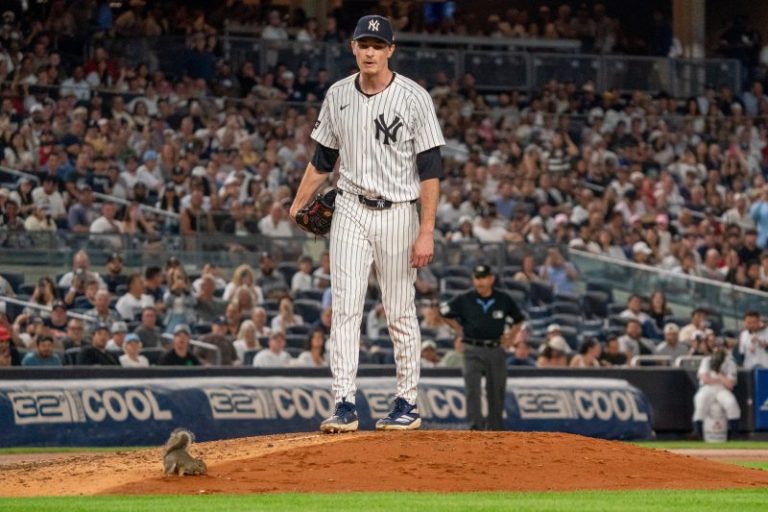
  • In the top of the fourth inning, a squirrel made its way onto the field at Yankee Stadium.
  • The squirrel ran into the foot of Boston’s Jhostynxon Garcia, who was making his major league debut.
  • The game was briefly stopped as the squirrel ran all over the field, including toward pitcher Max Fried.

The New York Yankees and the Boston Red Sox continued their historic rivalry on Friday night – with a special guest.

As the game reached the top of the fourth inning, a squirrel made its way onto the field at Yankee Stadium.

The squirrel ran into the foot of Boston’s Jhostynxon Garcia, who was taking his second at-bat in his major league debut and facing a 3-2 count against Yankees pitcher Max Fried.

The game was briefly stopped as the squirrel ran all over the field, including toward Fried on the pitcher’s mound.

Garcia eventually took a base after being walked by Fried.

The USA TODAY app gets you to the heart of the news — fast.Download for award-winning coverage, crosswords, audio storytelling, the eNewspaper and more.

This post appeared first on USA TODAY

The Cincinnati Bengals quarterback had been running for his life during the preseason – something that was on full display in the team’s preseason Week 2 matchup against the Washington Commanders.

As fans watched the action unfold on ‘Monday Night Football,’ many started questioning whether it was worth letting the star quarterback take unnecessary hits in a game that won’t count for the standings.

The Bengals took a new approach to the preseason in 2025, opting to play their starters in the hopes of avoiding a slow start to the regular season.

Cincinnati owns a 1-11 record in the first two weeks of the regular season since Zac Taylor took over as head coach. They have started each of the last three seasons with an 0-2 record.

That led to a change in strategy, but that strategy could’ve been disastrous if Burrow went down. Here’s a look at the team’s plans for their quarterback in the preseason finale.

Is Joe Burrow playing today?

Burrow will not play in the Bengals’ preseason finale at 1 p.m. ET against the Indianapolis Colts.

Taylor indicated in his news conference on Wednesday that the starters would be sidelined in Week 3.

‘I’m not anticipating any starters playing,’ Taylor told reporters. ‘I haven’t talked in depth with the players about this third game. I’ve talked to Joe, I haven’t specifically told these guys they’re not playing, but they’re not playing.’

Burrow completed 18 of 24 passes in limited action across two preseason games. He’ll finish with 185 yards passing and three touchdowns.

More important for the Bengals, Burrow will also be healthy to begin the season.

This post appeared first on USA TODAY

It’s one thing for Gianni Infantino to debase himself, fawning over autocrats and human rights abusers.

His sycophancy is also sullying the World Cup, however, as sure as if the FIFA president took that iconic gold trophy once held by Pelé, Maradona and Messi and dipped it in tar.

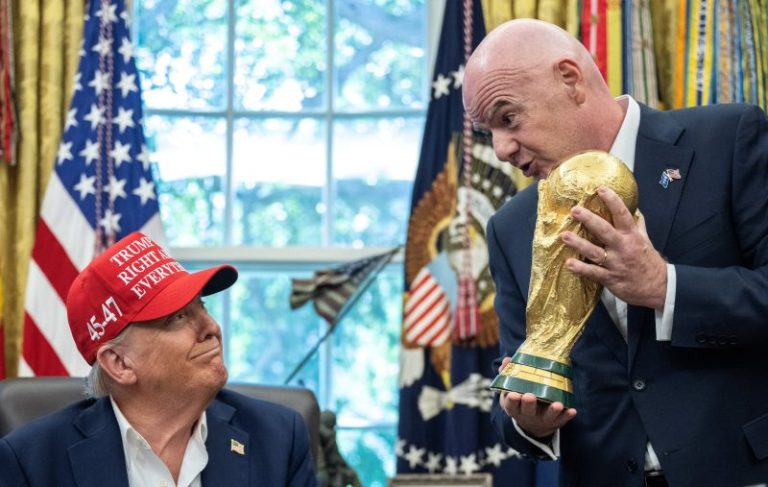
The men’s World Cup next year is shaping up to be a North Korea-style state propaganda event, and Infantino is going right along with it. He stood beside Donald Trump as the president turned what was supposed to be an announcement that the draw will take place at the Kennedy Center into a 45-minute stream of lies Friday, smiling, laughing and agreeing with Trump as if he was a Cabinet member.

And because sacrificing your dignity and self-respect doesn’t go as far as it used to, Infantino came bearing more gifts! The first ticket to the July 19, 2026, final at MetLife Stadium, and a hint of a role in the December draw.

“Ah! That’s an interesting proposal,” Infantino said, when someone asked if Trump will announce the results of the draw. “We’ll discuss that.”

Infantino even stood by while Trump suggested that Vladimir Putin ‘may’ attend the tournament, despite Russia being banned from FIFA competitions since the 2022 invasion of Ukraine.

FIFA and its leaders have never been paragons of virtue. Bribes and kickbacks were an accepted part of doing business, votes and support traded for bagsful of cash. Infantino’s predecessor, Sepp Blatter, is still ostracized by FIFA for his shady dealings, and half of the members of the Executive Committee that voted on the 2018 and 2022 World Cups were fined, suspended or banned for life for corruption.

But the World Cup was always viewed separately from its leaders’ tawdry behavior. FIFA and the (mostly) men who run it might be morally bankrupt, but soccer had center stage at the World Cup, the game a wonderful diversion from the ugliness of the world around it.

Under Infantino, however, that has changed.

When the World Cup was awarded to Qatar, that country’s leaders promised that it would not impose its local customs and rules on a global tournament. So much for that. Human rights violations were rampant, the LGBTQ community was targeted and longtime sponsor Budweiser discovered its $75 million sponsorship was worth less than warm beer.  

All of this was fine – just fine! – with Infantino, who saved his outrage for the critics of his besties rather than the cheapening of a World Cup that upended the global calendar and had all the atmosphere and authenticity of a timeshare sales pitch.

Now comes next summer’s men’s World Cup in the United States, Canada and Mexico.

The United States is sliding into autocracy, with Trump encouraging voter suppression in Texas, manufacturing a crime wave to justify a takeover of Washington, D.C., and retaliating against his enemies. And that was just in the last few days!

Trump likes anything that can be used to exalt his glorious leadership, so he is, naturally, all in on the World Cup. And Infantino is happy to oblige his grandiosity.

He was late to FIFA’s Congress because he was hobnobbing with Trump in the Middle East. He didn’t step in when Trump crashed Chelsea’s victory celebration after winning the Club World Cup, and he “let” Trump keep the original trophy. Now he’s fawning over Trump’s tales of Washington’s “resurgence” and placating his overestimation of the U.S. men’s national team’s chances next summer.  

“The home team always have a good chance to win,” Infantino said.

This is a team that lost four in a row earlier this year and got humiliated by Panama in the semifinals of the Nations League. At full-strength and at home, no less. Let’s slow the roll.

By allowing Trump to co-opt the World Cup, Infantino is risking the success of the tournament, FIFA’s crown jewel.

Trump is a deeply polarizing president, and there is widespread opposition to many of his policies. Most of the rest of the world has an even dimmer view, which is already being reflected by a drop in foreign tourism. Allow the World Cup to become “Trump’s tournament,” and Infantino should not be surprised if fans decide to sit it out. Or only go to games in Canada and Mexico.

The World Cup has always been a celebration of ‘the beautiful game.’ Infantino is giving it a very ugly look.

Follow USA TODAY Sports columnist Nancy Armour on social media @nrarmour.

This post appeared first on USA TODAY

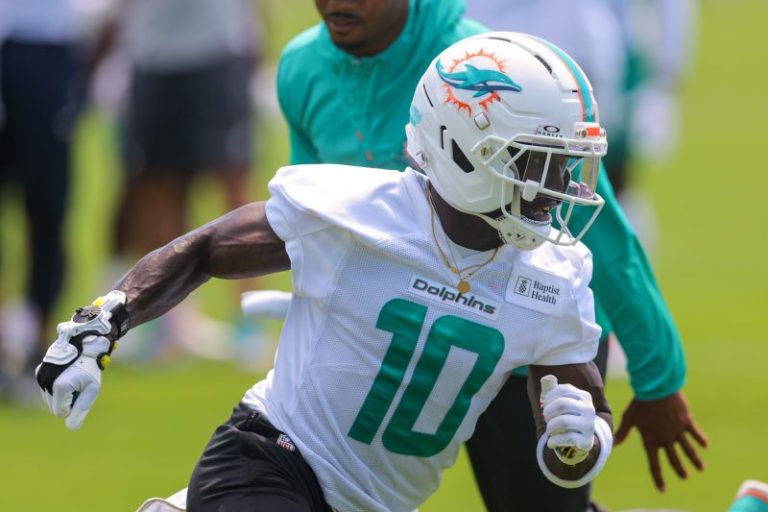
Peaks and valleys has been the name of the game for Tyreek Hill over the last calendar year.

Hill continues to be one of the best receivers in the league, routinely burning defenders with his blazing speed. However, the 2024 season wasn’t kind to the star – who missed the playoffs for the first time in his career and also dealt with a nagging wrist injury all season long.

After seemingly looking to force his way out of Miami at a press conference following the team’s Week 18 loss to the New York Jets, Hill repaired those bridges that once appeared to be burnt.

Despite turning a corner, Hill is now battling an injury with the regular season quickly approaching.

Here’s the latest on the star receiver:

Tyreek Hill injury update

Hill is dealing with an oblique injury, which has kept him off the practice field at times throughout training camp.

Head coach Mike McDaniel noted on Aug. 8 that the injury is due to overuse and that Hill still wanted to practice.

“He’s trying to practice,’ McDaniel said, via David Furones of the South Florida Sun Sentinel. ‘He’s working through an oblique that got worse because he was taking every rep that was on the books.’

It’s unclear if Miami will continue to keep Hill sidelined, especially with his experience.

The 31-year-old is coming off a down year, by his standards, after recording just 81 receptions, 959 yards and six touchdowns in 2024.

Hill doesn’t appear to be in danger of missing regular season action at this time, but obliques can be a tricky injury to navigate. All eyes will now turn to his practice availability ahead of the team’s opener on Sept. 7.

Dolphins WR depth chart

Without Hill, Miami’s depth chart at receiver takes a big hit. While training camp battles still have to be wrapped up, here’s a look at the proven options behind the All-Pro receiver:

  1. Jaylen Waddle
  2. Malik Washington
  3. Nick Westbrook-Ikhine
  4. Dee Eskridge
This post appeared first on USA TODAY

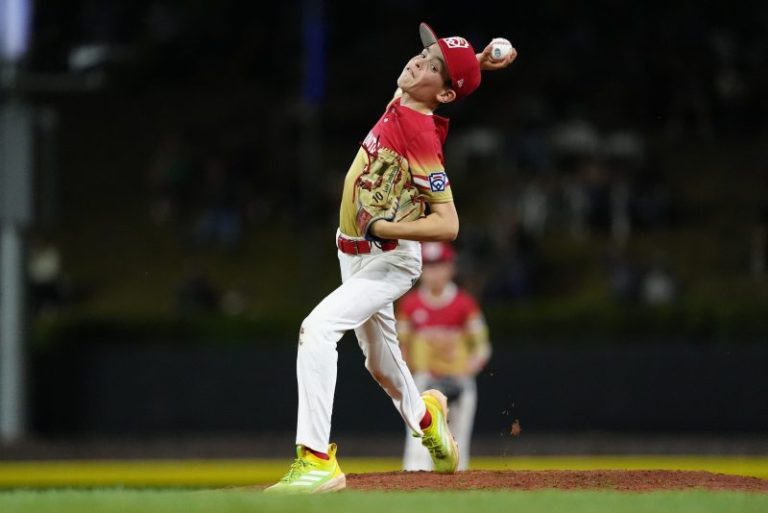
The 2025 Little League World Series continues Saturday with the United States championship game between Nevada and Connecticut, which will determine the final spot in Sunday’s championship game.

Nevada and Connecticut face off for the second time in this tournament. In their first meeting, Connecticut won 7-3 on Wednesday, Aug. 20 in a double-elimination game, which allowed the team from Fairfield to enjoy an extended rest before Saturday’s title game. Nevada rebounded by defeating South Carolina 5-3 on Thursday to keep its championship hopes alive. Now the Las Vegas team is up against the only squad that it has lost to in this tournament.

Don’t miss a moment of the action from the Little League World Series United States championship game between Nevada and Connecticut. Follow live for all the thrilling plays and game-changing moments.

Stream the Little League World Series on Fubo

How to watch 2025 Little League World Series

The 2025 Little League World Series will be broadcast on ESPN platforms, with the championship game airing on ABC. Games will also be available to stream on ESPN+.

  • Date: Saturday, Aug. 23
  • Times: U.S. championship game, 3:30 p.m. ET
  • TV: ABC
  • Stream: Fubo
  • Location: South Williamsport, Pennsylvania
This post appeared first on USA TODAY

Shares of Cracker Barrel Old Country Store plummeted roughly 10% on Thursday after the restaurant unveiled its new logo earlier this week as part of a larger brand refresh.

The new logo removes the image of a man leaning against a barrel that was prominently featured in the original, leaving behind just the words Cracker Barrel against a yellow background. The phrase “old country store” has also been removed.

The company said the colors in the logo were inspired by the chain’s scrambled eggs and biscuits.

Cracker Barrel’s new logo.Cracker Barrel

The change is part of a “strategic transformation” to revitalize the brand that started back in May 2024. Under that mission, Cracker Barrel’s brand refresh includes updates to visual elements, restaurant spaces and food and retail offerings.

Cracker Barrel said in March that the refresh will still maintain the brand’s “rich history of country hospitality” and “authentic charm that has made the brand a beloved destination for generations of families.”

“We believe in the goodness of country hospitality, a spirit that has always defined us. Our story hasn’t changed. Our values haven’t changed,” Chief Marketing Officer Sarah Moore said in a media release.

However, many social media users have criticized the new logo, especially those in conservative circles. The president’s son, Donald Trump Jr., amplified a post on Wednesday suggesting that the logo change was led by CEO Julie Felss Masino to erase the American tradition aspect of the branding and make it more general, as a way of leaning into diversity, equity and inclusion efforts.

Conservative activist Robby Starbuck added his commentary on Thursday, writing in a post on X, “Good morning @CrackerBarrel! You’re about to learn that wokeness really doesn’t pay.”

The company has a relatively small market cap of about $1.2 billion compared with other restaurant chains.

Customers have also complained on social media about the interior redesign of many Cracker Barrel restaurants, saying that the new decor favors a more sterile and modern style over its tried-and-true country feel.

On the restaurant’s latest earnings call in June, Masino said Cracker Barrel had completed 20 remodels and 20 refreshes. She said the company will be sharing more information about the remodeling initiative in September.

“Employees had given us great feedback about working in those newly remodeled and refreshed stores and guests continue to tell us that they’re lighter, brighter, more welcoming and they’re enjoying them,” Masino said on the call.

Cracker Barrel is not the only stock to see large swings based on political social media posts.

Earlier this month, shares of American Eagle soared after Trump posted that an ad featuring Sydney Sweeney, which faced significant social media pushback from the left, was “the ‘HOTTEST’ ad out there.”

Back in 2023, Anheuser-Busch InBev faced heavy criticism from conservatives after a collaboration between Bud Light and social influencer Dylan Mulvaney, who is transgender.

This post appeared first on NBC NEWS